
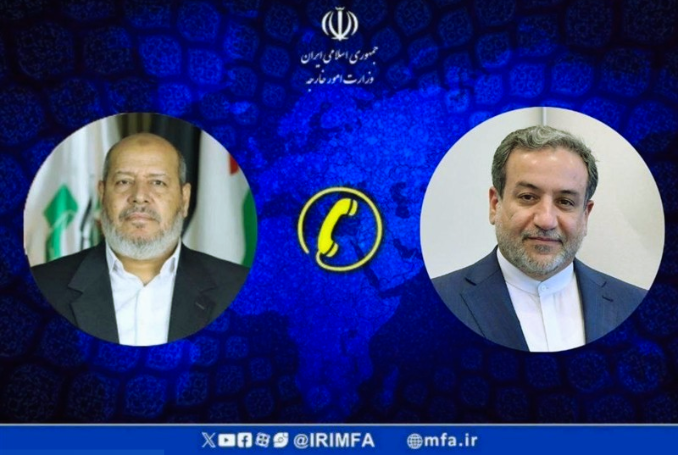
Araqchi and Hamas leader Khalil al-Hayya discussed Gaza, ceasefire efforts and continued support for Palestinian resistance.
Key Developments
- Hamas leader Khalil al-Hayya briefed Iran’s foreign minister on developments in Gaza and ongoing Israeli attacks.
- Al-Hayya praised Iran’s position linking a regional ceasefire to all fronts and thanked Tehran for supporting Palestinians.
- Araqchi reaffirmed Iran’s commitment to supporting Palestinian and Lebanese resistance while pursuing diplomatic efforts to end the war.
Iranian Foreign Minister Abbas Araqchi and senior Hamas leader Khalil al-Hayya held a telephone conversation on Thursday to discuss the latest developments in Gaza, the occupied Palestinian territories, and wider regional efforts aimed at ending Israeli aggression.
According to Iran’s Tasnim News Agency and the Islamic Republic News Agency (IRNA), the discussion focused on the continuing Israeli genocide in Gaza, efforts to secure a lasting ceasefire, and the broader political and military situation across the region.
The call comes amid ongoing diplomatic activity involving Iran and regional actors following the recent US-Israeli war against Iran and continuing negotiations concerning conflicts across the Middle East.
Al-Hayya Briefs Tehran
During the conversation, al-Hayya provided what Iranian media described as an overview of developments in Palestine, particularly in the Gaza Strip.
According to IRNA, the Hamas leader discussed the continued Israeli genocide and Israeli efforts to obstruct the implementation of ceasefire agreements.
Al-Hayya emphasized that Palestinian resistance groups and the Palestinian people remain committed to continuing their struggle until their core objectives are achieved.
He stressed that ending Israeli aggression and occupation remains at the forefront of Palestinian national goals.
The Hamas leader also highlighted the humanitarian and political challenges facing Gaza amid the ongoing genocide and blockade.
Praise for Iran’s Position
A major theme of the conversation was Iran’s diplomatic position regarding ongoing regional conflicts.
According to Tasnim, al-Hayya praised the Iranian negotiating team’s insistence that any effort to stop the war must address all regional fronts simultaneously.
The Hamas leader specifically welcomed Tehran’s emphasis on linking ceasefire arrangements across the region rather than treating individual conflicts in isolation.
IRNA reported that al-Hayya thanked Iran for its continued support for the Palestinian people’s legitimate struggle.
Condolences and Regional Solidarity
The call also included an exchange of condolences related to recent losses suffered by both sides.
According to Tasnim, al-Hayya offered condolences over the killing of Iranian leaders, military commanders and officials during the recent US-Israeli war against Iran.
The Hamas leader congratulated Iran on what he described as a major victory following the war, saying the Islamic Republic had succeeded in thwarting the objectives of its adversaries.
For his part, Araqchi renewed his condolences to al-Hayya over the killing of his son and several Palestinian resistance commanders during Israel’s war on Gaza.
The Iranian foreign minister praised what he called the “legendary steadfastness” demonstrated by Palestinians and resistance groups throughout the genocidal war.
Iran’s Diplomatic Efforts
Araqchi also briefed al-Hayya on Tehran’s latest diplomatic initiatives aimed at ending the wars and reducing tensions across the region.
According to IRNA, the foreign minister outlined Iranian efforts to stop the fighting and restore regional stability through diplomatic channels.
At the same time, he reiterated Iran’s longstanding position regarding support for resistance movements confronting Israeli occupation.
Araqchi said Tehran remains committed to supporting the legitimate resistance of peoples in the region, particularly in Palestine and Lebanon.
The remarks echoed statements made by Iranian officials in recent weeks emphasizing continued support for Palestinian and Lebanese resistance groups while simultaneously pursuing diplomatic initiatives to end ongoing conflicts.
The conversation occurred one day after Iranian leader Mojtaba Khamenei issued a message emphasizing the importance of the Resistance Front and reaffirming Iran’s support for movements confronting Israel.
In remarks marking the anniversary of Imam Ruhollah Khomeini’s death, Khamenei argued that the Israeli government had become increasingly isolated following recent military confrontations.