
By: Umar Khan (Candidate Attorney) and Attorney Ziyaad Ebrahim Patel (International Human Rights & Lawfare Advocate)
Ziyaad E Patel Attorneys – South Africa
26 June 2026
Introduction
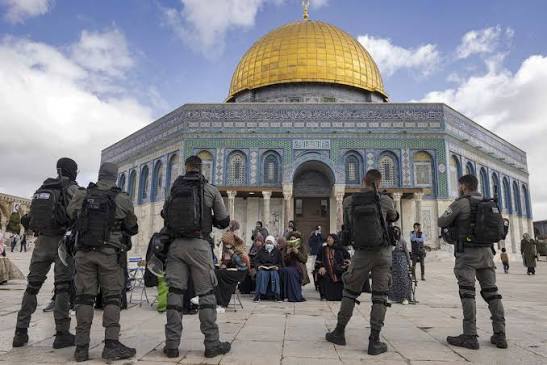
The recurring closure of Masjid Al-Aqsa to the Church of the Holy Sepulchre along with other major Old City Holy sites by the Israeli Security Forces and the IDF which include restrictions imposed upon Palestinian worshippers seeking access to the sacred compound raise profound questions under international humanitarian law and international human rights law.
This extends to the Geneva Conventions which an occupying force must abide to. Palestinian people cannot be denied their fundamental to right to religious convictions and practices.
As one of the holiest sites in Islam, Masjid Al-Aqsa is not merely a place of worship; it is a cornerstone of Palestinian religious, cultural, and national identity. Any attempt to restrict access to the mosque therefore engages a matrix of legal protections developed under international law to safeguard religious freedom and preserve cultural heritage.
From a South African perspective, informed by a constitutional commitment to human dignity, equality, resistance to systems of colonial domination, the legal implications of such closures cannot be viewed in isolation from the occupation and the rights of the Palestinian people.
We must carefully consider the Israeli regime’s closures particularly of Masjid Al-Aqsa over the years and whether it is lawful in doing so.
The Legal Status of East Jerusalem
Any discussion concerning Masjid Al-Aqsa must begin with the legal status of East Jerusalem. The international community, including the United Nations, the International Court of Justice (“ICJ”), and the overwhelming majority of states, judicially recognize East Jerusalem as an occupied territory. This was the position by the ICJ in its 2004 Advisory Opinion on the Legal Consequences of the Construction of a Wall in the Occupied Palestinian Territory, where the Court held that the West Bank, including East Jerusalem, remains occupied territory and is therefore subject to the Fourth Geneva Convention of 1949.
The Court stated unequivocally:
“The territories situated between the Green Line and the former eastern boundary of Palestine under the Mandate were occupied by Israel in 1967 during the armed conflict between Israel and Jordan.”
As a consequence, Israel assumes the obligations of an occupying power and remains bound by both international humanitarian law and international human rights law. The Court reaffirmed this position in its 2024 Advisory Opinion on the Legal Consequences Arising from the Policies and Practices of Israel in the Occupied Palestinian Territory, including East Jerusalem, emphasising that occupation does not confer sovereignty and that the occupying power remains subject to strict legal constraints.
Freedom of Religion Under International Human Rights Law
The right to access Masjid Al-Aqsa is protected by international human rights law, most notably Article 18 of the International Covenant on Civil and Political Rights (“ICCPR”). This provides that “everyone shall have the right to freedom of thought, conscience and religion.” The right includes the freedom to manifest one’s religion through worship, observance, practice, and teaching.
The United Nations Human Rights Committee has interpreted Article 18 broadly, emphasising that religious worship includes access to places of worship and participation in religious rites and ceremonies. The Committee further stressed that limitations upon religious practice must be interpreted narrowly and may only be imposed where they are prescribed by law and demonstrably necessary to protect public safety, order, or the rights and freedoms of others.
Consequently, any closure of Al-Aqsa or religious sites in the holy city of Jerusalem must satisfy a stringent test of legality, necessity, proportionality, and non-discrimination. The burden rests upon the occupying state imposing the restriction to demonstrate that no less restrictive alternative was available. From this it can be understood that in no way has the Israeli regime adequately considered the legality or proportionality in their abuse of power when dealing with the Palestinian population.
The freedom of religion in Palestine is so severely constrained as a result of the belligerent occupier’s constant disregard and utter disdain for international law and humanitarian law.
The Fourth Geneva Convention and the Protection of Religious Rights
As an occupying power, Israel is bound by the Fourth Geneva Convention. Wherein Article 27 provides that protected persons are entitled to respect for their religious convictions and practices. This provision creates a positive obligation not merely to refrain from interfering with religious life but actively to facilitate ordinary religious observance wherever possible.
The Convention recognises that occupation is intended to be a temporary legal situation. The occupier is therefore prohibited from administering occupied territory in a manner that unnecessarily disrupts the social, cultural, and religious life of the occupied population.
Restrictions preventing tens of thousands of Palestinians from accessing Al-Aqsa for Friday prayers, Ramadan observances, or Eid celebrations raise serious questions concerning compliance with Article 27.
Collective Punishment and Article 33
Particularly troubling are blanket restrictions affecting entire communities based on the doctrine of collective punishment. Article 33 of the Fourth Geneva Convention provides that “no protected person may be punished for an offence he or she has not personally committed. Collective penalties and likewise all measures of intimidation or of terrorism are prohibited.”
Where restrictions to access are imposed broadly upon an entire population to religious sites because of the alleged actions of a limited number of individuals, a compelling argument arises that such measures may amount to collective punishment.
International humanitarian law requires that security measures be individualised and proportional wherever possible. Measures affecting millions of Palestinians because of isolated security incidents are difficult to reconcile with the prohibition contained in Article 33. The duty and the liability is on the Israeli regime, their continued use of collective punishment is a violation of international human rights laws and as such Zionist Israeli actors and agents should be held accountable in international criminal courts and bear the consequences for their violation of the same.
Hague Regulations and the Duty to Respect Religious Institutions
An important consideration is The Hague Regulations of 1907, which has been widely recognised as reflective of customary international law, imposing additional obligations upon occupying powers. Article 43 therein, requires an occupier to restore and ensure public order and civil life while respecting existing institutions. While Article 46 provides that religious convictions and practices must be respected.
These provisions recognise that religious institutions are not incidental features of civilian life but form part of the social fabric of occupied communities. Arbitrary interference with access to Al-Aqsa therefore engages not only individual rights but the collective rights of the Palestinian people.
Protection of Cultural and Religious Heritage
Masjid Al-Aqsa enjoys additional protection as a site of immense cultural and religious significance. The Old City of Jerusalem and its Walls have been recognised by UNESCO as a site of outstanding universal value. International law has long recognised the need to protect religious and cultural heritage during periods of armed conflict and occupation.
The 1954 Hague Convention for the Protection of Cultural Property in the Event of Armed Conflict reflects the international community’s determination that cultural and religious sites should not become casualties of political or military disputes.
A holy site from which worshippers are excluded ceases to fulfil its fundamental religious purpose. These sites ought to be protected, and occupiers are bound by international law to protect them, regardless of the conflict and disputes within a given territory. As such, Israel is not only unlawful in their prevention of access to the Al-Aqsa compound, but they are also bound by international law to protect and preserve the site.
The Principle of Proportionality
Even where security concerns exist, international law does not disregard restrictions on a given state nor the protection of an occupied population. The principle of proportionality requires a careful balancing exercise. Measures that restrict fundamental rights must be suitable, necessary, and proportionate to the legitimate objective pursued.
The European Court of Human Rights has consistently held that freedom of religion constitutes one of the foundations of a democratic society. In Manoussakis and Others v Greece, the Court emphasised that state interference with religious worship requires exceptionally weighty justification.
Similarly, in the case of Svyato-Mykhaylivska Parafiya v Ukraine, the Court stressed that interference with the operation of religious communities must be justified by compelling reasons and subjected to strict scrutiny. Based on these principles, in the case of the Al-Aqsa compound, the Israeli regime continuously neglects their duties to uphold international law and as such should be held to account for these egregious violations.
The International Court of Justice and Palestinian Self-Determination
The issue extends beyond freedom of religion. Both the 2004 and the 2024, ICJ Advisory Opinions recognised the Palestinian people’s right to self-determination as a fundamental principle of international law.
Religious sites are integral to cultural identity and collective existence. Restrictions affecting access to Al-Aqsa therefore implicate not only individual religious rights but broader questions concerning the preservation of Palestinian cultural and national identity. The ICJ has repeatedly recognised that measures altering the demographic, cultural, or social character of occupied territory must be subjected to rigorous legal scrutiny.
A South African Perspective
South Africa’s constitutional order emerged from a struggle against institutionalised racial and ethnic discrimination, and restrictions on fundamental freedoms. International criminal jurisprudence proscribes ‘apartheid’ a crime against humanity. The Constitution places human dignity at the apex of constitutional values as indicated in the following provisions:
South African jurisprudence has consistently affirmed the importance of accommodating religious practice. In Christian Education South Africa v Minister of Education and MEC for Education: KwaZulu-Natal v Pillay, the Constitutional Court recognised that religious freedom is central to a democratic society founded upon dignity and equality. This is in terms of Section 15 of the Constitution.[1]
South Africa’s commitment to international law under Section 39 of the Constitution further strengthens the imperative to advocate for the protection of religious rights of oppressed peoples living under conditions of belligerent military occupation. This is relevant more now than ever in the occupied Palestinian territories where international law violations repeatedly occur.
Conclusion
International law does not prohibit every restriction upon access to a place of worship. Genuine and immediate security threats may justify temporary and narrowly tailored measures.
However, international law demands far more than a mere invocation of security concerns more especially when the IDF and settler colonizers are the perpetrators of settler violence on Palestinians and execution of these draconian measures through arbitrary military orders restrict access of holy sites to worshippers whose land remains unlawfully occupied.
Within the ambit of international law where an occupying force introduces restrictions, they must remain lawful, necessary, proportionate, non-discriminatory, and subject to meaningful oversight.
In the occupied Palestinian territories, they must also comply with the stringent obligations imposed by the Fourth Geneva Convention, the Hague Regulations, customary international humanitarian law, and international human rights law.
The closure of Masjid Al-Aqsa or severe restrictions imposed on access to religious sites, therefore, raise profound legal concerns. Such measures appear to forego the right to freedom of religion, the prohibition on collective punishment and the Palestinian people’s right to self-determination.
Regardless of if a given population or territory is occupied, their rights under international law must always be vehemently protected.
REFERENCES
International Treaties and Conventions
- Hague Convention (IV) Respecting the Laws and Customs of War on Land and its Annexed Regulations (adopted 18 October 1907, entered into force 26 January 1910) 205 CTS 277.
- Geneva Convention Relative to the Protection of Civilian Persons in Time of War (Fourth Geneva Convention) (adopted 12 August 1949, entered into force 21 October 1950) 75 UNTS 287.
- International Covenant on Economic, Social and Cultural Rights (adopted 16 December 1966, entered into force 3 January 1976) 993 UNTS 3.
- Convention Concerning the Protection of the World Cultural and Natural Heritage (adopted 16 November 1972, entered into force 17 December 1975) 1037 UNTS 151.
- Hague Convention for the Protection of Cultural Property in the Event of Armed Conflict (adopted 14 May 1954, entered into force 7 August 1956) 249 UNTS 240.
United Nations Documents
- UN Human Rights Committee, General Comment No. 22: Article 18 (Freedom of Thought, Conscience or Religion), UN Doc CCPR/C/21/Rev.1/Add.4 (30 July 1993).
- United Nations General Assembly Resolution ES-10/24, Advisory Opinion of the International Court of Justice on the Legal Consequences Arising from the Policies and Practices of Israel in the Occupied Palestinian Territory, including East Jerusalem (2024).
- United Nations Security Council Resolution 478 (1980) UN Doc S/RES/478.
- United Nations Security Council Resolution 2334 (2016) UN Doc S/RES/2334.
International Court of Justice
- Legal Consequences of the Construction of a Wall in the Occupied Palestinian Territory (Advisory Opinion) [2004] ICJ Rep 136.
- Legal Consequences Arising from the Policies and Practices of Israel in the Occupied Palestinian Territory, including East Jerusalem (Advisory Opinion) [2024] ICJ.
South African Case Law
- Christian Education South Africa v Minister of Education 2000 (4) SA 757 (CC).
- MEC for Education: KwaZulu-Natal v Pillay 2008 (1) SA 474 (CC).
Foreign Jurisprudence
- Manoussakis and Others v Greece (1996) 23 EHRR 387.
- Svyato-Mykhaylivska Parafiya v Ukraine, Application No 77703/01, Judgment of 14 June 2007.
[1] 15: Freedom of religion, belief and opinion
Everyone has the right to believe or think what they want, even if their opinion is different to the government. Everyone has the right to practice the religion they choose and in the way that they choose provided that their actions do not go against the Constitution. For example, a woman who marries according to customary law does not lose her rights of equality when she gets married.
Government institutions, like schools, can follow religious practices (like having prayers in the morning) but this must be done fairly and people cannot be forced to attend them.