
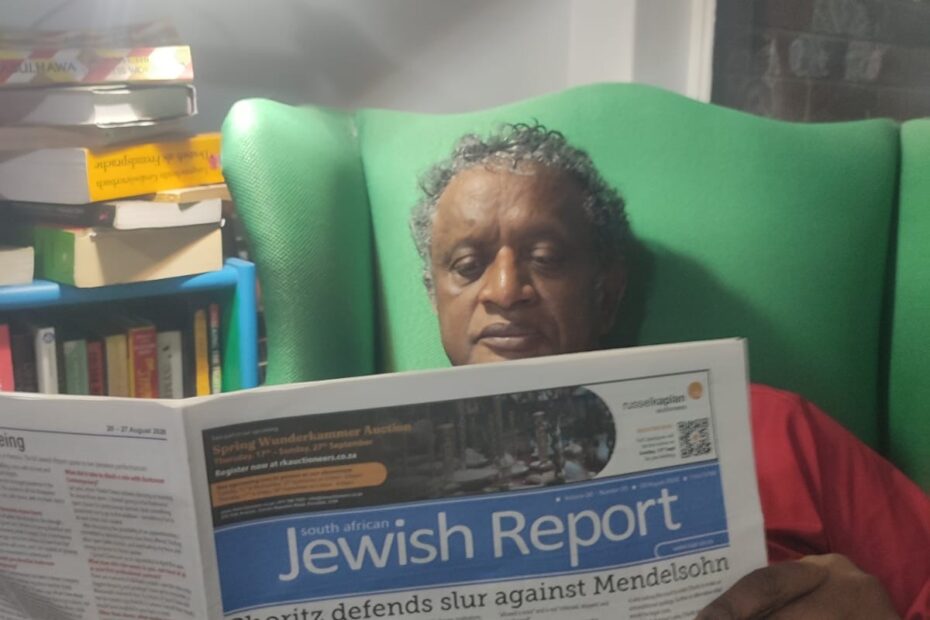
- Reading widely is good advice, but it is not for the faint-hearted.
By Hassen Lorgat
We cannot only read those we agree with, because that would be repeating the mantra of the Jewish Report. They seem to be not only loyal to the state of Israel but extremely close to the Likud party and the Israeli president Netanyahu.
Talking, writing, or even thinking about the SAJR in many circles invites labels like “rag,” “yellow press,” “Zionist front for Netanyahu,” and much worse. I confess that I have never shied away from reading it—or those I disagree with. On my shelf, I have books by the fugitive from ICC justice and international human rights law, Netanyahu: Terrorism: How the West Can Win, edited by Benjamin Netanyahu (1986), and Bibi: My Story (2022). I also know that the paper is extremely loyal to this leader.
Whilst I read high and low literature, and watch trash movies alongside quality films, I know this is not everyone’s cup of tea, and I understand and respect that. There is so much to read out there, and time is limited. But in my own defence: it is important to know and understand what the other side says and wants. We cannot only read those we agree with, because that would be repeating the mantra of the Jewish Report. They seem to be not only loyal to the state of Israel but extremely close to the Likud party and the Israeli president Netanyahu.
If you want some other insights about what is happening inside Israel, +972 magazine, Haaretz are great. The wider region includes Occupied Palestine. Lebanon, Syria etc – I recommend Middle East Eye, Mondoweis, Middle East Monitor, Palestine Chronicle and hundreds of progressive podcasts and online programmes The recent article by Tali—fresh from her battles with Redi Thlabi, whom she took issue with because Thlabi wrote on X about Israel’s “murderous soldiers” being “filth,” as is “everyone who cheers them on”—saw Tali objecting that she also called Israel a “terrorist state.”
Now this week she is back to Megan, and we would have hoped that since the story is about Megan’s plea, it would be her story. That was hoping for too much. Instead of herstory, we have his-story—support for the professor. The article once again turned out to be an attack against her, and this is confirmed in the headline: “Choritz defends slur against Mendelsohn.” Talk about fair and balanced journalism—this is given away in the headline.
A slur means an insulting or disparaging remark, but is that not for the court to decide?
Throughout the article, she repeats Mendelsohn’s lawsuit and brings out the usual commentators to back her up. She notes that Choritz rightfully asserts it is an “abuse of the judicial process,” brought “with an ulterior motive” to “deter her” from criticising him, the Zionist and Israel supporter. In addition, as we all know, Choritz has argued in her papers that this is a SLAPP (Strategic Lawsuit Against Public Participation) defence, stating that Mendelsohn’s case has the “designed aim of using litigation as lawfare in pursuit of an improper end.”
What is new is that she has brought in an attorney to essentially rubbish her claims and affirm Mendelsohn’s legal action, which they assert appears valid and does not constitute an abuse of the court process.
That attorney is Simon Dippenaar, who argues thus:
While Choritz admits to publishing the TikTok material, she denies that her statements carry the defamatory meaning Mendelsohn claims. To succeed with this defence, Choritz must prove her statements were recognisable as opinion, concerned a matter of public interest, and were based on true, clearly indicated, or well-known facts. Of the weaknesses of the Choritz case, Dippenaar argues that it will be difficult to argue that her claims—that Mendelsohn supported genocide, hated Muslims, held racist views, or acted in bad faith—are non-defamatory. This he bases on the idea that support for Israel is not support for these views. What?
I will conclude with some ideas refined by Palestine-supporting activists and intellectuals about Zionism, anti-Zionism and free speech, which I believe lies at the heart of this case.
What is Zionism?
Various scholars, including Ilan Pappé, have defined it as a European-origin movement to establish a Jewish nation-state in Palestine, which the text describes as a settler-colonial project that relies on the elimination or displacement of the native population through ethnic cleansing and, recently, genocide. Supporting Israel cannot be whitewashed from the violence that gave it birth and sustains it.
Anti-Zionism is a coherent political thought. It is a legitimate political and scholarly stance viewing Zionism as an ideology that violates indigenous rights, while drawing a distinction between opposing specific state policies and opposing the foundational ideology itself. It is in the realm of ideas that it opposes the violence of the Israeli state—through ideas and militant non-violent action.
In contrast, it is the Zionist state that uses laws and ideology to disenfranchise Palestinians and keep them out of their historic lands. Israel’s 2018 Nation-State Law, for instance, defines the country as the exclusive nation-state of the Jewish people, with self-determination reserved for Jews only—marginalising non-Jewish citizens by omitting constitutional equality. The legal manoeuvring for dispossessing Palestinians in East Jerusalem is out there for people to see, and much more. The attacks by settlers in the West Bank—stealing hilltops and encircling Palestinian villages—constitute the use of law, police, and army to effect ethnic cleansing. This violence is supported by the Knesset and has its roots in historical village expulsions, the events of 1948, and ongoing military occupations.
In contrast, the movement that Choritz belongs to—the BDS—has committed itself to working in a democratic and non-violent resistance way. Their website is a resource that must be visited by all and for context they write: “Israel maintains a regime of settler colonialism, apartheid, and occupation over the Palestinian people. This is only possible because of international support. Governments fail to hold Israel to account, while corporations and institutions across the world help Israel to oppress Palestinians.”
In the US, Europe, and even here, the Boycott, Divestment, and Sanctions (BDS) movement has been met with legal repression, censorship, and violence. The slur of antisemitism is a common refrain, as it attempts to delegitimise criticism of Israel. Another weapon—Hasbara and its supporters—is fighting us on the basis that they do not want to say that Israel is committing a genocide in Palestine (Gaza), and it has not stopped.
Media reports indicate that at least 300 children have been killed in Gaza during the roughly 300 days since a ceasefire was announced in October 2025, according to UNICEF data. Overall, localised reports and monitoring groups indicate that over 1,200 Palestinians have been killed by ongoing violations and strikes during this so-called truce. Many have summarised it as: we cease, but the IDF fires.
To conclude, free speech comes at a cost. This is speaking truth to power and reiterating that anti-Zionist activism—and anti-Zionism itself—is a protected philosophical belief that will free even those who oppress, kill, and maim children.
The role of journalists is to report accurately and within a human rights-centred perspective. The Press Council upholds the values and principles of accuracy, verification, context, accountability, and a clear distinction between fact and opinion, with the ultimate goal of serving the public’s right to be informed. That does not mean the SAJR is outside the Press Council; they cannot adhere to the principles of quality journalism.
Hassen Lorgat