
By Hassen Lorgat
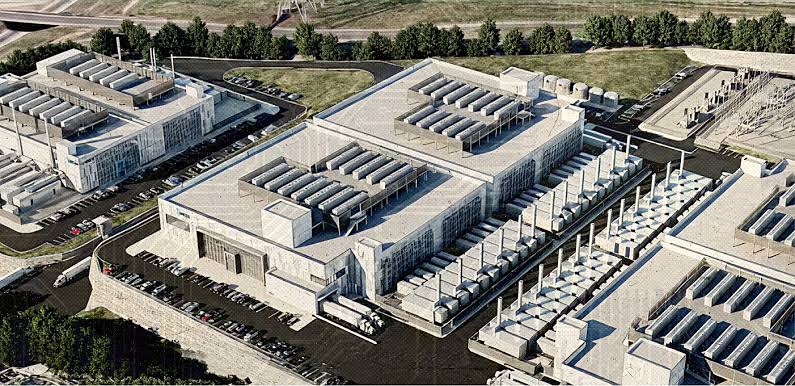
The public discourse—at least that I have been privy to—about AI data centres on our airwaves and in street talk is not sufficiently critical or vigilant about the dangers these centres pose. It is not uncommon to hear mainstream media full of self-praise: “South Africa is Africa’s largest economy and is said to possess advanced digital infrastructure—including connections with international sub-sea cables—helping to make it home to 70% of the continent’s data centres. These house the computer servers that power everything from cloud computing to artificial intelligence,” according to the business-friendly Engineering News.
They often do not see these companies as problematic, meaning that the likes of Musk and Palantir—with their illusions of being great empire leaders—may be landing on fertile ground.
However, across the Atlantic a few days ago, it was a completely different story. Data centres were the subject of vitriol, not praise.
On Wednesday, 6 August, two progressives—Abdul El-Sayed and William Lawrence—did the unthinkable. They beat big money, as activist Mamdandi has done, and in the process brought into sharp focus the role and functions of data centres.
Trump’s Data-Tunnelled Vision
They won their primaries to become the Democratic Party nominees in the forthcoming November elections against the Republicans. Their victories boosted the fight against data centres and firmly turned data centres into a political terrain. Their wins also mark a victory for real regulation of an industry that Trump sees as the new growth bonanza.
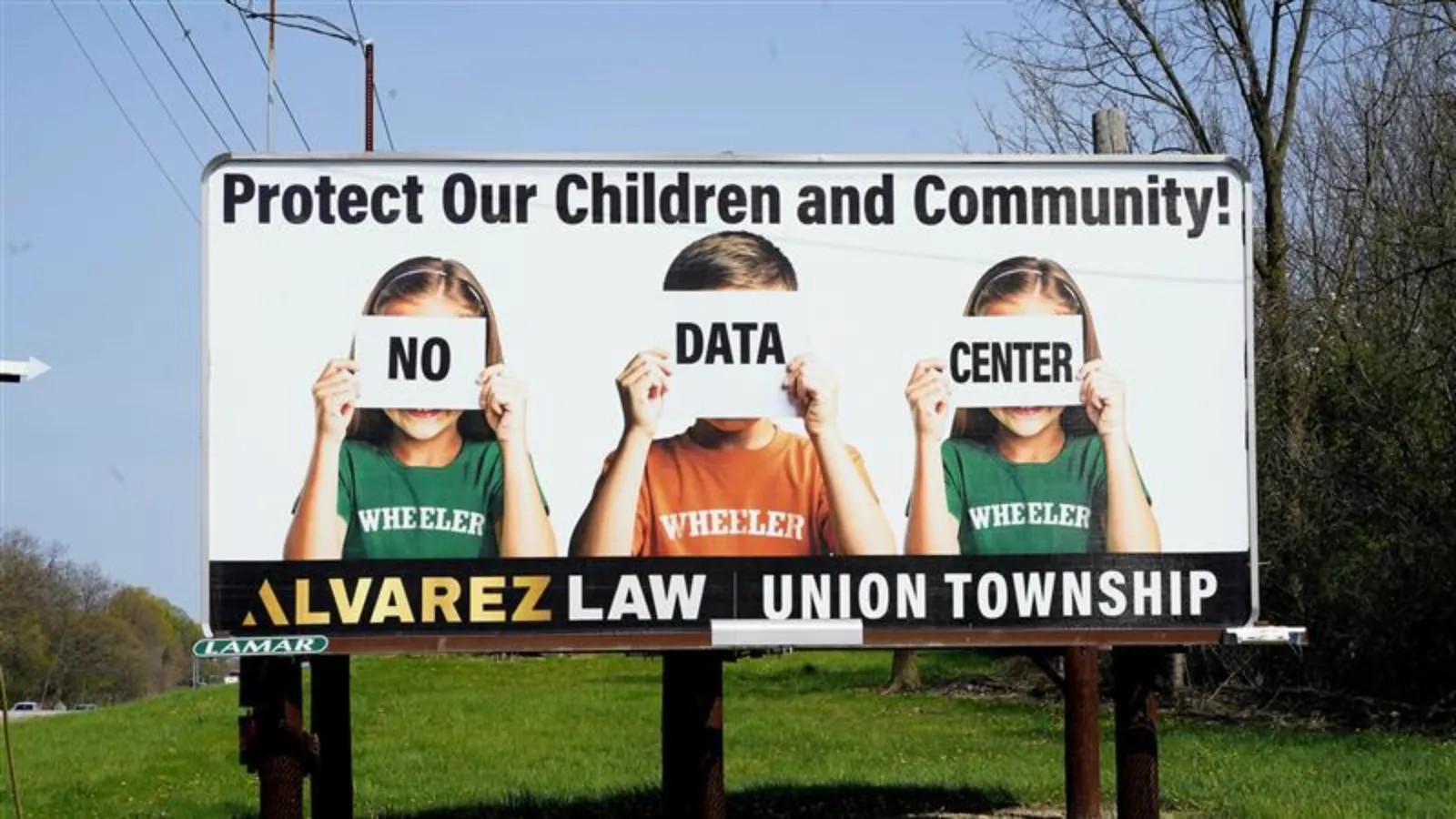
President Donald Trump, already strongly connected to tech companies, strongly supports expanding artificial intelligence data centres, calling them crucial “money machines.” His hope is that they will drive economic growth, create jobs, and maintain U.S. technological, AI, and military dominance over the People’s Republic of China. But fast-tracking these comes with serious obstacles, as communities increasingly complain about a lack of genuine consultation regarding the construction of these centres near their neighbourhoods. Concerns include noise, excessive electricity and water usage, land use, and other issues that strain local resources.
In theory the administration issued Executive Order 14318 is about the Federal permitting process, acceleration efforts of data centres. It is tied to a Ratepayer Protection Pledge requiring big tech companies to fund their own power plants but this has not managed to convince many of its benefits..
Grassroots Organising in the USA
One of the victors of the night is the young organiser William Lawrence, who co-founded the Sunrise Movement. He won the Democratic primary for Michigan’s Lansing-area 7th District on 4 August 2026 against two other more moderate candidates. A major focus of his campaign was a moratorium on data centres. This sets the stage for him to contest a Republican in November in a highly contested congressional seat. He had the backing of heavyweight progressives like Ro Khanna and Bernie Sanders.
The other victor was Abdul El-Sayed, who won Michigan’s Democratic Senate primary over the more moderate Representative Haley Stevens, who outspent him by over $65 million.
“People really effing hate data centres,” El-Sayed said at a July event before the election. And he was right.
As expected, this victory did not go down well with Donald Trump, who said on Fox News that the Democratic Socialists of America or its members will “ruin our country.” El-Sayed was not endorsed by the DSA, but democratic socialist lawmakers Rep. Alexandria Ocasio-Cortez and Sen. Bernie Sanders campaigned for him.
Trump said: “You go to these cities that are taken over by the socialists and the communists, they’re always filthy, dirty. They’re disgusting. Aside from crime, aside from all of the other problems—no jobs, no anything, no money—they’re always filthy, disgusting, dirty, and that’s what you’ll get.”
Beyond these slanderous remarks, it would appear that US citizens are at last seeing where their true interest lies: in their own power over politicians.

Photo courtesy: Sen. Bernie Sanders (I-Vt.) flanked by Michigan progressive Senate hopeful Abdul El-Sayed (left) and House candidate William Lawrence (right) during a rally this month in Lansing. Lawrence campaign
What Victory Looks Like
These hard-fought victories formed part of a progressive near-clean sweep in other states, such as Tennessee’s redrawn 9th Congressional District, where progressive anti-corporate funding campaigner Justin Pearson won the Democratic primary.
Organiser Lawrence blamed both parties for buying into the corporate agenda on data centres and the so-called AI boom. Check out this video here: https://www.youtube.com/shorts/6jkLAZ8BHcY
In his victory statement, Lawrence beat the moderate and better-funded Democrats by focusing on the people’s opposition to data centres. During campaigning, he highlighted the impacts of data centres and praised people’s power to hold the authorities to account.
But it all worked out in the end, as Lawrence said to supporters after his victory:
“It turns out that if you’re not taking money from Silicon Valley, you can fight hard for a federal moratorium on data centres. Tonight the people of Michigan’s 7th District sent a clear message: they are tired of Silicon Valley billionaires and DC insiders determining the future of our towns and our country.”
Lawrence also had luck on his side, as he faced two candidates—former U.S. Ambassador to Ukraine Bridget Brink and former U.S. Navy SEAL Matt Maasdam—who may have split their votes. He now has to face the Republican incumbent and first-term Congressman Tom Barrett.
Back to Basics
photo:https://www.context.news/ai/as-trump-promotes-data-centres-communities-push-back
Let us be clear: these two candidates secured major victories after making fierce opposition, not fudging the issues. All the progressive candidates:
- opposed corporate funding of US politics;
- opposed data centres on grounds that many of us are concerned about here: huge energy consumption, depletion of fresh water resources, and rising local utility bills;
- were committed grassroots organisers who spent time listening to communities and taking up their issues.
So we have much to do, as the thrust—both in narrative and on the ground—is expected to grow exponentially. The story out there is that AI data centre growth is driven by cloud computing, artificial intelligence, and digitalisation, although the scale and timing of this growth are uncertain. While South Africa is the biggest data centre hub on the continent, it is tiny compared to the US’s 5,500 data centres. People are slowly beginning to ask questions, but the answers are slow in coming. Another problem is that the uptake of this issue as an activist issue is not yet widely recognised. When it is realised, it presents opportunities for the resurgence of community activists from widely different movements—water, environment, land, and the wider ecology. That is the challenge that data centres pose to our democracy.
In the US, the right to question is often ignored. The Trump administration, as they have done in Boulder City, Nevada, unilaterally approved a data centre on a tract of public land within the city’s jurisdiction this summer without giving residents a say in the matter and without conducting an environmental assessment specific to the project. This seems typical and is carried out elsewhere in the world.
The South African Context
One modest intervention is the submission by the Data Centres and Surveillance Working Group to the South African Human Rights Commission (SAHRC) investigation into data centres, entitled “The Human Rights Crisis of Brute Force AI.” The report provocatively states that none of the 56 AI data centres have produced adequate, public environmental and human rights impact assessments—and challenges developers to prove otherwise with evidence of proper community consultation. Any deficiencies must be fixed within a strict deadline (e.g., three months), or operations should be suspended.
The submission argues for a more viable, scientifically grounded alternative: “distributed, scaled-down data centre infrastructure that prioritises resource sovereignty, community benefit, environmental sustainability, and agricultural protection over brute-force extraction.” It contends that through regulatory standards mandating distributed infrastructure, comprehensive human rights impact assessments, and community consent, South Africa can protect both constitutional rights and the environment.
Conclusion
South Africans historically have had a strong organising tradition, but I fear we may have lost the edge. We can learn something from the US here. They have really gone back to basics—taking every member in the union as important, every resident in the neighbourhood as a worthy resource for building an accountable democracy. It appears that for now, these primaries have turned their backs on corporate control of politics. That is the only reason they could put on the agenda the possible harmful impacts of AI data centres and demand regulation of them. We can do well to learn some of these lessons.
Hassen Lorgat