
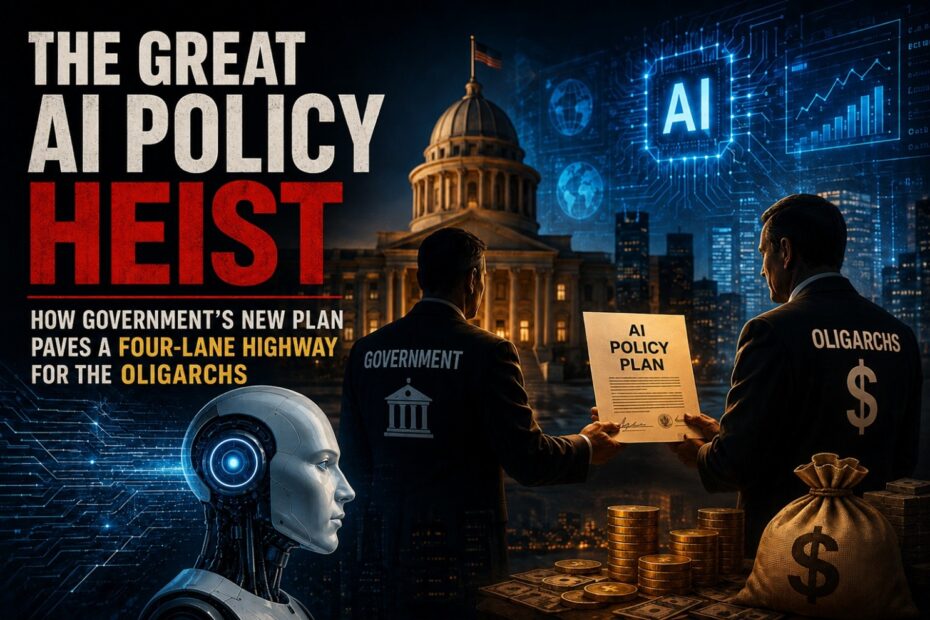
How Government’s New Plan Paves a Four-Lane Highway for the Oligarchs
By Nicholas H. Tucker – The Symanthesist Research Intiative – http://symanthesism.org
I had to to rub my eyes in utter disbelief when a colleague pointed me towards a news article, earlier in the weeek, https://techcentral.co.za/radical-rethink-for-south-africas-national-ai-policy/284284/
South Africa’s digital future is at a crossroads, and the government is signaling it will throw open the gates for the world’s tech giants while handing you, the citizen, an empty bag. The article alluded to above is not a murmur, but a loud warning about South Africa’s AI policy being “rethought.” What’s being planned is not a rethink but a retreat. The government is preparing to abandon comprehensive rules for a “light-touch” approach that leaves each industry sector to write its own AI strategy. Let’s be clear what this really means, and why it should terrify every South African.
Lets go back a few months, April 2026, when the Department of Communications and Digital Technologies issued a call for comments and/or ammendments to the “Draft South Africa National Artificial Intelligence (AI) Policy”. Two months later, in early June 2026 that draft paper was cancelled because, it seems that the officials who were tasked with its preparation had taken a “short-left” by using an AI to do the heavy lifting. Accused No. 1, aka, ChatGPT threw said officials under the bus by generating fictitious citations in an otherwise robust white paper.
And here beginith the lesson, which is, “the most dangerous AI isn’t the one that hallucinates – it is the one that the user believes”, and consequently we have a couple of high-level policy wonks benched for not checking “their” (more accurately – ChatGPT’s) work carefully. So, what have we learned from this – nothing, nothing I tell you. A whole new panel was subsequently appointed and already we see the Government veering away from a reasonably strong policy document (albeit fictitious citations) towards a seriously neo-liberal articulation.
From Strong Rules to Weak Guidelines
The original plan for a National AI Policy had problems, but the newly articulated direction is far more dangerous. Instead of strong, binding rules to govern AI and the massive data centres that power them, the government now wants to offer only “national policy guidelines.” Instead of creating a dedicated new watchdog with teeth and muscle, in order to hold Big Tech accountable, they want to rely on a “plethora” of industry/sector regulators, many of whom are clueless and lack the teeth or the mandate for this specific fight.
This is the exact environment where regulatory capture thrives:
- Regulatory Fog, Not a Framework:This “plethora” of existing regulators and “sectoral strategies” isn’t a cohesive framework. It’s a fog. When no single body has clear authority, the oligarchs don’t face accountability, they face a fragmented system they can easily navigate and exploit. We have already seen the government withdraw a draft policy that was written with AI and filled with completely fake academic citations. If they can’t even get the basics of crafting a policy right, how will they enforce one?
- Self-Regulation is a License to Exploit:The plan for “sectoral AI strategies” is a direct invitation for industry to write its own rules. The argument is that they “understand the architecture of their sectors.” In reality, it gives the “Epstein Class” the power to define risk on their own terms, ensuring that profit is always prioritised over people and the planet.
- The “Innovation” Smokescreen:The government is telling us directly that strict rules stifle innovation and harm competitiveness. This is the oldest trick in the corporate playbook. It frames oversight as a burden. They want to use our data and resources to build their AI empires while they claim any attempt to hold them accountable will “harm the economy.” This ignores that unregulated AI is already harming real people, from job losses to surveillance to environmental destruction.
- A Highway Built for Exploitative Extraction:This is a 4-lane highway for the oligarchs. They want a system where their AI models and data centres can operate with minimal oversight, using South Africa’s resources, our water, our energy, our land, and our data, as raw material for their wealth. The discussion has even framed AI policy as a choice between being a “creator” of AI or a “consumer.” With this new approach, we are being set up to be permanent consumers, stripped of our resources and agency.
What Does This Say About The SAHRC (South African Human Rights Commission)
Very recently the DCSC Working Group (Data-Centres, Surveillance, Control Working Group) made a policy submission to the SAHRC. This submission argued that there is an urgent need for mandatory Human Rights Impact Assessments, community consent, and resource prioritisation. DSCS firmly believes that its contribution would provide new policy direction for the country, unfortunately, given the Governments volta-face, our submission to the SAHRC is now worthless.
- Our call for mandatory HRIAswould become a soft suggestion.
- Our demand for resource prioritisationfor communities over corporations would be lost in a wave of self-serving “sectoral” plans.
- Our framework for distributed, community-owned infrastructurewould be replaced by a model that rewards corporate monopolies.
The government has appointing an “expert panel” to rewrite the policy, but the true direction is already set, a ‘light-touch’, hands-off approach that will leave South Africans exposed to the worst excesses of AI and the tech oligarchs.
South Africa cannot afford to be a testing ground for the world’s most powerful corporations. We need a policy that protects our rights and our resources, not one that creates a 4-lane highway for exploitation. The fight for a just AI future has just begun, and it’s a fight we can’t afford to lose.

Nicholas H. Tucker is an independent researcher with particular interests in systems architect whose work sits at the intersection of AI ethics, hermeneutics, and constitutional governance. He is the founder of the Symanthesism Research Initiative, a collaborative platform dedicated to developing ethical frameworks for human-AI interaction that prioritise dignity, interpretability, and democratic accountability.
As a member of the Data-Centres, Surveillance, Control Working Group (DCSC), Tucker contributed to a recent policy submission to the South African Human Rights Commission, which argued for mandatory Human Rights Impact Assessments, community consent, and resource prioritisation in the face of rapid data-centre expansion across South Africa.
His research spans decolonial epistemology, Ubuntu ethics, and the governance of autonomous systems. He has written extensively on the concept of “interpretive governance”, the need for structural separation between observation, interpretation, and governed definition in AI systems and on the threats posed by epistemicide and the destruction of indigenous knowledge in the digital age.
Tucker hails from the political tradition of Black Consciousness and lives in Johannesburg, South Africa.