
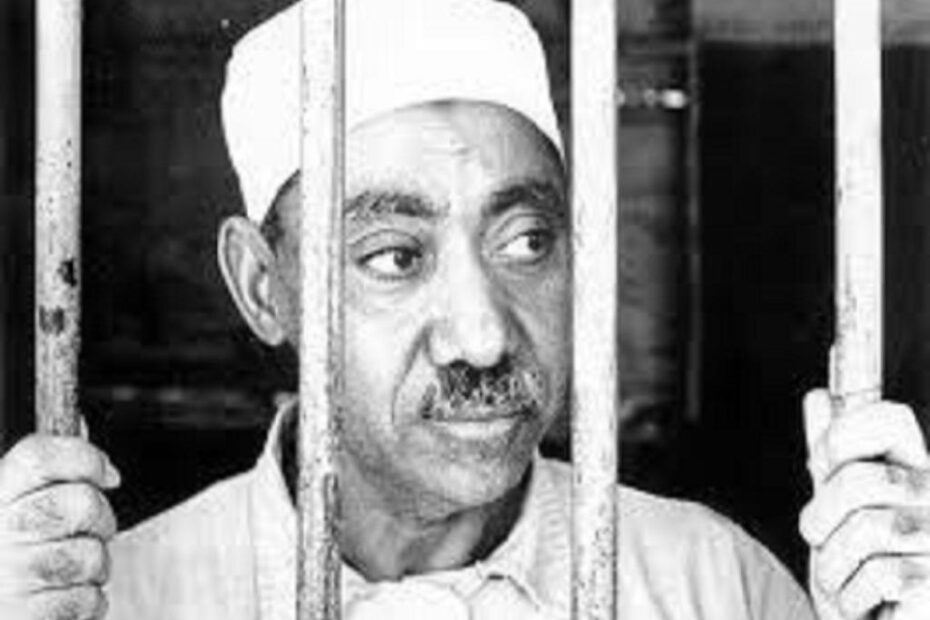
By Iqbal Suleiman
Sayyid Qutb was a man of letters. A voracious reader and writer. He was the author of 24 published books and approximately 30 of his books were not published because they were destroyed by the oppressive Egyptian government. His early career was that of a novelist, a poet and a literary critic. He read widely across various disciplines. He had a passion for literature and it was this area that guided his academic pursuits. He was deeply rooted in Islamic History and Islamic Governance and had an acute awareness of power dynamics and global politics. Qutb was also a very devout and committed Muslim. A Principalist. He became a Hafiz (memorised the Quran) at the young age of ten. As a young child, he was a collector of books. At age 12, he had a collection of 25 books. After reading the books, he would present lectures and presentations to the people of his village. At this young age he had an intuitive sense to empower people and make knowledge accessible to everyone. He published his first work whilst he was still a student, titled The Mission of the Poet in Life and the Poetry of the Present Generation.
As a wordsmith, he wrote beautifully. But there is something more beyond the quality of the writing, something deeper, subliminal and spiritual that touches deeply both the heart and mind simultaneously. When one reads his Magnum Opus FI Zilal al Quran, a Tafseer (Exegesis of the Quran) one is immediately reminded of the words of the holy Prophet (p.b.u.h) who is reported to have said “Beware of the committed Muslim when he sees with the light of God”. In the Shade of the Quran is a monumental and ground breaking work of exegesis in that its focus is on the Quran’s relevance and application to the contemporary world. The reader journeys through the past to the Prophetic era and then finds the Quran’s relevance to the lived experience in the modern world. This immediately brings to mind the words of Ibn Arabi who said that “The Quran continuously reveals itself”. The Tafseer engages and inspires the reader to internally introspect and refine his own soul and also be an activist for social justice. To become a complete human, a Quranic human, to see the darkness within oneself and the darkness outside of the self within the system of unjust and oppressive governance. To be guided by the light of God’s words, to liberate the self and the people. It is a powerful work which inspires the reader to develop his spirituality and journey on the path towards his Creator and simultaneously inspires the same person to be a revolutionary activist. The Quranic words are placed in its historical context, the time and circumstances in which they were revealed and its application to the contemporary world in the here and now. Each Surah begins with a succinct summary. It provides an in-depth analysis of the subject matter that the verses deal with and the Prophetic method that actualized the words. It took Qutb almost 15 years to complete. Most of it was written whilst he was a political prisoner living under the most deplorable conditions where he was tortured and did not have any access to writing materials-books had to be smuggled in to prison.
Qutb was not just a writer, an academic, a scholar who wrote about social justice. His work Social Justice in Islam outlines in detail the Islamic principle for the equal distribution of wealth and the system of Governance led by the Prophet and his successors. Qutb was an activist engaged in grass roots mobilisation, who fought to actualize social justice and Islamic Governance and ultimately gave his life in this pursuit, choosing martyrdom. This is the true measure of intellectual integrity and Qutb was simply killed because of his ideas and writings. His pen pierced through falsehood, exposed the “scholars for dollars’, the corrupt clergy class and the sell-out politicians.
As one of the leaders of the Ikhwan (Muslim Brotherhood), he initially had a good relationship with Gamal Abdel Nasser who was head of the nationalist Free Officers Movement but the same Nasser would be the one responsible for oppressing Qutb in prison and killing him. The Brotherhood worked with the Nationalists to overthrow the Egyptian Monarchy. Initially just after the Revolution, Nasser would seek counsel and advice from Qutb. When Qutb realized that the Nationalist Government was not committed to social justice, he fell out with Nasser. Nasser persisted in trying to co-opt Qutb into government and offered him any position that he chose in Government but Qutb being a principalist could not be co-opted. He declined the offer in the same way that Prophet Muhammad (p.b.u.h) declined the offers from the Qurayshi ruling class with the most revolutionary response telling them that even if they were to put the sun in his right hand and the moon in his left hand, he would not renege on his commitment to God and his struggle for truth and justice. In 1954, Nasser’s Government jailed Qutb because of his writings. In prison, Qutb suffered torture. After spending approximately ten years in prison, Qutb was released due to the special request of the President of Iraq Abdul Salam Arif. Arif like millions of Muslim around the world, was a reader of Qutbs works and greatly admired him.
In 1965, the brief period after Qutb was released from prison, a group of Iraqi military officers were despatched by Arif to Egypt to inform Qutb of intelligence gathered which revealed that the Egyptian government were planning to arrest and execute him. They offered to fly Qutb in a private plane out of Egypt to safety in Iraq where he would work as an adviser to the President. Qutb declined the offer.
Muhammad Ramadan al Hawisah was a Libyan diplomat based in Egypt at the time. He divulged to Aadil Salahi, the English translator of In the Shade of the Quran, of his encounter with Qutb in 1965 prior to his arrest and execution. Qutb told Hawisah that this time, the Egyptian’s government main target was Qutb. Hawisah said to Qutb “ May I suggest that you come with me right now, together with your family and I will drive you straightaway to Libya. As I have a car with diplomatic registration, no one will stop us. In a matter of a few hours you will be, with God’s help, safe in Libya”. Qutb declined this offer too.
The Intelligence provided by the Iraqis was accurate and after just 8 months of his release, Qutb was arrested by the Egyptian Government on trumped up charges. Military courts, Kangaroo style were set up specifically to try Qutb because his guilt would not be proved in civilian courts. Qutb was found guilty and executed by hanging on the 29th August 1966. When the death sentence was pronounced in court, Qutb responded with a broad smile and when journalists questioned him, he said simply with a smile “This is Martyrdom”
Qutb knew he was a dead man walking but chose not to escape or run to safety in Iraq or Libya. He chose self-sacrifice and martyrdom. After spending ten years in prison, and living outside of prison for just eight months, he was fearless of both prison and death. A fearless freethinker who could not be broken by prison or censored by the threat of death. He could easily have escaped to Libya or Iraq and lived a comfortable life as an academic or a presidential adviser where he could continue his work as a writer, unhindered and in a safe space. Qutb told al Hawisah that if he were to leave Egypt and abandon his comrades in the Islamic Movement, it would be the same as a fighter who abandons the battlefield. When we think about the prophetic words advising us that scholars are the inheritors of the Prophets, does it nor remind us of Sayyid Qutb and this rare calibre of scholars of integrity who speak truth to power and will not bend, bow or beg.
Qutbs leaves an eternal legacy, his writings inspired and continue to inspire seekers of truth and justice. Importantly, his appeal was universal, touching every corner of the world. Qutb has largely been misrepresented by Western Media and establishment scholars who present him as a reactionary conservative Isis and Wahhabi type figure seeking to impose “Sharia Law”. This is a deliberate and manufactured distortion. There might be a few who misread and misinterpret his writing and engage in random and reactionary acts of violence but most people influenced by his writings are engaged in social justice activism. In essence, Qutb’s writings advocate for social justice. This is his primary influence. In South Africa, Qutb was an inspiration to Muslims who were activists for social justice and part of the Anti-Apartheid Movement. Muslims who were members of national liberation movements like the ANC, PAC and Azapo as well as the progressive Islamic Movements like the Muslim Youth Movement, Call of Islam and Qibla who were all opposed to Apartheid. His influence is universal and not sectarian. For instance, his writings were respected and inspiring to the eminent Shi’i scholar Muhammad Baqir Al Sadr. In 1954, Qutb led the conference on Palestine in Jordan. The Iranian Islamic Movement Fidayin also participated in the conference and its leader Safavi greatly admired Qutb and his works which had a significant influence in the early stages of the Iranian Revolution. The late leader and martyr of Islamic Iran, Ayatollah Ali Khamenei, translated Qutb’s work into Persian. The Islamic Resistance Movement in Palestine has primarily been ideologically influenced by Qutb and the Ikhwan. His influence extends to every corner of the Muslim world, from workers toiling the fields, human rights activists, journalists, authors, Islamic Movement activists, Palestine solidarity activists, academics, diplomats and politicians.
More than 60 years ago Sayyid Qutb said “How has life been allowed to degenerate into such darkness and despair, while this rich treasure of guidance and enlightenment (i.e. The Quran) is readily available”. It is as though Qutb is speaking about our world today and pleading with us to return to the Book of God, seek out its meaning and relevance and make the world a more just place for all its people.
Rather than scroll, does it not behove every seeker of truth and justice to instead pour over the words of In the Shade of the Quran and Social Justice in Islam.