
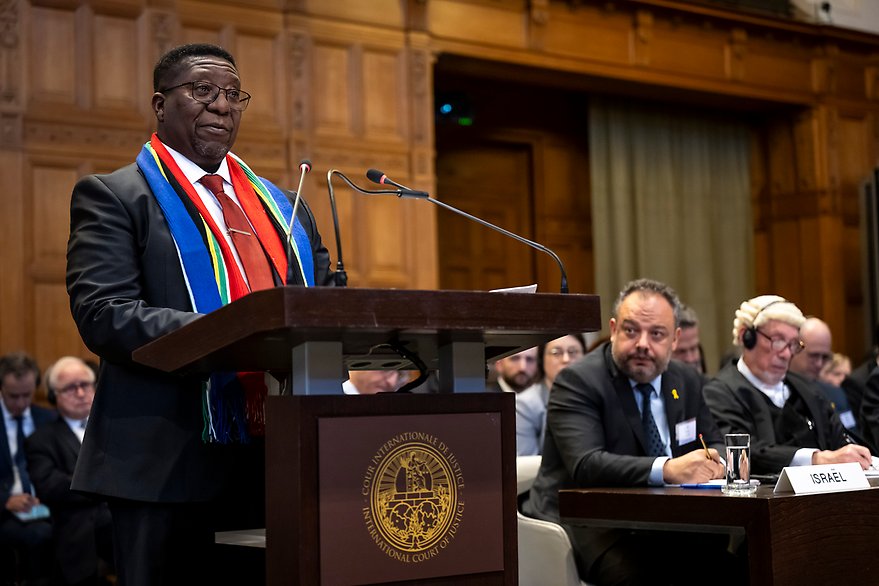
By Iqbal Jassat
In the arena of international law, when you cannot defeat the evidence, you attack the plaintiff. This is the oldest trick in the playbook of state-sponsored propaganda, and we are witnessing it play out in real-time as Zionist apologists scramble to discredit South Africa’s historic genocide case against Israel at the International Court of Justice (ICJ).
Unable to cleanly untangle themselves from the harrowing archive of civilian slaughter, manufactured famine, and explicit statements of intent broadcast by their own leadership, defenders of Israel’s military campaign have resorted to a desperate, defamatory fiction: claiming that South Africa’s legal intervention was bought by Iran and directed at the behest of Hamas.
This narrative is not merely false; it is a calculated insult to South Africa’s sovereign dignity, its deep-rooted history of anti-colonial struggle, and the foundational principles of post-apartheid international law.
To suggest that South Africa—a nation whose constitutional identity is explicitly forged in the fires of human rights advocacy and liberation politics—requires foreign capital or instruction to recognize oppression is a textbook display of colonial hubris.
It presumes that Global South nations lack independent moral agency. It implies that a country which systematically dismantled its own internal system of racial subjugation cannot look at the occupied Palestinian territories and independently diagnose apartheid and scholasticide.
South Africa’s legal recourse at the Peace Palace was not an act of foreign proxy warfare. It was a profound expression of historical duty.
The relationship between the South African liberation movement and the Palestinian struggle is decades old, famously encapsulated by Nelson Mandela’s declaration that “our freedom is incomplete without the freedom of the Palestinians.”
When South Africa filed its application under the 1948 Genocide Convention, it did so out of a legal and moral obligation to prevent the annihilation of a people—an obligation born directly from its own understanding of institutionalised dehumanisation.
Falsely framing this principled legal intervention as an “Iranian-funded plot” serves a distinct psychological and geopolitical purpose for the Zionist establishment.
First, it seeks to shift the global conversation away from the grueling realities on the ground in Gaza and the West Bank. By superimposing the geopolitics of the Middle East onto a legal filing in The Hague, apologists attempt to recast a clear-cut humanitarian crisis into a familiar, polarizing framework of regional proxy wars.
Second, it attempts to insulate Israel from international accountability by weaponizing islamophobic and anti-Iran anxieties in Western capitals. If the public can be convinced that South Africa’s legal team is merely an instrument of Tehran, the terrifyingly thorough legal briefs documenting the destruction of hospitals, universities, and refugee camps can be conveniently dismissed as hostile propaganda.
But the International Court of Justice did not dismiss it.
When the ICJ issued its provisional measures, acknowledging the plausible risk of genocide and ordering Israel to prevent genocidal acts, it effectively dismantled the “frivolous and vexatious” label that Israel’s defenders tried to stamp onto the case.
The court’s ongoing engagement with the merits of the case proves that South Africa’s arguments stand firmly on the bedrock of international jurisprudence, not the whims of external bankrolls.
To stand in defense of South Africa’s right to oppose genocide is to stand in defense of the international rules-based order itself.
The cynical smears aimed at Pretoria only expose the moral bankruptcy of those launching them. South Africa owes no apologies for refusing to be a silent bystander to history. By forcing the world to look into the judicial mirror at The Hague, South Africa did not act as a proxy for any foreign capital—it acted as the conscience of the world.
As this legal battle moves forward, domestic and international media platforms must exercise a heightened sense of vigilance against the deliberate dissemination of fake news.
Editorial rooms must remain hyper-aware of disinformation campaigns planted by Israel and its local lobbying arms in South Africa, designed specifically to inject the baseless “Hamas and Iran” conspiracy theory into mainstream reporting.
Regurgitating these unverified, politically motivated talking points without critical scrutiny does a profound disservice to journalistic integrity.
News organizations must refuse to be conduits for state-sponsored propaganda, ensuring that the public discourse remains focused on the rigorous legal and humanitarian facts of the ICJ case rather than manufactured distractions engineered to shield a state from global accountability.
Iqbal Jassat
Executive Member
Media Review Network
Johannesburg
South Africa