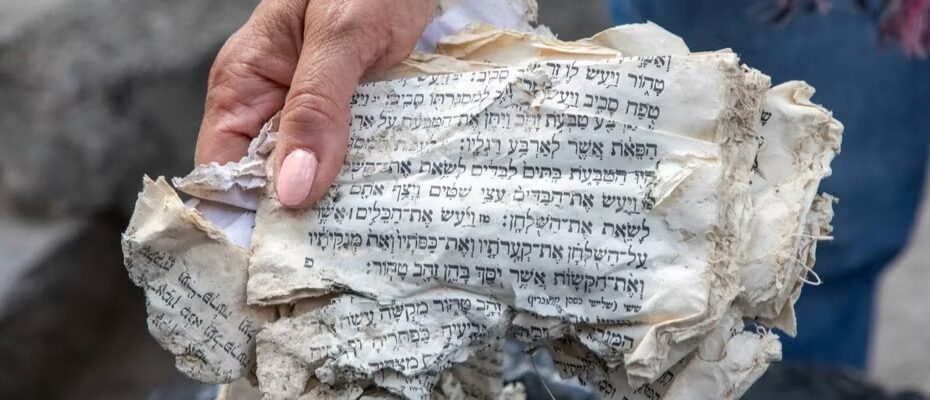
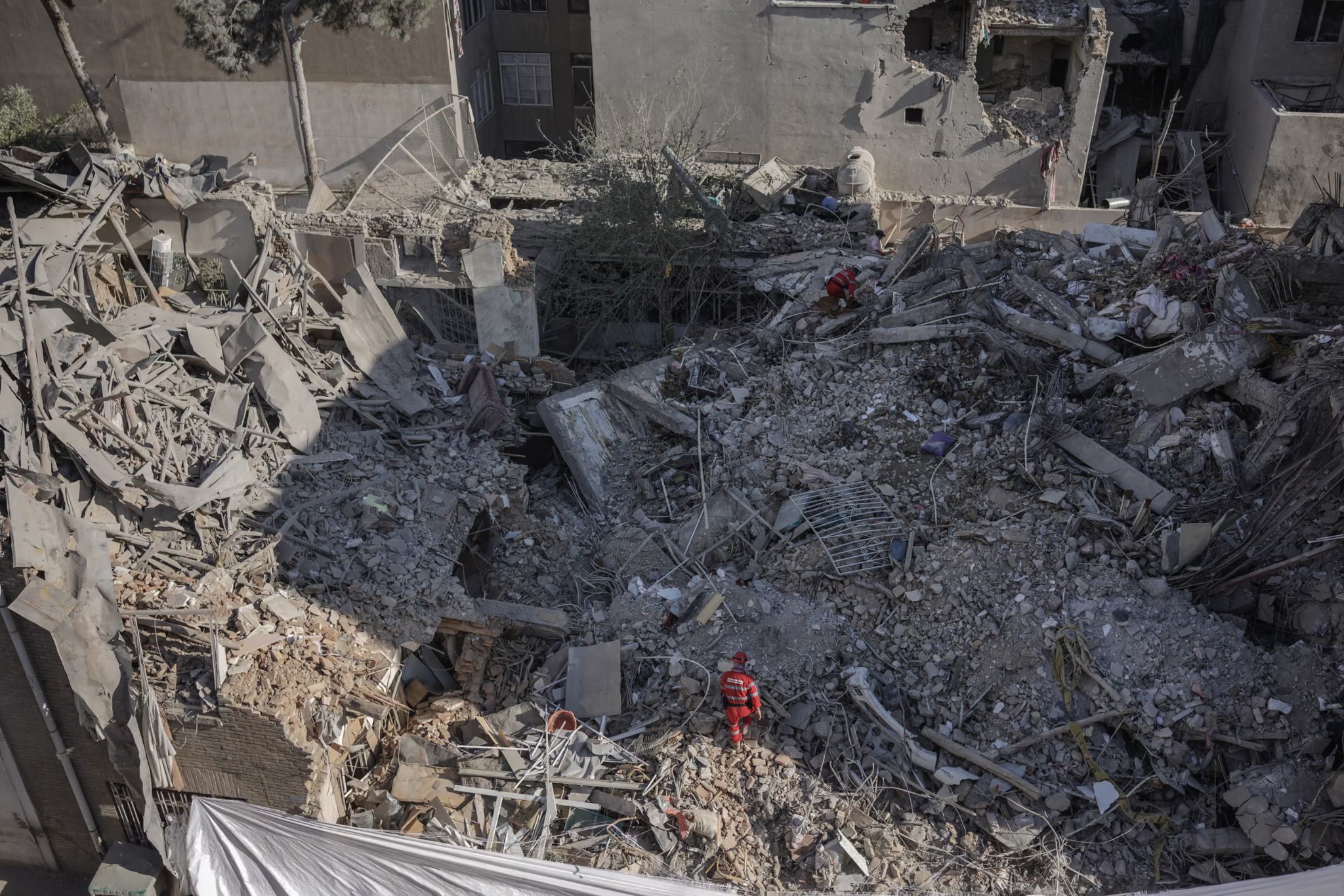
Close your eyes and imagine this is being read to you: A massive attack on a synagogue has occurred, leaving the place of worship totally destroyed. The Torah and other religious books lie buried in the rubble.
On any given day, many would suspect—and others would explicitly call this—an antisemitic attack. Right? Well, this has become a problem for some because they have not defined the act; rather, their definition is shaped by who the perpetrators are. When the perpetrators are the US-Israeli regimes and the country is Iran, specifically the city of Tehran, the waters get muddied. But should they? Even the controversial, Zionist-inspired International Holocaust Remembrance Alliance (IHRA) does not venture that far into the definition by looking at who the perpetrators are.
On the evening of 6 April, Tehran’s Jewish congregants braved US-Israeli bombings to celebrate an evening Passover service at the Rafi Niya Synagogue. When their leaders returned on the 7th, they—and the world—were horrified by the destruction. Rafi Niya is one of about 100 synagogues in Iran, including 30 in Tehran, that serve as houses of worship for Iran’s Jewish community. This community, the largest in the Middle East outside of Israel, is estimated to be between 10,000 and 15,000 people. The attack occurred on the sixth day of the Passover holiday.
The SAJR, which states that it works closely with Zionist groups to expose antisemitism in South Africa, reported the story. In the interest of transparency, I reveal my earlier dealings with the paper, where they were asked by the Press Council to apologize to me—as well as the PSA, BDS, and GIWUSA—regarding a cartoon they used to wrongly label us as antisemitic.
When the Press Ombud ruled that they should apologize, they refused and consequently withdrew from the Press Council under the threat of expulsion. In an editorial (in which the offensive cartoon was included), Peta Krost wrote: “The SA Jewish Report is in the news this week for supposedly having been ‘expelled’ from the Press Council for not obeying an order it gave us to apologize to the SA BDS (Boycott Divestment Sanctions) Coalition for calling it antisemitic. This is something we could never do.”
In response, I articulated our views widely, including in an article titled: “SAJR vs the Press Council: When in doubt, blame the victim”. Suffice it to say, we complained that the Press Council was taking far too long to adjudicate the matter and was ultimately unable to persuade this member to play by the rules they had signed onto.
Part B: Delving Deeper
The headline, “Iran claims synagogue in Tehran was ‘completely destroyed’ by a US-Israel strike,” sets a scene of doubt that the editors seemingly hold regarding the attacks. For a newspaper that speaks of Jewish suffering, the headline is a letdown, as it is couched as a “claim” emanating from Iranian state media. Like other international media, the SAJR went along with reporting from social media and government sources, but the slant is so pro-US-Israel that it undermines the compassion these stories usually evoke.
They state that the claim that the Rafi Niya Synagogue was “completely destroyed” was “impossible to verify.” They noted that footage posted online “showed open Hebrew prayer books scattered among the rubble of a building.” Like other media, they quoted a Jewish congregant, but only as a foil to emphasize Zionist talking points.
This stands in contrast to other reports, such as the commentary by Jewish writer and podcaster Antony Loewenstein, who knows the Iranian Jewish community quite well. He has written of their ordeals, both now and in the past, when Israel encouraged Iranian Jews to emigrate by offering cash incentives—a move many rejected while reiterating their support for Palestinian rights.
The Guardian reported on 22 April, revealing photos of the destruction and the voices of the community. However, at the time of writing, there appears to be no follow-up story from the SAJR. While the significance of this story warrants a follow-up, that remains the prerogative of the editors. It is worth noting that others reporting on the day the news broke were more balanced, and those who wrote subsequently were clear about who the perpetrators of this cowardly deed were.
(Photo: The Guardian)
The rest of the SAJR article reads like an apologia:
· The synagogue was damaged because it is located near Palestine Square, an “epicenter of the Iranian regime’s anti-Israel propaganda.”
· The US-Israel coalition has attacked Iran for more than a month.
· Israel “does not target religious sites.”
· Thousands of Jews live in Iran and worship in dozens of synagogues, but “hundreds of Iranian Jews who have applied for refugee status because of religious persecution are trapped in the country after the United States halted refugee admissions.”
· The “alleged attack” followed Israel posting a video of an undetonated missile, claiming an “Iranian regime missile struck next to a mosque in Israel.”
· The Israeli Prime Minister’s office issued a statement regarding the alleged damage: “Iran is firing missiles at civilians, Israel is striking terror infrastructure… Missiles on civilians versus precision strikes on terror targets. That’s the difference.”
Historical Precedents and Strategic Logic
I want to respond to a few of these points. First, I will detour to historical examples to locate this strategy of Israel attacking Jewish people. Anyone who has reported on the State of Israel must have encountered the history of how Jews from across the world arrived in the country. This history is complex but a contributory factor in our understanding of the colonial project.
Renowned British-Israeli historian Avi Shlaim, who is of Iraqi ancestry, writes in his book Three Worlds: Memoirs of an Arab-Jew about evidence suggesting that Zionist underground agents were responsible for bombings targeting Iraqi Jews in the early 1950s. Shlaim’s research—drawing on Baghdad police reports and interviews with former operatives—indicates that Israeli intelligence provided explosives and orders “to terrorize and not to kill” as a means to spur migration to Israel. These bombings successfully transformed Iraqi Jews from respected citizens into a suspected “fifth column,” ultimately driving a mass exodus of 110,000 people.
While other studies contest these findings, the strategic and political motive to encourage Jewish emigration through such means is well-documented. I am convinced that a similar logic regarding the “benefit” of such an operation applies to the recent synagogue bombing in Tehran.
They reported that the IDF struck a top commander from Khatam al-Anbiya, Iran’s military emergency command, and that the place of worship was “collateral damage.” The IDF stated, “The strike was directed at a senior military target within the regime’s armed forces.”
Like the SAJR, The Times of Israel maintained a justificatory tone. They ended skeptically, but the admission was made: “Multiple Iranian news sources reported on the strike that damaged the synagogue… The ministry’s internal report noted that the claim the synagogue was damaged is supported ‘by several sources, albeit all of them Iranian.’” For members of SA Jews for a Free Palestine (SAJFP), there was and is no equivocation. They stated clearly that Israel does not speak for them or world Jewry, asking: “If Israel keeps Jews safe, why did it bomb a synagogue?”
A Systematic War on Faith
Thirdly, the IDF and Israeli government statements quoted by the SAJR present Israel as a nation that respects all faiths. The claim that “Israel does not target religious sites” goes unchallenged by the Jewish Report and begs the question: Where has the SAJR been over the last few years?
The wars in Gaza, the West Bank, and Lebanon have shown that the bombing of the synagogue was predictable. Israeli assaults consistently result in indiscriminate killings and the destruction of homes, workplaces, hospitals, schools, and places of worship:
· In October 2023, the IDF destroyed a church-run social services building adjacent to the 1,600-year-old Church of Saint Porphyrius, reportedly killing 18 people, including eight children.
· The Ministry of Awqaf and Religious Affairs in Gaza reports that since October 2023, 89% of Gaza’s mosques have been destroyed or severely damaged—1,109 out of 1,244. Of these, 834 were completely reduced to rubble.
· Major Islamic landmarks, including the Great Omari Mosque, were demolished, and hundreds of religious leaders have been killed, leading observers to describe this as a systematic war on faith and heritage.
A core sentiment in these attacks is the Israeli view that Jews are only safe in Israel. When the Jewish Report writes that Iranian Jews want to immigrate but cannot because of the war, this narrative is at play. The SAJR once again gives the US-Israeli coalition a free pass on Jewish safety, but the SAJFP rebutted this on 15 April, pointing to an “ugly truth”: the State of Israel does not truly care about Jewish safety or holy sites if it destroys one of the few remaining gathering places for the ancient Jewish community of Iran during Passover.
Conclusions: The Duck Test
I have two concluding points: advice for the SAJR regarding how to identify antisemitism, and a reflection on the role of global media.
There is no “ducking” this one. About seven years ago, Zane Dangor, then-Special Adviser to the Minister of International Relations and Cooperation (DIRCO), wrote an opinion piece in the Sunday Independent, “Anti-Semites under the bed” (14 April 2019). He was writing in the context of the downgrading of diplomatic relations at the SA embassy in Tel Aviv, arguing that accusations of antisemitism were being used as “a well-honed tool to silence criticism.”
Zev Krengel, National Vice President of the SAJBD, responded with an article titled “Racism: Do The Duck Test.” Krengel argued that singling out Israel for punitive sanctions is “hypocritical and unjust” and applied the “duck test”: if something looks, swims, and quacks like a duck, it probably is a duck. He thus concluded that Dangor’s comments were a form of anti-Jewish bigotry.
The SAJBD and Jewish Report have consistently applied this test in other scenarios, yet they have failed to apply it here. Regarding the attack on Rafi Niya, the context of a war on Iran, the intent of encouraging Jews to leave the country, and the dismissive tone of the subsequent denials all look, swim, and quack like antisemitism. For some strange reason, the SAJR and others have failed to call it such.
Finally, I concur wholeheartedly with the SAJFP in condemning the “glaring double standard of Western media and political leaders.” As they rightly argued: “Had a synagogue been bombed in the United States, Europe, or Israel itself, it would dominate global headlines for weeks and be rightly condemned as an antisemitic atrocity.”
We must continue to do battle against the weaponization of antisemitism. False claims of antisemitism are as damaging as the failure to recognize real cases, such as this attack on the Rafi Niya Synagogue. Fundamentally, these attacks only fuel the voracious appetite for war and resources—including oil, gas, and critical raw materials—particularly in the Middle East. Sadly, by failing to apply the “duck test” here, the SAJR has failed to inform and educate its constituencies and society at large.