
By Sõzarn Barday
AirPods have become part of everyday life. People slip them into their ears to listen to music, catch up on podcasts, or take calls without a second thought. They are small, familiar, and almost invisible in public spaces.
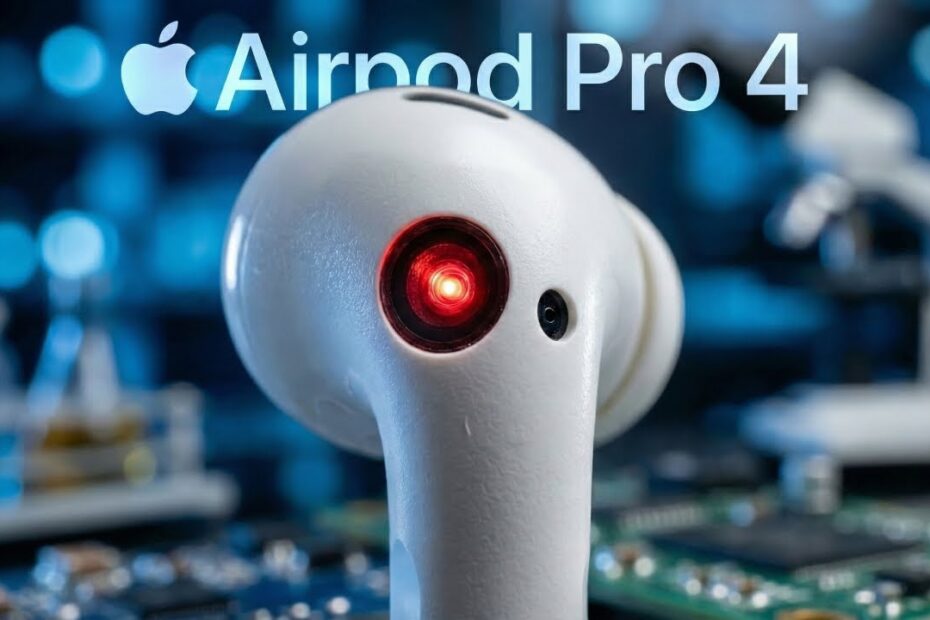
But according to industry reports, Apple is developing a new generation of AirPods — likely the AirPods Pro 3 — that could include tiny side-mounted cameras. These cameras would reportedly feed visual data to Siri, allowing the assistant to respond to questions about what the user is seeing. Apple refers to this concept as “visual intelligence.”
In practice, however, it raises a far more unsettling possibility: a camera that moves wherever your AirPods go.
Apple is expected to include a small LED indicator that lights up when visual data is being captured or transmitted. Yet AirPods are already so common and discreet that most people barely notice them. That combination — constant wear and low visibility — is where concerns begin to emerge.
If such devices become mainstream, they could quietly accompany users everywhere: into offices, gyms, medical consultations, restaurants, and even private homes. Unlike a phone camera, which is visible and deliberately used, AirPods would sit almost unnoticed in the ear, making it difficult for others to know when recording or environmental scanning is taking place.
This is where the idea of invisible surveillance becomes central. Monitoring is no longer limited to obvious devices or intentional recording. Instead, it becomes embedded in everyday tools that blend into ordinary life. Conversations, environments, routines, and personal spaces could all be processed as data without clear awareness from those being observed.
Some critics compare this broader shift to location-based platforms such as Pokémon Go, which drew scrutiny over the scale of behavioural and location data it collected from users. While the experience was framed as entertainment, it also normalised the continuous capture of movement patterns, habits, and environmental context — often without users fully appreciating the extent of data extraction involved.
The concern is not limited to one app or one company, but to a wider ecosystem in which everyday interaction increasingly feeds machine learning systems. In many cases, the technologies underpinning modern surveillance have evolved across a global security and intelligence landscape, where tools developed for defence, policing, and intelligence purposes — including in various countries with advanced surveillance industries — gradually filter into civilian consumer technologies. The question is whether users meaningfully understand what is being collected, where it is stored, and how it may be used in the future — including for training artificial intelligence systems.
History has also shown that surveillance is rarely neutral. Across different political systems and eras, expanded monitoring of populations has often been linked to shifts in power and control. From state surveillance apparatuses to modern digital tracking systems, the ability to observe behaviour at scale has consistently raised concerns about how information can be used to influence, manage, or constrain individuals and communities. The concern, therefore, is not only technological, but structural: who holds the data, and what power does that enable over those being observed.
The legality of such technology is likely to become a significant issue. In many jurisdictions, including South Africa, privacy and data protection are governed by laws such as the Protection of Personal Information Act (POPIA), while comparable frameworks like the General Data Protection Regulation (GDPR) in Europe set strict conditions for lawful data processing. These laws generally require informed consent, transparency, and clear purpose limitation when collecting or processing personal data.
Wearable devices with continuous visual capture capabilities could test the boundaries of these legal frameworks. Questions may arise around whether meaningful consent is possible in public and private shared spaces, how bystander privacy is protected, and whether individuals are adequately informed when data is being collected in real time. In this sense, the issue is less about a clear-cut violation and more about whether existing legal systems are equipped for ambient, always-on surveillance technologies.
Apple would likely argue that such technology is designed to enhance accessibility, improve user experience, and make AI assistance more context-aware. But critics argue that convenience is increasingly being used to justify deeper forms of data extraction.
The broader concern is not just what these devices can do, but what becomes normal once they exist.
For now, the answer may still be Siri. But in an era where data has become one of the world’s most valuable commodities, the real question is whether society is quietly accepting a future of constant, ambient observation — and whether that future is being shaped with meaningful consent.
Sõzarn Barday is a South African lawyer and author focusing on human rights, international law, and geopolitical events in the Middle East. The views expressed are her own.