
By Iqbal Jassat
Having read the article by Kenneth Kgwadi’s (Sunday Times, May 31, 2026) titled “Focus on Africa instead of Palestine”, surely the expectation by readers to not be kept in the dark, about the writer’s pro-Israel bias, is a reasonable one.
If his ties to the anti-Palestinian camp as well as his advocacy for the Zionist regime are brought to the surface, which the publication failed to do, readers will happily be able to take what he says, with a pinch of salt.
Context is a crucial factor for media platforms to incorporate into sensational opeds of the Kgwadi type, to ensure that consumers are not misled.
Nevertheless, his argument is an overused one by Israel’s lobbyists in South Africa, for it seeks to bolster the false notion that solidarity with Palestine is a distraction from African crises.
On the surface, the position appears reasonable. Sudan is burning. The DRC remains trapped in cycles of violence. The Sahel faces escalating instability. Millions across the continent face displacement, famine and conflict. These realities are undeniable.
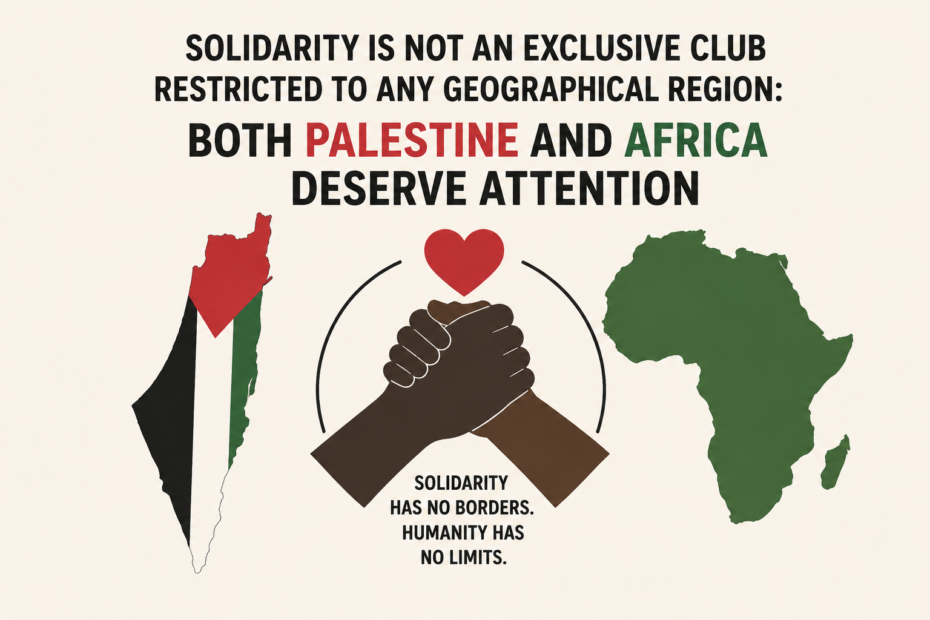
What is conveniently omitted, however, is the false assumption that support for Palestine and concern for Africa are mutually exclusive.
This framing narrows the discussion into a competition of suffering. It suggests that African governments must choose between opposing Israeli actions in Gaza or addressing crises in Sudan, Congo or elsewhere.
There is no evidence that diplomatic support for Palestine prevents African states from engaging African conflicts, nor does he provide any proof.
We obviously are seriously concerned with the deeper question about why some crises receive international protection, military backing and media amplification while others are allowed to deteriorate in strategic silence.
Indeed, absent from this argument is the historical relationship between African liberation movements and the Palestinian struggle. For many African governments, particularly South Africa, Palestine has never been viewed as a distant foreign issue. It has been understood through the lens of anti-colonial resistance, land dispossession, military occupation and apartheid.
That political memory is equally crucial for it remains central to the undeniable fact about how liberation movements interpret Israel’s settler colonial project.
Apartheid, ethnic cleansing, home demolitions, forced evacuation, detention with trial, rampant torture and genocide, define the regime’s claim to infamy.
South African consumers of media are aware of these violations and war crimes, and possess the agency to oppose them. To suggest that to engage in solidarity with Palestine’s freedom struggle amounts to a betrayal of Africa’s wide array of challenges, is not true.
In fact it is equally problematic to assume that. The line adopted by Kgwadi that Africa feature as the only exclusive area of social activism, excluding Palestine, is both untenable and impractical.
The attempt to portray Palestine as an “external” issue also ignores the reality that Africa itself remains deeply entangled in global power structures. Western governments, military alliances, financial institutions and multinational corporations continue to shape outcomes across the continent.
The same geopolitical architecture driving the genocide in Gaza, also influences Sudan, the DRC and countless other African crises. A key destabilizing force operating in tandem with Israel in the Horn of Africa, particularly Somalia and Sudan is the United Arab Emirates (UAE).
In an explosive report published a few days ago, the German think tank Stiftung Wissenschaft und Politik accused Abu Dhabi of being a major force behind instability across Africa.
“Until the Sudan war, the United Arab Emirates had largely escaped sustained scrutiny. That period now appears to be over. Its support for Hemetti’s Rapid Support Forces, which have been accused of carrying out massacres and using famine and rape as weapons of war, has brought renewed attention. The war against Iran has further intensified the spotlight”, reported Maïssata Koné-Dubois, of Mondafrique.
Being tied to Israel’s apron strings, the UAE’s involvement in Israel’s repression of Palestinians emanates from the same Zionist playbook in Africa.
Kgwadi is thus wrong to argue that when African governments raise Palestine, they are ignoring or neglecting Africa.
On the other hand, when African governments remain silent on Palestine, they are praised for being pragmatic.
This does not absolve African leadership from criticism. The African Union (AU) has often appeared paralysed in the face of continental disasters.
Sudan’s humanitarian catastrophe has exposed serious failures of regional diplomacy and political leadership. The suffering of millions of Africans should never be relegated to the margins of global attention.
Yet the conclusion that Africa should turn away from Palestine is nonsensical. A continent that emerged from colonialism understands that injustice does not become irrelevant because it occurs beyond its borders.
The principle underpinning solidarity is precisely that oppression is not geographically selective, nor do we have the luxury to remain silent when it is blatantly evident that African leaders have failed to apply the same urgency, consistency and political courage to crises within Africa itself.
The double standard stands exposed. Africa does not need less solidarity with Palestine. It needs the same solidarity extended to Sudan, Congo, Mozambique and every other people facing violence, displacement and abandonment.
Iqbal Jassat
Executive Member
MEDIA REVIEW NETWORK