
By Salman Khan
Balochistan occupies a unique position at the intersection of South Asia, Central Asia, and the Middle East. Rich in natural resources and strategically located along the Arabian Sea, the province has long attracted the attention of regional and global powers. While public discourse often focuses on insurgency, separatism, and security operations, the conflict in Balochistan has increasingly become intertwined with broader geopolitical rivalries, competing strategic interests, and allegations of foreign interference.

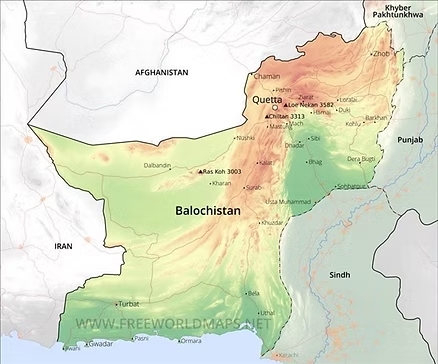
Geographically, Balochistan occupies a pivotal position at the crossroads of South Asia, Central Asia, and the Middle East, making it an important gateway for regional trade, energy transportation, and strategic connectivity. The deep-sea port of Gwadar Port, situated near some of the world’s busiest maritime routes, further enhances the province’s geopolitical importance. As global competition intensifies over energy corridors, maritime access, and emerging trade networks, Balochistan’s location has transformed it into a region of significant strategic interest for regional and international powers alike. “Consequently, developments in Balochistan are rarely viewed solely through a domestic lens; they are increasingly interpreted within the broader context of regional security architecture, international trade corridors, energy security, and great-power competition.”
Video confession of Kulbhushan Jadhav: https://www.youtube.com/watch?v=yTes1LSz_KA
Regardless of the geopolitical disagreements surrounding the conflict, one reality remains difficult to ignore: ordinary civilians continue to bear the heaviest burden. Among the most troubling dimensions of the conflict are allegations concerning the recruitment, radicalization, coercion, and exploitation of women by militant actors and affiliated networks. These allegations raise profound human rights concerns that deserve serious scrutiny independent of broader political arguments.
Families across Balochistan continue to endure uncertainty, fear, and loss. Parents search for missing loved ones. Communities struggle to understand the forces drawing young people toward radicalization. Mothers, fathers, siblings, and friends often become the forgotten victims of prolonged instability. The emotional and psychological consequences extend far beyond those directly involved in violence. Entire communities experience the erosion of trust, the disruption of education, and the loss of economic opportunities. For many families, the conflict is not a geopolitical contest but a daily reality marked by anxiety and grief.
Reports from families, community leaders, and security sources have highlighted claims that vulnerable young women are targeted through ideological indoctrination, psychological manipulation, social isolation, and, in some cases, coercive recruitment practices. Critics argue that these methods transform women from participants in civil society into instruments of political confrontation and, in extreme cases, violent militancy. If substantiated, such practices would represent a grave violation of human dignity and fundamental human rights.
The tragedy extends beyond the individuals directly affected. Behind every allegation of recruitment or disappearance lies a wider circle of suffering: parents searching for answers, siblings living with uncertainty, and communities struggling with fear and mistrust. The social consequences of prolonged conflict are often measured not only in security statistics but also in fractured families, interrupted education, and lost opportunities for an entire generation.
Equally concerning are allegations that university campuses and youth platforms have become arenas of ideological contestation. Supporters of these movements describe them as expressions of political dissent and advocacy, while critics contend that they serve as recruitment channels for more radical agendas. Determining where legitimate activism ends and militant influence begins remains one of the most challenging questions confronting policymakers and researchers.
The future of Balochistan cannot be secured through violence, coercion, or the exploitation of vulnerable populations. Whether viewed through the lens of national security, human rights, or regional stability, the protection of women, access to education, economic opportunity, and the rule of law must remain central to any sustainable solution. The women of Balochistan deserve to be recognized not as symbols in competing political narratives but as citizens entitled to security, dignity, opportunity, and justice.
As regional competition continues to shape the strategic landscape of South Asia, the humanitarian consequences of the conflict should not be overlooked. The true measure of success will not be determined solely by geopolitical outcomes but by whether the people of Balochistan—particularly its women and youth—can pursue their futures free from violence, coercion, and fear.
Author:
Salman I Khan. Paul Harris Fellow, T.I
An independent Geopolitical Analyst for South East Asia.
Email: salkhan1@yahoo.com