
Hassen Lorgat
The Israeli Ambassador to the United Nations, Danny Danon displayed in the usual dramatic fashion a FPV (First-Person View) drone supposedly from Hezbollah, during a UN Security Council meeting. It was vintage Israel, – the brutal aggressor, accused of genocide before UN and other tribunals, once again, trying to play the victim.

(image from video)
This was his warning that Hezbollah’s use of cheap, low-altitude, and fiber-optic-guided drones thus:
“These drones weigh less than two kilograms. It flies low, it is very difficult to detect, and by the time you hear it above your head, it’s too late. It can fly undetected for tens of miles, and all of a sudden you see it above your head. A thin cable is what makes this drone different. It does not rely on a radio signal. It cannot be easily jammed, unfortunately. It gives the operator a live video feed and direct control until impact. This is modern warfare, cheap, precise, deadly.”
This was a desperate admission that guerilla tactics are effective in an asymmetrical war against one of the world’s most immoral, yet very powerful army in the world.
Labeling Hezbollah as Israel, the US and a few other states as terrorists is insignificant as they remain in the eyes of their supporters as a resistance movement. The effectiveness of these drones is widely known now and I will use this perspective to invite the readers to take a wider personal view from the downtrodden, on global developments. For many, resistance is the innate and part of the universal DNA of the oppressed and to see display of these creative inventions was surprising – but not novel.
Danon’s lament was a simultaneous attempt to engineer a consensus against the resisting people the natives they cannot subjugate. His was a call for a united front against this stubborn resistance which must be defeated. A call to find strategies that would counter this new intervention – low cost that has challenged the advanced electronic welfare systems of the US and Israel.
Some believe that Israel was also putting out a call for funding and research for counter-drone systems (lasers, micro-interceptors, directed energy) that could change the cost equation back in their favour.
Israel styles itself as a start up nation where AI technologies for surveillance and control inside OPT (Occupied Palestinian Territories) and Israel are quite advanced but fighting on the wider battlefield against the low cost fiber-optic menace remains for them a worrying challenge to the goals of a greater Israel.
Their headache is intercepting a 500 dollar drone with a 50,000–100,000 US dollar missile is unsustainable if the drone swarm is large. This is guerrilla warfare turning the asymmetries of power in their favour: knowledge of the terrain, agility and working in small units. Their Zionism believes that their cause is fair and that Israel has no right to occupy as much land as they desire — in defiance of international law and justice – whether for safety reasons or because of the belief that all of the land belongs to Israel.
Like past groups such as the Vietcong, the National Liberation Front of Algeria (FLN), and other anti colonial movements, they had time on their side. The recent wars against Palestinian groups, Lebanese resistance movements like Hezbollah, the Iranian people – too have time and history on their side. For the record it is not the first time that an oppressor like Danon has complained about the weapons of the weak, whilst condoning its own brutality as the normal exercise of power.
Let me just give one simple example out of many: For decades, national liberation movements were left out of the Geneva Conventions’ protections. The laws of war only applied to battles between official state armies. This meant that people fighting against racist or colonial regimes were not given prisoner-of-war status—a right that formal state soldiers received.
In 1977, the South African government captured an MK soldier (from the ANC’s military wing) when he re-entered the country. The ANC demanded he be treated as a prisoner of war under the Geneva Conventions, not as a common criminal. However, the apartheid regime tortured him and rejected those international principles. He was executed on 5 April 1979, (Pillay P (2000).
Their aim in the region which they have taken to all parts of the world is to undermine and where possible criminalise and punish resistance or ideas that support resistance. Now it is Hezbollah in Lebanon, yesterday Gaza and Iran…the years before, it was in the colonies in Africa, Asia and Latin-America. These neo-right ideas of Empire, and global apartheid are trying to assert their rule over us all.
It may be necessary to reflect upon a first person’s view of history and affirm that it was not the first time that an oppressor has complained about the weapons of the weak. This brings me to many countries in the so-called Third World. It brings me to Haiti. The people who have suffered the most are the Haitians who lived in a country that was Saint‑Domingue. It is their punishment on behalf of the so-called Third World that we must never forget.
The people that suffered the most are the Haitians who lived in a country that was called Saint‑Domingue which was considered the crown jewel of the French empire built on slaves from Africa which constituted 90% of the island’s population of about half a million people before 1789.
It was the most lucrative colony in the whole world because of the sweat and blood of African slaves. The slaves were forced to produce sugar, coffee, and other cash crops for the global market. The ideas of the French and American revolutions helped inspire the enslaved to revolt. They led in 1791-2 what is still considered the largest and most successful slave revolt that defeated their better‑armed owners, who fled to France and America. Haiti then successfully fought off subsequent attempts by the former colonial powers to reinvade and re‑enslave the population. These revolts directly led France’s Convention regime to abolish slavery in 1794 (Piketty) but we must note the unprincipled Napoleon reinstated slavery in 1802. Haiti was forced to take up these struggles in their war of independence (1802–1804) against the colonists as well as the downtrodden of the world.
Haiti was the first nation to permanently ban slavery which intimidated the rule of white supremacy as it became the world’s first black republic. The Haitian revolution is arguably the greatest liberation story that our schools still do not teach.
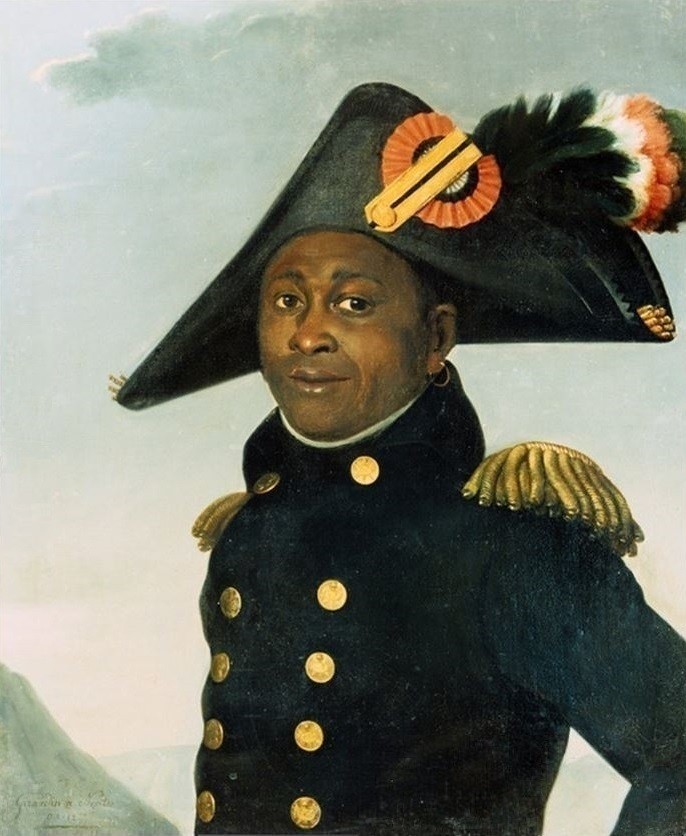
Former President Thabo Mbeki speaking in the bicentenary celebrations on 01 January 2004 thus: “Today we celebrate because from 1791 to 1803, our heroes, led by the revolutionary Toussaint L’Ouverture and others, dared to challenge those who had trampled on these sacred things that define our being as Africans and as human beings.”
(image wikipedia)
Leaders like Toussaint Louverture, Jean-Jacques Dessalines, and Henri Christophe organised and mobilised the masses successfully to orchestrate the defeat of multiple colonial superpowers, including Spain, Britain, and France.
It was this defeat of white supremacy by black slaves that may have inspired their punitive response of the former rulers. They demanded that Haiti pay them for defeating them. Sounds familiar?
Soon after winning its independence from France in 1804, it was almost immediately ostracised and Haiti was turned into a “pariah” state by world powers and this resulted in what University of Virginia scholar Marlene Daut calls “the greatest heist in history” after the island was surrounded by French gunboats, a newly independent Haiti was forced to enter into an agreement to pay them back.
The rule of Black people over themselves even threatened the global powers such as France and the United States of America. The U.S. President Thomas Jefferson feared Haiti’s success would inspire slave revolts in America, especially because the cotton gin had made slavery more profitable. So the U.S. isolated Haiti economically and didn’t officially recognize it until 1862, when slavery was ending.
The USA worked hard to isolate independent Haiti during the early 19th century and through violent force occupied the island nation for 19 years and only officially left Haiti in 1934. But it continued to control Haiti’s public finances until 1947, siphoning away around 40% of Haiti’s national income to service debt repayments to the U.S. and France.
It is reported that Haiti took out massive loans from French banks (notably Caisse d’Épargne and later Crédit Industriel et Commercial) to make the initial payments. The interest on those loans meant Haiti ultimately paid far more than the original sum.
France was even more direct: In 1825, France sent warships to force Haiti to pay 150 million francs (10 times what the U.S. paid for the Louisiana Purchase) in exchange for France recognizing Haiti’s independence. Haiti couldn’t afford it, so it took out high-interest loans from a French bank. Over 122 years, Haiti paid the equivalent of $20–30 billion today, which severely damaged its ability to prosper.
Today Haiti is one of the poorest nations in the world and a few western powerful countries have played a role in their underdevelopment. Around two-thirds of Haitians live on less than US$3.65/day, and nearly 5.4 million face acute food insecurity, with 6,000 internally displaced persons at risk of starvation.
Many years later campaigners agreed that the demand was illegitimate and illegal. Thomas Piketty notes on his blog posted (2025):
“Let’s state it outright: France owes approximately €30 billion to Haiti, and should immediately start restitution talks. The notion that France cannot afford such a payment does not hold up. While the sum is significant, it represents less than 1% of France’s public debt (€3.3 trillion) and barely 0.2% of private wealth (€15 trillion): It’s like a drop in the ocean.”
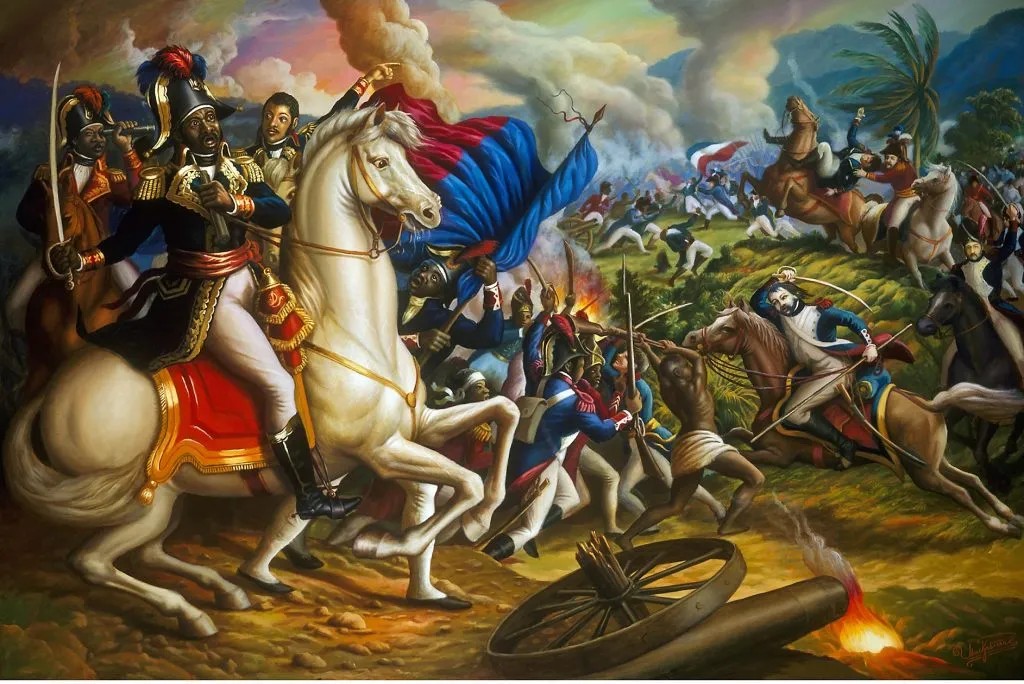
However, we must note that even as a poor country that appears in the news as always troubled and ungovernable its memory and symbols continue to cause fear. Just the other day FIFA asked the Haitian national team to change their kit – just four days before their opener against Scotland with FIFA citing regulations that prohibit political imagery on kits. This was a war that killed racism…which FIFA supposedly also supports?
(image courtesy: https://haitiantimes.com/2025/11/18/battle-of-vertieres-haiti-independence-day-in-history/)
The team was used in two other friendly matches because it contains an illustration of the Battle of Vertières in 1803, which secured Haiti’s independence, with the national flag embedded on the shirts worn by the players. This is Haiti’s first World Cup.
To end, I return to the hypocrisy of Danon and his government which shines through when I see them using the UN to condemn resistance to colonialism in South Lebanon and the destruction of Beirut and other places, I think of Haiti. We must challenge this: Israel uses the UN when it suits its agenda, yet routinely defies the very institution that granted it international legitimacy. Israel is a state born of the UN, yet it now treats that body with open contempt, brutally attacking its institutions and personnel. Whatever they do, resistance remains…
Hassen Lorgat