
By Iqbal Jassat
Islamophobia in South Africa can no longer be dismissed as the work of a few misguided individuals or isolated extremists.
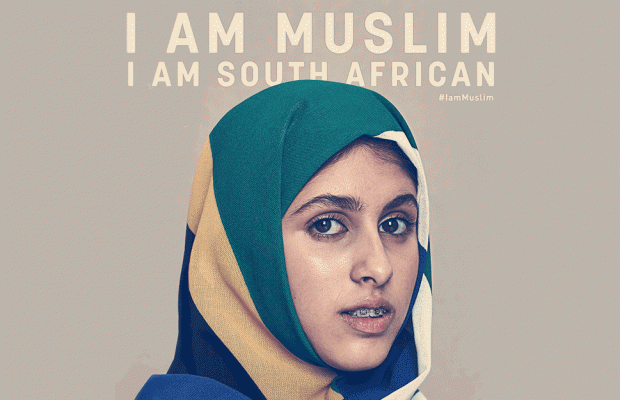
The evidence points to something far more organised. Anti-Muslim prejudice is being shaped by an ecosystem of media narratives, political opportunism, imported ideological networks and social media disinformation that increasingly defines Muslims as outsiders, regardless of their history, citizenship or contribution to the country.
The recent intervention by South Africa’s Film and Publication Board following the circulation of a grotesque Facebook post depicting the Prophet Muhammad, peace be upon him, in a vile and hateful manner illustrates both the seriousness of the problem and the urgency of confronting it. The Board correctly recognised that the material amounted to advocacy of hatred based on religion and warned that it had the potential to incite harm.
The episode exposed more than one hateful individual. It exposed an environment in which anti Muslim hatred has become normalised.
That environment was on full display following President Cyril Ramaphosa’s Cabinet reshuffle, when Yusuf Cassim was appointed Deputy Minister of Higher Education. Within hours, a South African citizen whose family has deep roots in the country was being labelled a foreigner, terrorist, suicide bomber and associated with Boko Haram, Al Qaeda and Hamas simply because he is a young South African of Indian Muslim heritage.
Though Cassim belongs to a political party, the Democratic Alliance (DA), whose policies on Palestine we find reprehensible due to its bias in favour of the settler colonial regime, we find the abuse was not based on facts. It was based on identity.
The campaign against Cassim demonstrated how quickly political appointments can become vehicles for racial, religious and ethnic scapegoating. What should have been a debate about governance became an attack on whether a Muslim belongs in South Africa at all.
Veteran journalist Max du Preez warned that the intensity of the hatred reflected levels of ethnic and religious bigotry not witnessed since the democratic transition in 1994.
Absent from much of the public discussion was the fact that Yusuf Cassim is not an immigrant. He is a South African citizen who has participated in the country’s democratic institutions for years. Yet the facts mattered little because the objective was never accuracy. It was narrative construction.
The architecture of Islamophobia depends precisely on this process. Muslims are first portrayed as perpetual outsiders. Once that perception takes hold, citizenship, history and constitutional rights become secondary to prejudice.
This process did not begin in South Africa.
Following the attacks of September 11, Muslims across the world became associated with extremism, terrorism and violence through relentless media stereotyping. Entire communities were judged through the actions of fringe organisations while the overwhelming majority of Muslims disappeared from public consciousness except when viewed through the prism of security.
These portrayals reflected more than poor journalism.
Israeli aligned think tanks, lobbying organisations, intelligence networks and politically connected research institutions supplied narratives that were amplified by sections of the media. Anonymous intelligence briefings, speculative research and unverified claims became accepted truths through constant repetition. Those same reports were later cited as evidence to reinforce the original assumptions.
Manufactured consent evolved into manufactured suspicion.
South Africa has not been immune to these influences.
Years ago, sensational reporting claiming widespread ISIS recruitment in South Africa illustrated how irresponsible journalism can reinforce anti Muslim prejudice. Emotionally loaded language blurred the distinction between criminal organisations and ordinary Muslim communities. The effect was to encourage readers to associate Islam itself with terrorism rather than to understand the complexities of violent extremism.
The same mechanisms continue today.
During the recent surge in anti immigrant protests, fuelled by economic hardship, unemployment and failures in border management, Muslim organisations appealed for calm, rejected vigilantism and warned against xenophobia, Afrophobia and Islamophobia. Humanitarian organisations provided emergency assistance to displaced migrants facing threats of violence, consistent with their longstanding charitable obligations.
Yet these humanitarian efforts were immediately recast by nationalist voices as evidence that Muslims were siding with foreigners against South Africans.
The accusation reveals how humanitarian action itself has become politicised.
Muslim organisations were criticised for assisting vulnerable migrants while simultaneously being accused of divided loyalties, foreign influence and hostility towards Black South Africans. Support for refugees was deliberately conflated with support for illegal immigration. Calls for peaceful and lawful responses were reframed as opposition to South African interests.
This narrative serves a broader political purpose.
It redirects legitimate public frustration over unemployment, crime, corruption and ineffective immigration policies away from state failures and towards visible minority communities. Muslims become convenient symbols through which wider anxieties are channelled.
History demonstrates the dangers of such politics.
Apartheid relied upon narratives that identified certain communities as permanent threats requiring exceptional treatment. Different populations were targeted, yet the underlying logic remains unchanged. Social problems are personalised, minorities are blamed, fear is amplified and discrimination is presented as common sense.
The beneficiaries of this process extend well beyond fringe activists. Political opportunists, media platforms driven by outrage, lobbying networks, ideological movements and foreign influence operations all benefit when society becomes polarised along religious and ethnic lines.
Once Muslims are portrayed as outsiders, the definition of who belongs continues to narrow. Today the target may be Muslims. Tomorrow it may be another minority community. The machinery of exclusion rarely confines itself to one group.
South Africa’s constitutional democracy was built upon the rejection of precisely this politics of exclusion.
Confronting Islamophobia therefore requires more than prosecuting hate speech after it occurs. It requires exposing the institutions that manufacture prejudice, challenging media narratives that normalise suspicion, scrutinising imported ideological campaigns that inflame division and refusing attempts to weaponise economic hardship against vulnerable communities.
The Film and Publication Board demonstrated that institutions can recognise explicit religious hatred. Equal vigilance is required against the more sophisticated forms of prejudice that operate through political rhetoric, media framing and digital disinformation.
The silence surrounding these deeper forces is not accidental.
It reflects an ecosystem in which prejudice is manufactured, misinformation is legitimised and political interests profit from keeping Muslims under perpetual suspicion.
Iqbal Jassat
Executive Member
Media Review Network
Johannesburg
South Africa