
By Shaimaa Eid
That night, Mahmoud lost his wife, his seven-year-old son, Ziad, and his four-year-old daughter, Ghada, along with 33 members of his extended family.
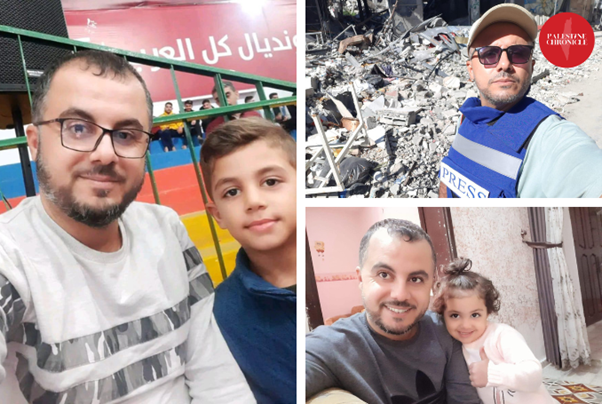
Photojournalist Mahmoud Abu Hasira walks through the streets of northern Gaza, camera in hand. Through his lens, he documents the brutal reality of Israel’s ongoing genocide while carrying an indescribable emptiness after losing his wife, his two children, and dozens of members of his extended family since the war began on October 7, 2023.
His mind always returns to one particular date: November 4, 2023.
The clock read 9:15 p.m.
For Mahmoud, that was the moment time stood still, and the people he loved were gone.
“I remember hearing massive explosions west of Gaza’s seaport,” he recalls. “That’s where my home was, where my wife, my two children, and the rest of my family were. But I never imagined that our home itself would be the target.”
Mahmoud had been away from home with his father. As soon as reports identified the location of the strike, they rushed there, convinced that a nearby mosque had been hit. It never crossed their minds that their own home had been deliberately targeted.
Tragically, that was exactly what had happened.
That night, Mahmoud lost his wife, his seven-year-old son, Ziad, and his four-year-old daughter, Ghada, along with 33 members of his extended family. Most of those killed were women, children, and elderly relatives.
He vividly remembers the morning of that day and the final moments he spent with his children. He had taken them to a neighborhood grocery store, which was later bombed as well. He bought them some of their favorite snacks, hoping to distract them, ease their fear, and offer them a brief escape from the terror of the bombardment, killing, and displacement surrounding them.
“My children were killed before they could even finish the bag of snacks I bought them,” he says quietly.
Mahmoud is overwhelmed by grief every time he thinks of his wife and children, whose bodies remain buried beneath the rubble of their destroyed home to this day.
“The Israeli strike was so devastating that civil defense crews were unable to reach the site because of the intensity of the explosions,” he says. “Israeli forces were also targeting rescue teams attempting to save those trapped beneath the rubble.”
Since the start of Israel’s war on Gaza, attacks targeting Palestinian journalists have intensified in what many rights organizations have described as a systematic campaign. At the time of writing, 263 Palestinian journalists have been killed.
For Mahmoud, that is all the more reason to continue.
“The essence of the war we are living through in the Gaza Strip is to tell the truth and bring the voices of people being exterminated in cold blood to the entire world,” he says.
Despite the pain that never leaves him, Mahmoud chose to keep working.
He walks through Gaza’s streets—now reduced to vast fields of rubble—documenting what remains of the city’s neighborhoods and landmarks. Through his camera, he seeks to show the world the grief etched onto the faces of children robbed of their innocence, and the funeral processions of entire families brought from hospitals after being wiped from the civil registry.
When Mahmoud returns each day to the place where he is now displaced, he often finds himself scrolling through photographs of his two children.
“I miss the feeling of my children welcoming me home,” he says. “They used to greet me with hugs and ask me to fulfill their little wishes.”
In every photograph he takes, he sees the faces of the family members he lost. The rubble surrounding him has become a symbol of unbearable pain—the very rubble beneath which so many of his memories remain buried.
Standing before the ruins of his destroyed home, Mahmoud says, “Not even my children’s toys were spared. They are still trapped beneath the rubble, just like some of my family members.”
Like many journalists in Gaza, Mahmoud believes his work has become more important than ever. He sees every photograph he captures and every report he files as one of the few remaining tools available to document what he describes as a war of extermination.
“The occupation may try to silence our voices,” he says, “but it will never extinguish the truth. The truth will continue to live through our lenses, our photographs, and our daily reports.”
Despite everything he has lost, Mahmoud continues his work with determination, confronting what he calls the crimes of the occupation with the only weapon he has: documenting the truth.
“The occupation wants us to break, but we will not give it that victory,” he says. “This camera is my weapon, and through it I will continue to show the world what is happening here—the reality of the horrific crimes being committed against defenseless civilians in Gaza.”
(The Palestine Chronicle)
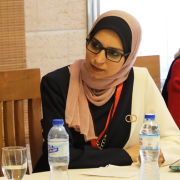
– Shaimaa Eid is a Gaza-based writer. She contributed this article to the Palestine Chronicle.
“Reprinted from…”https://www.palestinechronicle.com/after-losing-his-family-a-gaza-journalist-keeps-documenting-the-war/