
By Iqbal Jassat
For decades, India projected itself to the world as a vibrant, secular mosaic—a nation where the call to prayer harmonized with the chiming of temple bells. Today, tragically that mosaic is being systematically dismantled.
Islamophobia in India is no longer just a social undercurrent; it has become a central pillar of the ruling Bharatiya Janata Party’s (BJP) political mobilization and institutional policy.
To look at India in 2026 is to witness a democracy undergoing a dangerous majoritarian mutation, where its 200 million Muslims are increasingly subjected to a dual assault: grassroots violence on the streets and systemic erasure through the law.
The scale of this crisis is best understood through personal accounts supported by human rights monitors. According to data compiled by the India Hate Lab, hate speech incidents targeting minorities surged by 13%, with the vast majority directed squarely at Muslim communities.
The evidence suggests it is not accidental but a calculated political strategy.
An overwhelming majority of these documented hate speech events occurred within states governed by the ruling BJP or its coalition partners.
More alarming still is the physical toll of this rhetoric. Ground-level monitoring by the South Asia Justice Campaign’s India Persecution Tracker revealed that at least 44 Muslims were killed in religiously motivated violence and state-enforced actions during the first seven months of this year alone.
The data points to a horrifying reality: 2026 is on track to become the deadliest year for anti-Muslim violence since record-keeping began. The geographic concentration of these fatalities—primarily across BJP-ruled strongholds like Uttar Pradesh and Jharkhand—demonstrates a terrifying correlation between hardline political governance and lethal vigilante impunity.
What makes the current phase of Islamophobia in India particularly insidious is how seamlessly vigilante violence blends with state policy.
Consider the escalating crackdown on Islamic education. In states like Uttarakhand, the government has aggressively dismantled traditional Muslim educational frameworks. Just this past July, Uttarakhand became the first state to abolish its statutory Madrasa Education Board, replacing it with a heavily centralized state authority.
The message is clear: Muslim identity, even within the confines of educational and religious institutions, must be placed under state surveillance and control.
Simultaneously, the widespread implementation of sweeping anti-conversion laws across 13 Indian states has criminalized interfaith relationships.
Framed loosely to prevent “coerced” conversions, these laws are weaponized by right-wing vigilantes who peddle debunked conspiracy theories like “love jihad” to harass, arrest, and socially ostracize Muslim men who marry outside their faith.
Furthermore, the bureaucratic machinery of the Citizenship Amendment Act (CAA) and the National Register of Citizens (NRC) continues to loom large. In regions like Assam, arbitrary tribunals have stripped Bengali-speaking Muslims of their legal status, classifying them as “foreigners” and exposing them to detentions and forced deportations.
While international condemnation seems limited, it has not gone unnoticed by the UN Committee on the Elimination of Racial Discrimination (CERD).
A few weeks ago, it issued an extraordinary rebuke of New Delhi. Reviewing India for the first time in nearly two decades, the UN panel explicitly cited the state for systemic discrimination against its Muslim and Christian minorities.
The committee raised urgent alarms over the racial profiling of Bengali Muslims, arbitrary detentions, and a massive voter purge that has disproportionately disenfranchised Muslim voters in multiple states.
New Delhi’s response to these findings follows a well-worn script of defensive deflection. Rather than addressing the empirical realities on the ground, Indian diplomats at the United Nations have chosen to pivot, demanding that international watchdogs expand their frameworks to combat “religiophobia” against Eastern faiths like Hinduism and Sikhism.
While biases against any faith must be universally condemned, using this argument to minimize the targeted, state-backed persecution of 200 million domestic citizens is a masterclass in geopolitical gaslighting.
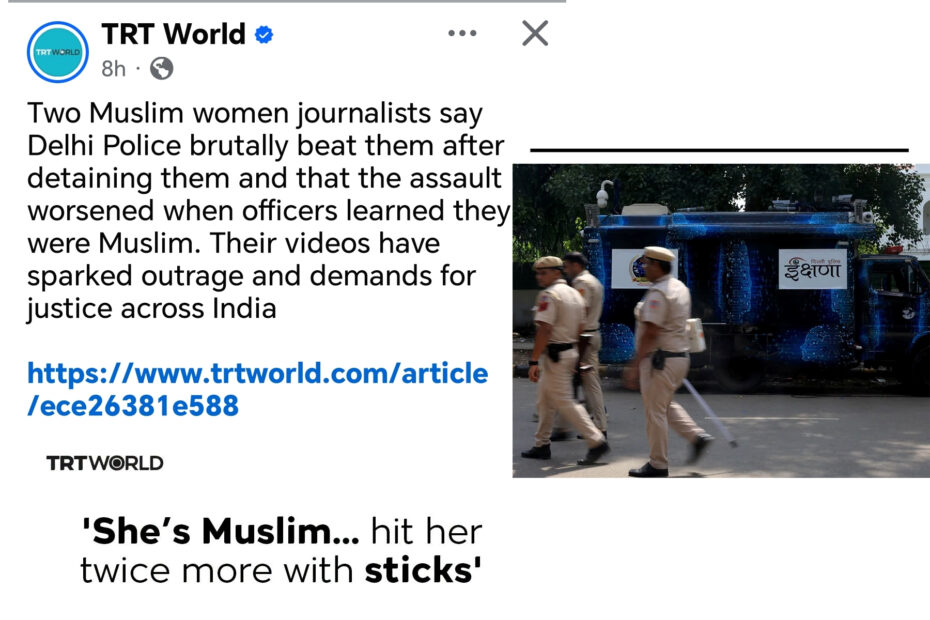
India stands at a profound historical crossroads. When everyday public spaces become arenas for ideological intimidation—where viral videos capture the policing of Muslim dress and religious expression—the democratic fabric of a nation is torn.
Islamophobia in India is no longer an abstract academic debate; it is a structural crisis. When hate speech is normalized by the ruling elite, when state actors account for a significant portion of minority fatalities, and when the law itself is reshaped to alienate an entire community, democracy risks becoming majoritarian tyranny.
If India wishes to preserve its constitutional soul, it must stop dismissing international critiques as “foreign interference.” It must look into the mirror, confront the bigotry festering within its borders, and actively restore the values of equal rights and protections upon which the republic was founded.
Iqbal Jassat
Executive Member
Media Review Network
Johannesburg
South Africa