
By Iqbal Jassat
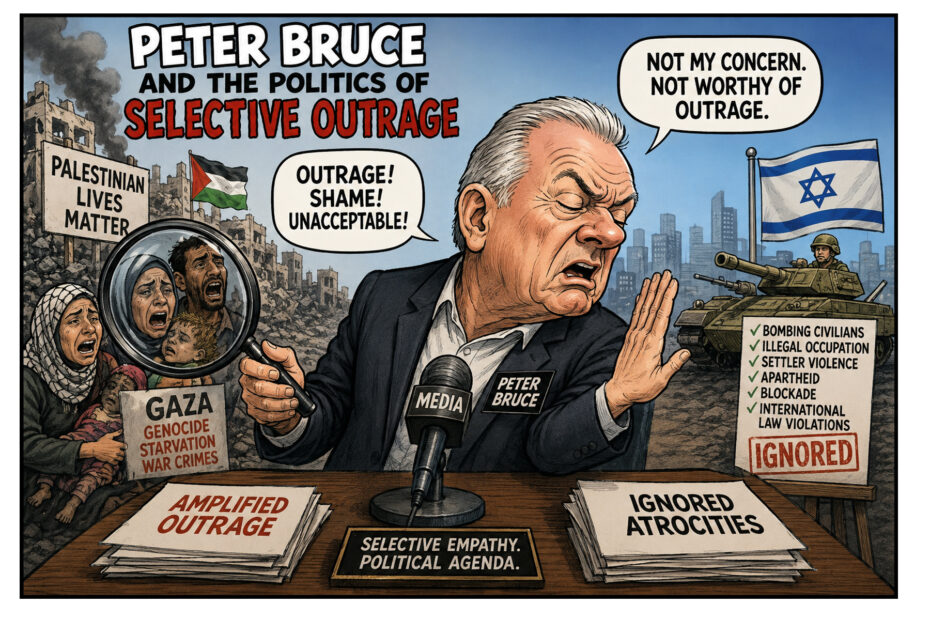
I’ve read with interest Peter Bruce’s defence of Cape Union Mart (Sunday Times, September 13, 2026) titled “Picking on the wrong Jew”, and despite his attempt to be balanced, I find he has missed a central issue in the boycott debate.
He presents Philip Krawitz as an admirable South African businessman, highlights his charitable work and local employment, and then asks how such a “civic minded” retailer became the target of what he calls a “vicious hate campaign”.
What he fails to acknowledge is that Krawitz became a political target because of his public identification with Israel, his institutional connections and statements that placed him within a wider debate about South African support for Israel.
Ironically, Bruce confirms Krawitz’s connections with the settler colonial regime by reminding readers that he was once photographed with Benjamin Netanyahu, who has an arrest warrant issued by the International Criminal Court for war crimes.
So contrary to Bruce’s argument summed up in the misleading heading, Jewish identity does not make a legitimate basis for political targeting, but public affiliations with a genocidal regime can be questioned, scrutinised, condemned and boycotted.
Bruce himself acknowledges the political context. He records the October 7 Hamas attack, the Israeli military campaign that followed, the deaths of more than 70,000 Palestinians according to the figures cited in his article, and South Africa’s position that Israel is committing genocide. He also acknowledges that Israel has become diplomatically isolated.
Yet having established that context, Bruce appears to want the political consequences of it to stop at the doors of Cape Union Mart.
That is where his argument collapses, for the court did not outlaw the boycott. It ruled
against specific allegations made by protesters.
That distinction matters for the court found that claims portraying Krawitz and Cape Union Mart as funders of genocide, the Israeli military or the killing of children lacked the necessary evidentiary foundation.
But the judgment did not establish that consumers have no right to boycott Cape Union Mart, nor did it prohibit criticism of Israel.
Indeed, the judgement did not outlaw Palestinian solidarity, nor
did it remove the constitutional right to peaceful protest.
Bruce himself concedes that protesters remain within their rights provided they comply with the court’s restrictions.
The legal position is therefore considerably narrower than the moral conclusion Bruce appears to draw from it.
Surely by repeatedly raising the question of whether Krawitz was targeted because he is Jewish, he ventures into identity politics.
He does so by asking whether protesters would have targeted Raymond Ackerman or Adrian Gore had they still been alive.
This is an important issue, but it requires precision. Jewish identity is not a legitimate basis for political hostility. Neither is Muslim identity, Christian identity, African identity or any other religious or ethnic identity.
But criticism of an individual’s political affiliations does not become antisemitic simply because that individual is Jewish.
And as for consumer boycotts, we learn from our own history that South Africa’s liberation movement understood this very well.
Economic boycotts were deliberately used to pressure companies and institutions associated with apartheid.
The purpose of a boycott is to impose an economic consequence, but if such boycotts are made illegitimate,
much of the international campaign against apartheid would have to be condemned as irresponsible.
The argument therefore cannot be that Cape Union Mart should be exempt from economic pressure because South Africans work there.
The real argument must be whether the political reasons for the boycott are legitimate.
Strangely, Bruce makes another revealing comparison by arguing that if protesters targeted Ford or Amazon, the South African government would move quickly to protect major American investors. He points out that American aircraft have been involved in Israel’s military campaign.
But this comparison undermines his own argument for it
demonstrates precisely how economic relationships become political.
If anything, Bruce’s comparison confirms that economic relationships cannot be separated from politics simply because doing so becomes inconvenient.
Further, he fails to acknowledge that a boycott does not require a court to establish criminal liability.
A consumer does not need proof beyond reasonable doubt before deciding that a company no longer deserves their business.
Indeed it does not require South Africans to surrender their right to political judgement.
Bruce also fails to concede that the protesters’ strongest case was never dependent on proving that Krawitz personally financed Israeli military operations.
Their political argument concerns the relationships between South African institutions, public figures, Israel and the wider system of international support that has allowed the terrible genocide in Gaza to continue.
I also detect that there is an uncomfortable irony in Bruce’s argument because as South Africans, we understand the power of consumer pressure because we experienced it ourselves.
The anti apartheid movement did not wait for every company targeted by international campaigns to become legally responsible for apartheid crimes.
That history cannot suddenly become irrelevant when the target is connected to a debate over Palestine.
The issue is not whether Krawitz is Jewish but rather whether his public affiliation with Israel can be examined.
And whether South Africans have the right to use their purchasing power in opposition to a government and political project they believe is responsible for grave injustice.
Iqbal Jassat
Executive Member
Media Review Network
Johannesburg
South Africa