
By Sõzarn Barday
Can collecting rainwater become a question of international law?
It might sound like an absurd question. Rain falls freely. No government creates it. No authority controls where the clouds gather or when the water reaches the ground.
Yet in parts of the occupied West Bank, the ability of Palestinian communities to collect and store that rain has become entangled with planning rules, permits, demolitions and, ultimately, questions about access to water.
That raises a larger legal question: when restrictions on rainwater harvesting affect a community’s ability to obtain water, where does ordinary planning regulation end and international law begin?
The issue is particularly significant in Area C of the West Bank, which comprises more than 60% of the territory and remains under extensive Israeli control, including over planning and construction.
Is it illegal to collect rainwater?
It is important to be precise.
It would be inaccurate to say that collecting rainwater is simply “illegal in Palestine”. There is no blanket rule making the collection of rainfall itself unlawful throughout the Palestinian territories.
The legal issue is more specific.
In Area C, Palestinian communities have faced Israeli Civil Administration permit requirements for water infrastructure. A United Nations fact-finding mission reported that additional approval was required even for small-scale projects such as wells and rainwater-collection cisterns.
This creates an important distinction.
The law may not prohibit rain from being collected. It can regulate, and potentially prevent, the construction or use of the infrastructure needed to collect and store it.
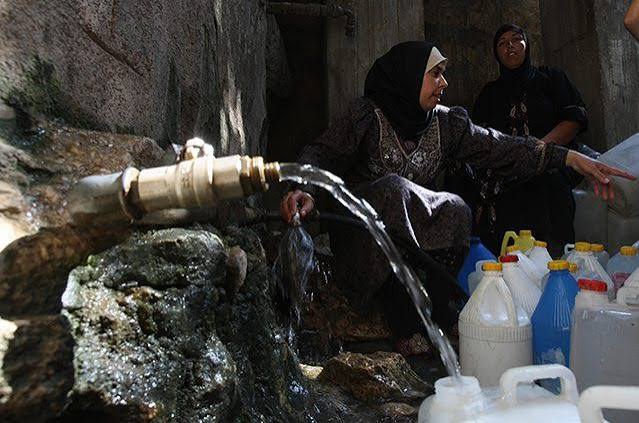
That distinction matters because a rainwater cistern is not simply a piece of concrete. For a community without reliable access to a piped water network, it can be part of the infrastructure that makes water available for drinking, domestic use or livestock.
If a cistern requires authorisation and that authorisation cannot be obtained, the consequences can extend beyond a planning dispute.
The structure can face a demolition order.
And that is where the question becomes one of international law.
When planning law affects the right to water
International law does not prevent states or occupying authorities from regulating buildings and infrastructure. Planning systems can serve legitimate purposes, including safety, environmental protection and orderly development.
But planning rules do not operate in isolation.
International human-rights law recognises a right to water. The UN Committee on Economic, Social and Cultural Rights has interpreted that right as requiring water to be sufficient, safe, acceptable, physically accessible and affordable for personal and domestic uses.
The legal significance of water infrastructure therefore changes when the removal or restriction of that infrastructure leaves people without meaningful access to water.
A rule that regulates the construction of a building is one thing.
A regulatory system that, in practice, prevents a community from developing basic means of obtaining and storing water raises a much more serious human-rights question.
The legality of a particular measure depends on the applicable legal framework and the facts of the case. But the consequences for access to water cannot simply be separated from the legal analysis.
The evidence is not merely historical
This is not only an issue arising from older reports.
UN OCHA has continued documenting the demolition and damage of Palestinian water and sanitation infrastructure in the West Bank during 2026.
In July, OCHA reported that Israeli authorities had demolished Palestinian-owned structures in Area C for lacking Israeli-issued building permits, including a water cistern in the Ar Rifa’iyya community east of Yatta.
In April, OCHA documented the demolition of two water cisterns among 29 Palestinian-owned structures demolished for lacking Israeli-issued permits.
And in its July reporting on access to water, OCHA said that demolitions and settler attacks had damaged water and sanitation infrastructure across the West Bank, increasing reliance on emergency water trucking. It reported that Israeli authorities had demolished an average of about 14 WASH structures per month in Area C during 2025 and the first seven months of 2026 — more than three times the monthly average recorded between 2009 and 2024.
These figures matter because they demonstrate that water infrastructure is not merely an abstract legal issue.
It is an ongoing infrastructure issue.
What happens when climate adaptation requires permission?
There is another dimension to the question: climate change.
Rainwater harvesting is commonly regarded as a way of increasing water resilience, particularly in places where rainfall is seasonal or conventional water infrastructure is unreliable.
For communities already experiencing water insecurity, collecting rainfall can provide an additional source of water and reduce dependence on expensive water deliveries.
But adaptation only works when people are able to implement it.
That creates an uncomfortable paradox.
Around the world, governments, international organisations and environmental programmes increasingly encourage communities to become more resilient to climate change. Rainwater harvesting can be part of that adaptation.
Yet where the construction of a rainwater cistern is subject to a restrictive permit regime, a community may face a legal barrier to implementing one of the very measures that can strengthen its resilience to water scarcity.
The question is therefore not simply whether rainwater harvesting is environmentally useful.
It is whether people experiencing water insecurity can legally and practically access the means of harvesting the water that nature provides.
The law of occupation
The West Bank is an occupied territory, bringing international humanitarian law into the analysis.
Under the law of occupation, the occupying power has extensive responsibilities concerning the administration of occupied territory and the welfare of the protected population. Those obligations exist alongside applicable international human-rights law.
The significance of this becomes clearer when planning restrictions affect essential civilian resources. A demolition order concerning a cistern cannot be understood solely as a dispute about whether a structure has a permit if the practical consequence is that a community loses an important source of water.
The legal question becomes broader:
What happens when the enforcement of a domestic planning regime interferes with access to a basic human necessity?
Water is not just infrastructure
It is easy to reduce the issue to concrete, pipes, permits and demolition orders.
But water law ultimately concerns people.
A water cistern can determine whether a household has water available when the nearest network does not reach it. A damaged tank can increase reliance on water trucking. The loss of a local water source can affect domestic needs and livestock.
OCHA reported in July that damage to water infrastructure across the West Bank was increasing reliance on emergency water trucking, particularly in communities where alternative sources were limited.
The human-rights significance is therefore difficult to separate from the infrastructure itself.
The right to water does not necessarily mean that every person has an unrestricted right to construct any water facility they choose. But it does mean that access to water has legal significance beyond ordinary property regulation.
That is why restrictions on water infrastructure deserve scrutiny through more than one legal lens.
So, is restricting rainwater harvesting contrary to international law?
The strongest answer is not a simple yes or no.
International law does not create a blanket rule that every restriction on rainwater collection is unlawful.
But where restrictions on rainwater harvesting infrastructure substantially impede access to sufficient, safe and accessible water, they can engage international human-rights obligations. In an occupied territory, the analysis must also take account of international humanitarian law.
That is the important legal distinction.
The issue is not that international law gives communities an unlimited right to build whatever water infrastructure they want.
It is that access to water is itself protected by international law, and measures that significantly obstruct that access cannot be examined as though they were merely ordinary building disputes.
In Area C, the UN has documented permit requirements affecting even rainwater-collection cisterns, while more recent OCHA reporting continues to record the demolition of water infrastructure.
That combination raises a serious legal question about whether regulatory restrictions, as applied and in their cumulative effects, are compatible with obligations concerning access to water and the protection of the civilian population.
Who gets to catch the rain?
Perhaps that is the real question.
Rain is one of the few resources that arrives without regard to borders, permits or political authority.
But turning rainfall into usable water requires infrastructure.
And when the law determines whether that infrastructure can exist, the question is no longer simply about rain.
It becomes a question about land, governance, occupation, climate vulnerability and human rights.
The point is not that rainwater collection has been made illegal throughout Palestine. That would be an inaccurate description of the law.
The point is more precise — and perhaps more troubling from a human-rights perspective.
In parts of the occupied West Bank, particularly Area C, Palestinians can face legal restrictions on the infrastructure through which they collect and store water. UN reporting shows that water cisterns and other WASH infrastructure continue to be demolished or damaged, with consequences for access to water.
International law recognises that water is not simply a commodity or a construction project.
It is a human necessity with legal protection.
So when the rain comes, the question is not whether anyone owns the clouds.
The question is whether the people on the ground are legally and practically allowed to catch what falls from them.
Sõzarn Barday is a lawyer and author who writes on human rights, international law and public policy. The views expressed are her own.