
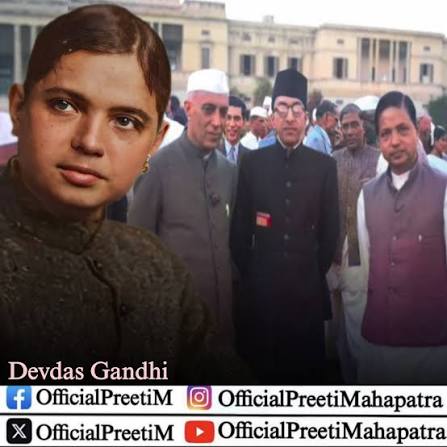
On Gandhi’s birthday, a protest, Laura Loomer and what it means to be a Muslim journalist in India.
I woke up yesterday, after a couple of nights of restless sleep, and headed to a protest in Mumbai on Gandhi’s birth anniversary. By the time I got home, my clothes were soaked with sweat and my phone was full of messages. Somewhere between the heat, the crowds, the shouting and the endless notifications, I realised that I had lived through one of those days that leaves you physically exhausted but strangely unable to sleep.
The protest had been called by student organisations against what they see as corruption by the Election Commission of India and the potential disenfranchisement of millions of voters ahead of the next general election. There were protests in Delhi and Mumbai. In Mumbai, we gathered in the kind of heat that made 41 degrees feel entirely plausible. I spent much of the afternoon perched on a wall with a colleague recording interviews and videos from the protest.
It should have been miserable. Instead, it was exhilarating.
There is something reassuring about being among people who have come out into the streets because they are angry about what is happening to their country. And there was something deeply satisfying about seeing people begin to recognise, for themselves, what some of us had spent more than a decade warning about.
It was heartening to see Gandhi make a comeback among India’s Gen Z. This is a generation that has grown up amid relentless right-wing propaganda against the apostle of non-violence, even as the glorification of his assassin has become increasingly normalised.
It was heartening to see students come out in their thousands on a public holiday, dancing to revolutionary songs, wearing Che Guevara, Martin Luther King Jr. and Gandhi masks. For a few hours, I felt something I had almost forgotten. I came home and opened my phone. While I had been at the protest, much of the Indian right-wing internet, including sections of the mainstream news media, had been occupied with me.
The reason was a tweet by Laura Loomer asking Marco Rubio why I had been given a visa to live in America and why I should not be deported. The irony, of course, was almost too obvious to miss: I live in India.

But that did not stop parts of the Indian right-wing ecosystem from celebrating Loomer. Some prominent Indian television anchors and commentators amplified her attack, presenting it as though an American activist had finally “called out” an Indian journalist.
No one seemed particularly interested in the rather basic question of why someone who lives in India would need to be deported from America. Nor did anyone seem troubled by the fact that Loomer herself has made racist and deeply derogatory remarks about Indians. Not long ago, sections of the same Indian right-wing ecosystem had been condemning her for those remarks. But yesterday, she was a hero.
Why?
Because yesterday, her target was me. a muslim
The idea that I live somewhere in America and spend my time criticising India from afar has been a persistent myth about me. Anyone who has actually followed my work knows how absurd it is. But the factual error was almost beside the point.
What mattered was why she had singled me out in the first place, and why her attack was so readily embraced as an indictment of my journalism.
The tweet that had prompted her attack was about Narendra Modi and Benjamin Netanyahu, and what I see as a common thread in their politics and among their supporters: a deep hostility towards Muslims. I had written it after seeing Indian users celebrating the killing of a Palestinian journalist, and after watching the response to the FlyDubai incident involving an Indian pilot, where Netanyahu’s intervention was being used by sections of the Indian right to turn an individual incident into yet another occasion for vilifying Muslims.
The argument was not particularly original. People have made it before. But the reaction to my tweet was enormous. News channels were asking whether I wanted to respond to Loomer. Relatives were checking in. My name was circulating in memes and WhatsApp groups. My timeline had become a stream of abuse. I have lived through this before.
But something about yesterday felt different. Perhaps it was because of where I had just been. A few hours earlier, I had been standing in a crowd on Gandhi’s birthday, watching young Indians come out into the streets to protest what they saw as an attack on their democracy. I had spent the afternoon in the heat, surrounded by people who did not know me and had no reason to care about me. For those few hours, none of that mattered. We were simply there together.
And then I came home and was reminded that, to some people, my Muslimness will always be the first thing they see. The examples were not subtle.
An Indian right-wing commentator speculated about my supposed terrorist inclinations. Another news anchor asked why I did not move to Pakistan. My inbox filled with explicit rape threats and messages calling me a traitor. A well-known “liberal” journalist analysed my tweet and concluded that I had brought the abuse upon myself, suggesting that the least I could have done was post something expressing solidarity with the Indian pilot and the Jews on board the FlyDubai aircraft.
One news clip placed my image alongside visuals of the September 11 attacks, asking in Hindi whether this was what Rana Ayyub wished for India. It has been viewed more than a million times. Among the comments was one from a former colleague.
Another colleague suggested that I post a clarification about my intentions.
I kept thinking about that word: clarification. What exactly was I supposed to clarify?That I am a journalist? That I live in India? That I am allowed to have an opinion about the politics of my own country? That I am Muslim?
I have spent much of my life writing about India because I care about India. That sounds almost embarrassingly obvious to say. But perhaps it needs saying.
I have spent years doing what journalists do: following stories because I believe they matter, going to places because I want to understand them, sitting in courtrooms, at protests, in homes and hospital rooms, listening to people whose lives would otherwise remain invisible.
But somewhere along the way, I have realised that for some people, my Muslimness is inseparable from my journalism. When I criticise the government, they do not see a journalist making an argument about her country. They see a Muslim making an argument about her country. It is a distinction I cannot always see from where I stand. Yesterday, after all the abuse, I found myself thinking about it. Not about Laura Loomer. Not really. I don’t think anyone in their right mind would take Laura Loomer’s commentary seriously.
I kept thinking about the strange fact that I can stand in a crowd on Gandhi’s birthday and feel an almost overwhelming sense of belonging, and then come home to thousands of strangers insisting that I do not belong here. Maybe that is the part I cannot quite shake.
Perhaps that is what I am carrying into this sleepless night.I don’t know what it means to love a country that keeps asking you to prove that you belong to it. I only know that I am still here.