
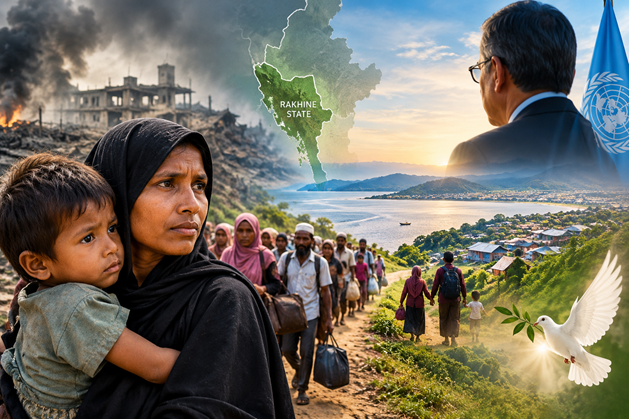
During his visit, Koumjian met with senior Government officials and more than 200 people from Rohingya and other communities living in camps in Cox’s Bazar, including many who fled from Myanmar in the past two years.
“The Mechanism is investigating allegations of very serious international crimes that are currently being committed in Rakhine State by perpetrators from different ethnicities, religions and political affiliations. Many Rohingya shared with me their recent and traumatic experiences that drove them to seek refuge in Bangladesh, and these testimonies are crucial to furthering our investigations,” said Koumjian.
More than 154,000 Rohingya have arrived in Cox’s Bazar since early 2024 to escape the violence committed against them during the ongoing conflict between the Arakan Army and the Myanmar military. The number of displaced Rohingya in Bangladesh now exceeds 1.2 million.
During his visit, Koumjian met with senior officials, including His Excellency Mr. Salahuddin Ahmed, Minister of Home Affairs; His Excellency Mr. Asadul Habib Dulu, Minister for Disaster Management and Relief; His Excellency Mr. Humayun Kabir, State Minister for Foreign Affairs; His Excellency Mr. Asad Alam Siam, Foreign Secretary; and Major General Mohammad Ashrafuzzaman Siddiqui, Director General of Border Guard Bangladesh.
Koumjian expressed his profound gratitude to the Government of Bangladesh for its continued cooperation with the Mechanism and for facilitating its investigations into serious international crimes committed in Myanmar. He also expressed appreciation for the cooperation and support provided by the Refugee Relief and Repatriation Commissioner (RRRC) and the Camp-in-Charge (CiC) offices in Cox’s Bazar.
“The current situation in Rakhine State is a major concern for everyone I spoke to,” said Koumjian. “Ending the violence against civilians and pursuing justice for these crimes are critical steps to ensure that Rohingya communities can return home safely and sustainably. Only then can the process of rebuilding begin for all communities in Rakhine.”
Koumjian’s visit comes as the International Court of Justice (ICJ) considers the case concerning Myanmar’s obligations under the Convention on the Prevention and Punishment of the Crime of Genocide. The Court is deliberating on whether Myanmar failed to comply with its obligations to prevent and punish genocide against the Rohingya in 2016 and 2017, with a decision expected in the coming months.
The Independent Investigative Mechanism for Myanmar (IIMM or Mechanism) was created by the United Nations Human Rights Council in 2018 to collect and analyse evidence of the most serious international crimes and other violations of international law committed in Myanmar since 2011. It aims to facilitate justice and accountability by preserving and organizing this evidence and preparing analysis that can be used by authorities to prosecute individuals in national, regional and international courts.
For more information, visit iimm.un.org or contact iimm@un.org.
Facebook: @MyanmarMechanism LinkedIn: @MyanmarMechanism