
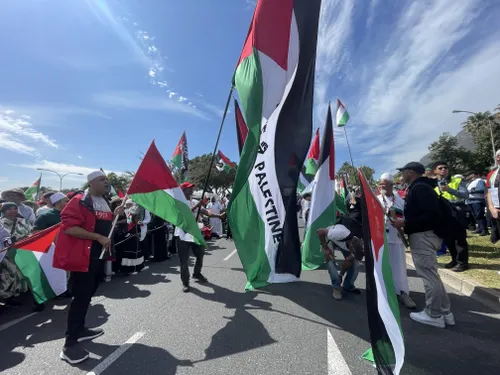
By Sõzarn Barday
Who gets to move in search of a better life, and who is left fighting to remain on the land they call home? Cape Town’s semigration debate raises uncomfortable questions about land, political power and belonging—questions that take on a different urgency in Palestine.
Cape Town has become a destination of aspiration. For some, it offers economic opportunity, better municipal services and an escape from the frustrations of life elsewhere in South Africa. For others, it is home: a place where generations have built communities while struggling against inequality and the rising cost of living.
These experiences exist side by side, but they do not carry equal weight. Those arriving with substantial capital can often choose where to live. Existing residents may have little choice but to move further away as property prices rise and neighbourhoods change.
This is not simply an argument about migration. It is a question of power: when a place becomes desirable to those with money and political influence, what happens to the people whose lives are already rooted there?
In Palestine, the question of who gets to arrive and who has the right to remain is inseparable from a history of settlement, territorial control and Palestinian dispossession. Cape Town’s semigration debate unfolds in a fundamentally different legal and political context, but both invite scrutiny of how power shapes land, belonging and the future of existing communities.
When a city markets itself
In my earlier article, “There’s a New Movement in Town — Aleinu,” printed in Muslim Views in 2024, I examined the so-called “Good Hope rush”: efforts to encourage Jewish South Africans, particularly those in Johannesburg, to relocate to the Western Cape, promoted by the Cape South African Jewish Board of Deputies and publicly endorsed by Cape Town Mayor Geordin Hill-Lewis and Western Cape Premier Alan Winde.
The campaign’s stated objectives are important to understanding its political significance. As I noted in my earlier article, Cape SAJBD Executive Director Daniel Bloch described the plan as being “to keep South African Jewry strong”. The organisation also stated that the initiative would help ensure that the Jewish community remained “stable and sustainable” while allowing the Cape’s community to grow. These statements frame semigration not merely as individual relocation, but as a collective effort to sustain and expand a particular communal presence in the Western Cape. The question is what happens when such efforts intersect with a city already struggling with unequal access to housing, land and opportunity.
The deeper question is not simply who chooses to move, but who has the institutional power to turn individual movement into a political project. Relocation campaigns do more than describe a place as desirable; they can help shape who imagines themselves belonging there and what future they expect the city to offer them. That is why such campaigns deserve scrutiny in a city still confronting the consequences of dispossession and spatial segregation.
These questions become especially significant when the campaign is considered alongside the politics of Zionism and the struggle over land in Palestine. Zionism’s project of establishing a Jewish national home developed in a territory already inhabited by Palestinians, whose claims to land and self-determination were increasingly subordinated to that project. The history of Palestine demonstrates why settlement cannot always be understood as a neutral matter of individuals seeking a better life. It can also form part of a wider political project that changes who controls land, whose presence is prioritised and whose rights are marginalised.
Cape Town is not occupied Palestine, and semigration within South Africa is not equivalent to the displacement of Palestinians. Nevertheless, the political promotion of relocation deserves scrutiny, particularly in a city marked by severe inequalities in housing, land ownership and access to opportunity. Who is encouraged to come? What interests are being advanced? And where does the future imagined by political and community institutions leave those who already call the city home?
The issue is not that Cape Town attracts newcomers or investment, but that the celebration of relocation can obscure the unequal conditions under which people experience the city. For those with capital, moving may represent opportunity; for residents priced out of their neighbourhoods, the same transformation can mean insecurity and exclusion. When political and communal institutions promote relocation, their vision of the city must be considered alongside the rights and needs of those already living there. In a city still confronting the consequences of dispossession and spatial segregation, the freedom to arrive cannot be separated from the question of who can afford to remain.
Palestine and the politics of dispossession
Zionism emerged in nineteenth-century Europe as a movement for Jewish national self-determination, shaped in part by antisemitism and persecution. Its pursuit of a national home in Palestine, however, unfolded in a land already inhabited by Palestinians, who had their own social, political and national aspirations.
During the British Mandate, Zionist institutions acquired land to establish and expand Jewish communities. Some purchases, including transactions involving absentee landlords, resulted in Palestinian tenant farmers losing access to land they had cultivated. Land acquisition was not the whole story, but it formed part of a wider struggle over who would control the territory and determine its political future.
The consequences became catastrophic in 1948. During the genocide surrounding Israel’s establishment, more than 700,000 Palestinians fled or were expelled from their homes. Hundreds of Palestinian villages were depopulated or destroyed, and many refugees were prevented from returning. Known as the Nakba, this mass displacement transformed control over land and left generations of Palestinians in exile.
The genocide and dispossession did not end in 1948. Since 1967, Israeli occupation and settlement expansion in the West Bank, including East Jerusalem, have further restricted Palestinian control over land and fragmented communities. Settlements, associated infrastructure, land confiscation and movement restrictions have undermined Palestinian self-determination.
The violence and destruction in Gaza since October 2023 have prompted explicit findings of genocide by major human rights and international investigative bodies. In December 2024, Amnesty International concluded that Israel had committed and was continuing to commit genocide against Palestinians in Gaza. In September 2025, the United Nations Independent International Commission of Inquiry reached the same conclusion. The International Court of Justice, meanwhile, has ordered provisional measures in South Africa’s case against Israel but has not issued a final judgment on the merits of the genocide allegations. The distinction matters: although the ICJ has not reached a final determination, the genocide findings of these other bodies are explicit, not merely interpretations of the violence.
In its advisory opinion of July 2024, the International Court of Justice separately concluded that Israel’s continued presence in the Occupied Palestinian Territory was unlawful and that it must end as rapidly as possible. The Court also addressed settlement activity and violations affecting the Palestinian people’s right to self-determination.
These findings make clear that Palestine cannot be understood merely as a dispute between competing claims to property. Land is inseparable from sovereignty, freedom and the ability of a people to determine its own future.
No person’s desire for security, a home or opportunity can justify denying another people those same rights. Nor can Palestinian dispossession be resolved through economic development alone. A people cannot be compensated for the denial of political freedom by being offered commercial opportunities elsewhere.
The view from South Africa
South Africa’s history makes these questions especially difficult to ignore.
Apartheid was a political and legal order that controlled where people could live, where they could work and how they could access land and resources. Its legacy remains visible in South African cities, where wealth and opportunity continue to be separated from many of the communities that sustain urban life.
Cape Town cannot be understood outside that history. Its beauty and economic promise coexist with profound inequalities in housing, transport and access to opportunity. The freedom to choose a neighbourhood is not experienced equally by everyone.
The connection with Palestine is not that semigration in Cape Town is equivalent to occupation or forced displacement. The comparison is about the politics of land: how institutions shape ideas of belonging, whose claims to place receive political recognition, and whose interests are prioritised when a territory’s future is being imagined. In Cape Town, these questions arise amid housing inequality and the enduring spatial legacy of apartheid. In Palestine, they arise within the far more coercive realities of occupation, settlement expansion and the denial of Palestinian self-determination. The contexts are profoundly different, but examining them together draws attention to a common question: who has the power to shape the future of a place, and what happens to those whose rights are pushed aside?
South Africa’s solidarity with Palestine should mean more than invoking its own history of oppression. It requires a consistent defence of the principle that people are not disposable, that land cannot be detached from the rights of those who inhabit it, and that political or economic power does not confer an unlimited entitlement to determine another community’s future.
This principle must also be applied carefully. Not every newcomer is an agent of displacement, every property purchase an act of dispossession, or every investment illegitimate. The question is how institutions organise and promote change, whose interests they prioritise, and what happens to those with the least power.
Beyond the language of investment
Investment is often presented as an unquestionable public good. Yet its value should be measured not only by the money it brings into a place, but also by the society it helps create.
Who can afford to live near their workplace? Who is pushed towards the city’s margins? Who benefits from rising property values, and who bears the costs? Does economic growth improve life for existing residents, or deepen the divisions between those who can afford the city and those who keep it running?
Cape Town needs investment, employment and sustainable growth. It also needs housing policies that protect residents, reliable public transport and planning that accommodates people across income levels. Welcoming capital should not mean surrendering the public interest to the property market.
In Palestine, the demands are more fundamental: an end to occupation, an end to unlawful settlement activity, protection against forced displacement and the realisation of Palestinian self-determination. These are questions of rights and international law, not simply economic development.
The contexts differ, but the principle remains important: a just future cannot be built by ignoring the rights of people whose lives and histories are bound to the land.
The right to arrive is not the right to dispossess
There is nothing inherently wrong with moving to Cape Town, establishing a business or seeking a better life. The problem arises when the freedom of those who arrive is treated as more important than the rights of those who remain.
For Palestinians, this is not an abstract concern. Their struggle is not simply to find affordable housing or better economic opportunities. It is a struggle for freedom, dignity and the right to determine their future in their homeland.
For South Africans, the challenge is to recognise that solidarity must be grounded in consistent principles. If we defend Palestinian rights, we must understand why land, home and self-determination cannot be reduced to questions of market value or political convenience.
A city should be able to welcome newcomers without making existing residents strangers in their own neighbourhoods. A people should not have to watch their homeland become a place over which they have no meaningful control.
The right to arrive matters. But it cannot cancel the right to remain.
And in Palestine, that right must mean more than survival under occupation. It must mean freedom.
Sõzarn Barday is a lawyer and author who writes on human rights, international law and public policy. The views expressed are her own.