
By Hassen Lorgat
Paula Slier, a veteran journalist who has been in the trenches, has nonetheless surprised me—and, I suspect, many others—with her latest piece, headlined “Nobel Prize for Pillay: Applause from the Wrong Side.“
The headline, delivered without irony, fails to read the room and implies that Judge Pillay’s detractors constitute both the moral and numerical majority. She is wrong on both counts. Many South Africans celebrate the fact that so many of their fellow citizens have been recognised as champions of peace:
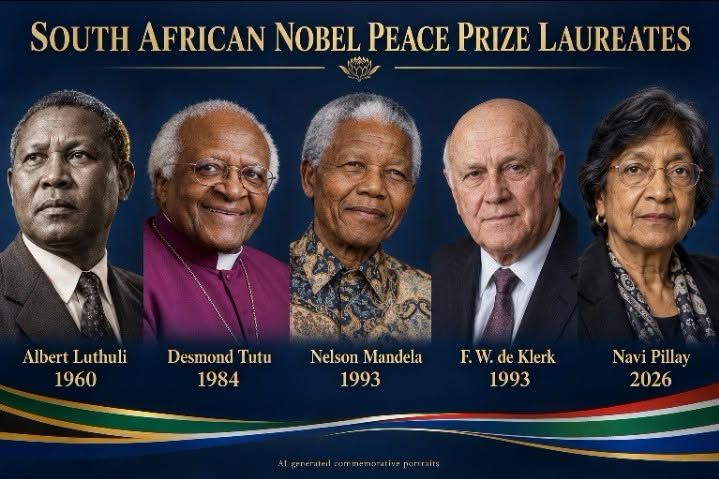
Chief Albert Luthuli (1960)
Archbishop Desmond Tutu (1984)
Nelson Mandela (1993, jointly)
F.W. de Klerk (1993, jointly)
Judge Navanethem “Navi” Pillay (2026)
In celebrating Judge Pillay’s laureateship, I do not for a moment believe that the Nobel Committee that awarded the prize is apolitical. Far from it: just a year ago, we saw its unpopular choice of Peace Prize winner widely criticised—by this writer, among others, and, for different reasons, even by President Trump.
From the outset, the noble profession of journalism was compromised, as the headline underwrote her editorial judgment. Her piece frames the South African government and those who rejoice in the newly anointed Nobel laureate, Judge Navi Pillay. When Hamas congratulates the judge, a tone of suspicion is cast, and once again the country and its people are relegated to the naughty corner of democracy.
This is a hit piece, and let me explain briefly why it is so—and, in passing, point out that Hamas is not a proscribed political organisation in South Africa and could easily have been reached for comment. Here are other additional issues important to this discussion:
It appears that this is the first piece in which Slier has written about the Nobel Peace Prize, and she did not write about the so-called Venezuelan opposition leader María Corina Machado, who won in 2025. But she did not have to do any bidding for Israel or its supporters, as Machado did it herself. After receiving praise from Netanyahu after she called him, Machado framed the international struggle by saying that Venezuelans “deeply value peace” and know it “requires immense courage, strength, and moral clarity to stand against the totalitarian forces that oppose us.” She linked Iran to the Maduro government and to groups like Hamas, Hezbollah, and the Houthis, calling it evidence of “the global nature of the struggle between freedom and authoritarianism.”
In this short piece, Slier frames or targets Hamas as the arch-enemy. Hamas is mentioned 19 times in a short piece—excluding the screenshot from Hamas—only to be superseded by the supposed victim, Israel, whom she repeats 25 times. It is not that the numeracy outweighs the literacy of the alphabet, as we have to go to the adjectives that accompany those nouns, Hamas and Israel.
If truth has to be told, these words do not speak for themselves; it is how they are used and manipulated. In the opening, the South African president’s praise of jurists is neutered by Slier when she writes that “However, congratulations also came from the terrorist organization Hamas, and for entirely different reasons.” Further down the article, she develops the argument by detailing that in welcoming the award, “the terrorist organisation praised Pillay’s defense of ANC activists during apartheid” as well as her UN leadership role investigating Israel. She explains that “By linking the two, Hamas portrayed the prize as further validation of its accusations against Israel.”
Praise for mentioning Palestinian/s is whittled away when the article raises it in the context of both-sidesism. Menachem Rosensaft, she writes, acknowledges both the suffering of Palestinian civilians and the possibility that Israel may have violated international law. His objection is that the report assigns almost all responsibility to Israel while not adequately addressing Hamas’s role in the conflict.
All the above was employed as proof that the award was tainted, and the whole house was constructed around these foundations. But what are the implications for journalism?
It is a case, as is evidenced in most mainstream media in the world, that there is a league or log of top deserving victims or survivors, or a hierarchy of the sufferings which she buys into.
Slier’s choice of words is not innocent but is employed to serve an argument that undermines discussion and collegiality. It affirms a viewpoint of supremacy: massacre, atrocities, and hostage-taking have a force of dominance that she wanted to portray when she chose members of the same tendency as her guests to be interviewed.
“Massacre” is the strongest. It names a deliberate killing of defenceless people. Applied to October 7, and from there we have a perpetrator of violence and the violated, and readers are hooked into supporting the victims.
Outside a wider context, it is clear who is called on for sympathy and who has the right to exist, defend itself, and so on. “Atrocities” falls into the same category but is not as strong as massacre.
This verb [hostage-taking] is followed by another action by Hamas, that of “hostage-taking.” On face value it is a neutral term or concept, but when one realises that it excludes the Palestinian prisoners, hostages, and captives (charged or non-charged) and the deceased Palestinians who are still kept by Israel for various reasons, including bargaining with Palestinians at a future date. This I have written about elsewhere as well as here.
The Israeli human rights NGO Btselem confirms that “at the end of June 2026, the Israel Prison Service (IPS) was holding 9,187 Palestinians in detention or in prison on what it defined as “security” grounds, including 1,554 from the Gaza Strip. At that time, the IPS was also holding 2,075 Palestinians, 27 of them from the Gaza Strip, for being in Israel illegally.
All of the above served at various times as slogans (and moral authority) that mobilised for war on Gaza: if the hostages are not released, they have massacred us, we have the right to defend ourselves—to quote a movie, granting them a license to kill.
What’s on the other side?
Now look at how Palestinian death appears in Slier’s text:
“the conditions imposed on the Palestinian civilian population”
“the suffering of the Palestinian civilian population”
“the possibility that Israel may have violated international law”
This passivity and neutrality in the reporting of Palestinian victims is confirmed by other studies. Take a look at these sentences: suffering (not imposed by anyone) and putting in doubt whether “Israel may have violated international law….” If only Slier had named the ICJ and ICC cases, it would have helped a wee bit, but she did not dare.
This is replicated in many countries. A German study, aptly entitled “Hierarchies in Death: Coverage of Palestinian and Israeli Victims in the Context of October 7 and the War on Gaza,” found these asymmetries in coverage: Israeli victims are humanised with personal, emotional stories, while Palestinian casualties are reduced to statistics and war side-effects. This disparity raises serious ethical questions for journalists and the media in general as to their role in shaping public empathy and mourning, which I believe shapes their view on the question of whether what is happening in Palestine/Gaza is a genocide or not.
The Centre for Media Monitoring’s 2025 report, BBC on Gaza-Israel: One Story, Double Standards, analysed over 35,000 BBC items from October 2023 to October 2024 and concluded that BBC coverage was systematically biased against Palestinians. They found that Israeli deaths were given 33 times more coverage, per fatality, and significantly more emotive language. I will share the headings of the findings here, as they seek to further explain the findings, but space does not permit me to go through them in detail; you must go to the link below to follow the report:
Key Findings headings:
-Palestinian deaths treated as less newsworthy
-Systematic language bias favouring Israelis
-Suppression of genocide allegations
-Muffling Palestinian voices
Journalism for hire?
Slier’s opening pits Hamas alongside the South African government, and from thereon—journalistically speaking—it was all downhill.
The second failing of Paula Slier’s piece is that she falls foul of cherry-picking journalism by choosing to interview people who confirm her point of view, or agenda. Whilst this point of view is shared amongst four people, excluding herself, it does not cut it. She interviewed:
-Adam Charnas – South African Jewish Board of Deputies
-Michael Bagraim – Jewish community activist, former SAJBD board member and its president. He serves as a Member of Parliament (MP) in the National Assembly for the Democratic Alliance (DA), a position he has held since 2014.
-Menachem Rosensaft – former World Jewish Congress chief legal officer
-Dr. André Thomashausen – international law professor critical of the genocide finding
So, she interviewed four people from the same side of the mouth; this does not lead to eloquence, or veracity. Every single voice she interviewed is either directly affiliated with Israeli advocacy or critical of Pillay’s findings. Dr Thomashausen’s views on the genocide in Palestine were clear from the outset. Two years ago, in this television debate with Naeem Jeenah, he revealed his political allegiances in various debates.
There is no Palestinian voice, let alone a request for comment from Hamas, or from advocates for Palestinian liberation. Nor is there the South African government voice defending its statement of support for Judge Pillay, nor any of the thousands of professors out there who support the Pillay-led commission’s conclusions. It is clearly not her intention to get comments from the UN commission itself, nor from a spokesperson to support South Africa’s case at the ICJ.
Those on the wrong side, and the left-off side, are outside the page. They are the news not fit to publish.
As indicated, Hamas is not a banned organisation in our country, and she could easily have obtained their voice. But this was not the purpose. It is clear that she did learn that journalists cannot rely on a single source—but she did not bother to look. She made a political choice. This is similar to her reference to the Kothari “Jewish lobby” remark and Pillay’s 2020 petition as evidence of bias, but if she wanted to determine the veracity of their concerns, it is out there, even a phone call away.
The basic test of credible journalism is not only the protection of sources but the presenting of voices that relies on protected and openly acknowledged sources. I wonder whatever happened to the joyous dissent so popularised by activists from so many diverse intellectual traditions?
Good News for South Africa
Whilst Slier’s article pretends to be considered and rational, others in government and civil society were more ecstatic. Speaking through the mouth of Charnas, we read “of the mixed feelings within South Africa’s Jewish community, pride in a South African receiving the honour but dismay over the choice of Pillay.”
The reality is different. It is a deliberate containment strategy, presenting the writer and the person quoted as appearing to acknowledge disagreement while actually subordinating it to a narrative of national pride. This fake dissent is presented as a concession but in reality only to conclude against the learned judge. Thereafter, Bagraim comes in: openly critical. Rosensaft questioned the commission’s treatment of Hamas and the events of 7 October, while Thomashausen challenged its interpretation of genocide, even as he acknowledged Pillay’s important contribution to international justice.
Through the consistent assertion of Hamas in the story the way they did is distraction. It was clearly ideological, which renders all their other caveats redundant. Slier, for instance, writes that the “Nobel Committee recognised Pillay’s decades of legal work, not specifically her investigation of Israel. And Hamas congratulating her does not mean she supports Hamas. But the very different reactions to this award raise questions about the credibility and impartiality of international institutions, particularly when dealing with Israel.”
Yet there is no follow-through. There is no discussion of Israel’s violations of UN resolutions, ICJ recommendations, and even the ICC warrant of arrest for Israeli leaders. I would be foolish to think that Slier would mention the recent exposés about persons spying on UN officials on behalf of the state of Israel?
Through the use of bogus non-governmental organisations such as UN Watch, a body UN staff members consistently given flak to UN staff such as Francesca Albanese, the UN Special Rapporteur on Palestine, and Dr Tlaleng Mofokeng who served as the UN Special Rapporteur on the right to health.
In August 2025, Drop Site News released a story based on hacked emails revealing that Ron Prosor, Israel’s former UN ambassador, routinely gave Israeli diplomats advance notice of incoming UN investigations. Marking one leak “For your eyes only. Do not forward,” Prosor provided Israel early intelligence to lobby against key UN initiatives, including the 2014 inquiry into Gaza. In response, a UN oversight body has launched an investigation to determine if additional UN staff were complicit in the breach.
The Good News Guys saw it for what it was: a moment of pride.
What are the consequences of this form of reporting? It makes all of us readers with views that are more critical dispensable readers and disposable people.
This is a good news story, and relying only on the SAJBD as detractors of human reaction is short-sighted. All these groups that gave their thanks and solidarity to Judge Navi Pillay go unnoticed.
In addition, President Cyril Ramaphosa issued a statement celebrating her service to humanity and impact on global justice. The national parliament formally thanked and congratulated Justice Pillay for her service to the country and humanity. Similarly, his predecessor, the Thabo Mbeki Foundation, echoed the country’s choices for seeing her talents by first choosing her to have a seat at the ICC.
The SA Human Rights Commission stated that they “had the privilege of working closely with Judge Pillay on a number of human rights initiatives and extends its appreciation to her for her steadfast support and contribution to justice and the rule of law. In congratulating Judge Pillay on this significant achievement, it acknowledges that she is justly deserving of the Nobel Peace Prize.”
There were many others whom I must mention simply because the article attempts to minimise the magnitude and dignity of this prize for the person and the country. The Nelson Mandela Foundation sent a congratulatory message honouring her work in promoting peace, whilst the Desmond & Leah Tutu Legacy Foundation acknowledged her historic achievement alongside South Africa’s previous laureates. The Luthuli Museum welcomed Justice Pillay to South Africa’s lineage of Nobel Peace Prize winners. The FW de Klerk Foundation has failed to comment.
Civil society groups were very pleased because she had come from them and thus was rooted in struggle. The legal fraternity was obviously pleased, to put it mildly. Lawyers for Human Rights wrote about her rise from poverty to recognition thus: “From defending anti-apartheid activists in SA to serving in leading international justice roles, Judge Navi Pillay has dedicated her life to advancing human rights, accountability and the rule of law.”They ended: “Thank you for a lifetime of service to justice and humanity. Your work continues to inspire generations of lawyers, activists and human rights defenders.”
The two trade union federations, Saftu and Cosatu, were united in their praise. The South African Federation of Trade Unions congratulates Judge Navanethem “Navi” Pillay and condemns Donald Trump’s response. After the award was announced, he dismissed Pillay as someone “nobody” had heard of, called the decision disgraceful, and complained that the prize should have gone to him. Cosatu went further, saying that this “reaction reveals a disturbing sense of entitlement: when an independent committee honours someone else, Trump attacks the laureate, the committee, and even the country where it is based. A Nobel Peace Prize is not a personal trophy to be claimed by a head of state. It recognises work judged to advance peace and international law.”
SAFTU: The South African Federation of Trade Unions, in congratulating Judge Navanethem “Navi” Pillay, condemned Donald Trump’s response stating that a Nobel Peace Prize is not a personal trophy for heads of state to claim. The federation adds that: “Pillay’s record speaks for itself. She stood against apartheid and went on to serve in international courts and human rights institutions. Her achievement deserves respect, not the spiteful belittling of a leader who believes every honour should belong to him.”
Conclusion
I have used Paul Slier’s article to illustrate how public conversations may or may not be conducted. Journalists cannot assume that all readers share their worldview. Because their task is reporting rather than propaganda, their writing must be humane, just, and truly ethical toward the people it describes.
In this piece, Slier did not even consider approaching the South African Jews for a Free Palestine (SAJFP) for comment—presumably, in her eyes, the only legitimate representatives of Jewish people are the Jewish Board. Had she reached out, they would have commented, as I discovered when I contacted them.
In their 16 October statement, the organisation took issue with Judge Pillay’s detractors, particularly those who sought to label her as antisemitic. South African Jews for Free Palestine condemned the country’s Holocaust and Genocide Centres for refusing to acknowledge genocide in Palestine or permit open public study of it.
The organisation added that Judge Pillay’s Nobel Peace Prize challenges these centres either to remain committed to ignorance or to fulfil their mission of recognising all genocides regardless of the perpetrator. It accuses them of suppressing recognition of Israel’s actions and suggests that, by conflating anti-Zionism with antisemitism, they fear inviting Pillay to speak because of what she would say.
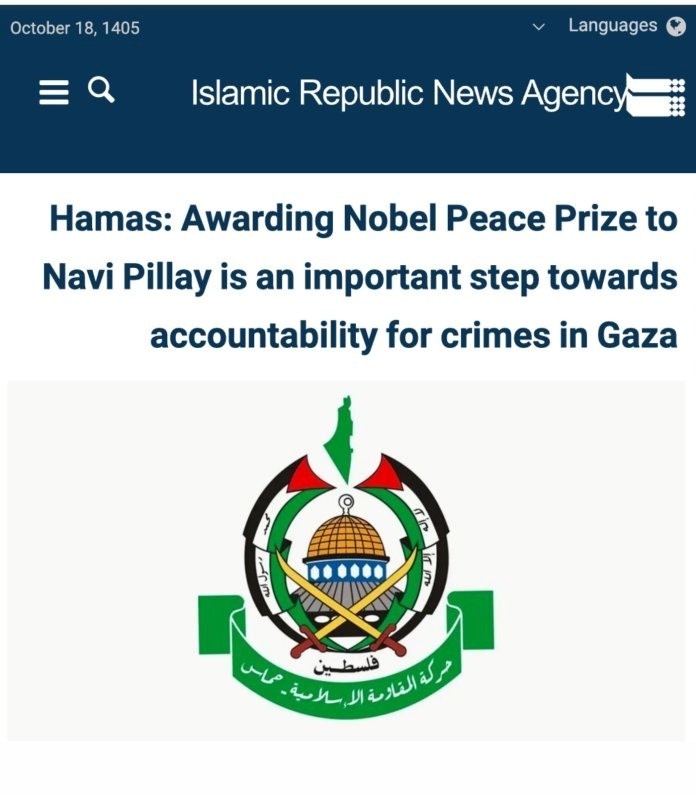
Photo Screenshot IRNA
A list poem: Applause from the wrong side
concluded Israel had committed genocide in the Gaza Strip.
specifically for her research on Israel,
Hamas massacre in Israel on October 7, 2023,
Pillay concluded that Israel had committed
The commission cited Israel’s
statements by Israeli officials as evidence
Israel rejected the findings as false
genocide claim against Israel.
Israel criticized not only the report
a comparison Israel rejects.
South African government brought Israel
acted impartially toward Israel.
sanctions against Israel
questioned Israel’s place at the UN.
criticism from Israel
October 7, the hostage-taking and Israel’s right to respond.
not claim that Israel is above all criticism
and the possibility that Israel may have violated international law.
UN officials dealing with Israel
is not whether Israel should be investigated
UN commission investigating Israel.
against Israel.
accusations against Israel.
Pillay’s record regarding Israel and antisemitism
Hassen Lorgat
(Not my poem)