
By Mohamed Ousman
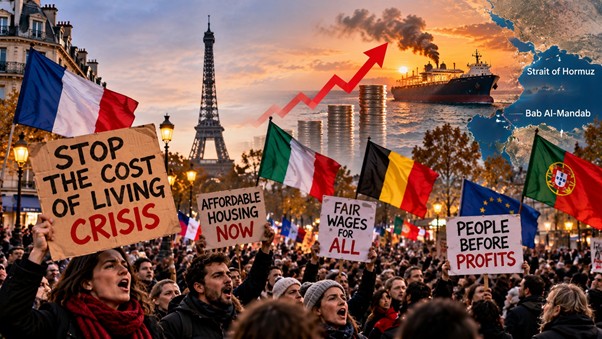
In France, Italy, Belgium, Portugal and Albania, there exists non-identical economic grievances, pressures and dissatisfaction with public policy.
Nevertheless, they expose a shared tension: economic systems may generate substantial aggregate wealth but ordinary people cannot afford the necessities of life.
The cost-of-living protests reflect mounting frustration over the affordability of essentials.
When wages fail to keep pace with prices, households experience declining purchasing power, while economic insecurity deepens existing inequalities.
Protests can unite affected groups, but their impact depends on organisation, demands and leadership.
The zionist-imperialist imposed war on Islamic Iran disrupted oil flows thereby demonstrating how geopolitical instability transmits costs across global markets.
The protests coincide with the closure of the Straits of Hormuz and Bab Al-Mandab by the Islamic Republic in Iran and Ansar-Allah respectively.
The Iran-led Islamic Resistance allied with Yemen’s Ansar-Allah challenge the geopolitical arrangements underpinning western hegemony over energy supplies and regional security.
Disruption to oil shipping has increased energy costs, intensified inflationary pressures and exposed western economies to geopolitical vulnerability.
Imam Muhammad Al-Asi’s Qur’anic framework: Economic hardship as a crisis of social order
Al-Asi’s framework interprets economic unrest beyond immediate price increases. The central question is not merely whether governments can restore stability, but whether the economic order distributes wealth, resources and political power justly.
This perspective connects material deprivation with the Qur’anic critique of greed, concentrated wealth and social arrangements that normalise exploitation (Al-Āsī, Muhammad: The Ascendant Qur’an: Realigning Man to the Divine Power Culture. Vols 1-12. ICIT, Toronto (2008-2024)).
Al-Asi’s critique of capitalism is particularly relevant.
He argues that society must transform its attitudes towards wealth and establish “equitable wealth management and distribution” as its norm.
His objection is not simply to individual extravagance; it concerns a structural arrangement in which wealth accumulation becomes detached from social responsibility.
The protests can be read as symptoms of a crisis in the legitimacy of economic institutions when essentials become increasingly inaccessible.
Al-Asi states that the capitalist system cannot be displaced by abstract arguments, temporary reactions or a coup d’état alone.
The distinction between protest and sustained transformation is fundamental. Al-Asi emphasises “a massive change in the social attitude of the people.”
This challenges two inadequate responses to the protests.
The first is the governmental assumption that restoring public order resolves the underlying crisis.
The second is the belief that protests constitute revolutionary change.
Neither follows logically: a protest may expose an injustice without changing the institutions that reproduce it.
The political test is whether collective mobilisation develops a coherent programme for affordable necessities and accountable economic governance.
It must also confront the concentration of ownership and the power of financial interests over public priorities.
Al-Asi’s argument does not negate every proposed anti-capitalist programme, nor judge every movement using revolutionary language as insincere.
Rather, it provides a criterion for evaluating political alternatives: do they change the moral assumptions and the distribution of resources governing economic life, or merely replace one set of administrators with another?
Al-Asi warns that western civilisation can experience profound spiritual and social disorientation despite its claims to rational inquiry.
He writes that the western mind has investigated everything except the Qur’an.
He raises a useful question about political purpose: can movements identify what they oppose without clarifying the social and ethical order they seek to establish?
Anti-capitalist mobilisation may identify genuine inequalities while leaving unresolved questions about human purpose, responsibility, consumption and the distribution of power.
The distinction matters when Leftists participate in protests associated with anti-Imperial resistance.
Political claims should be evaluated by their actual commitments, institutional proposals and consequences.
Al-Asi emphasises patient tabligh—dialogue and deliberation—alongside preparation for a strategic struggle.
Its relevance is methodological: durable change requires political education, organisation and strategic preparation, not simply the intensification of anger.
Al-Asi’s discussion also offers an alternative to the possessive individualism he criticises.
He argues that voluntary redistribution can bring society closer together, describing assistance to those in need as a means of creating a “cooperative and accommodative family.”
Applied to the protests, this suggests that solidarity must be institutional and emotional. Public budgets, taxation, social protection and ownership arrangements become questions of moral responsibility.
Charitable assistance may relieve suffering, but enduring justice requires policies that address exploitations, insecurity and unequal access to essentials.
The Qur’anic framework thus challenges both market absolutism and superficial gestures of solidarity.
A society cannot credibly celebrate prosperity while treating widespread insecurity as an acceptable externality.
Nor should compassion be confined to national or ethnic boundaries when economic interdependence connects populations across artificial borders.
The oil weapon and the limits of material leverage
Its underlying argument is that energy-producers possess material leverage but often fail to employ it collectively against injustice.
Read through Al-Asi’s framework, this proposal raises an important question about the political purpose of natural resources. Oil is not merely a commodity generating revenue; its production, pricing and distribution affect employment, transport, food costs and industrial activity. Energy policy therefore has ethical and distributive consequences.
However, strategic leverage should not be confused with a guaranteed outcome.
Higher energy prices can burden lower-income households, including people with no influence over the policies being challenged.
A Qur’anic economic critique must assess both the political effectiveness and the distributive consequences of an oil strategy.
A measure that pressures a government while impoverishing vulnerable populations presents a serious ethical dilemma.
The objective should be the protection of civilians and reduction of structural dependence, rather than economic pain treated as an end.
This may explain why the Islamic Resistance did not hastily close these Straits decades earlier despite the zionist-imperialists’ long history of wholesale killing of Muslims, Palestinians included.
Finally, Al-Asi cautions against making worldly victory the ultimate measure of faithfulness.
In this framework, struggle must retain ethical integrity even when it yields neither immediate success nor material reward.
The protests challenge economic inequality, but their direction remains contested.
Through Al-Asi’s framework, the decisive question is whether popular discontent develops into a just system of resource distribution and collective responsibility assessed by their means, their social consequences and the just order they seek to create.
Imam Zafar Bangash’s Seerah framework and the Covenant of Madinah: From protest to organisation
Bangash’s Seerah-based analysis examines the protests through the relationship between principled leadership, community formation, strategic patience and the construction of an alternative social order (Bangash, Zafar: Power Manifestations of the Sirah. Toronto: ICIT. (2011)).
The Prophet’s migration supports this approach: the Hijrah was not an impulsive retreat caused by exhaustion, but a strategically prepared transition towards a viable base for the establishment of Islam.
Applied to contemporary protests, this distinction separates spontaneous protests from sustained political organisation.
Protests can expose injustice, but enduring change requires preparation, collective discipline, leadership and institutions capable of translating grievances into a programme.
The lesson is that strategic transitions require more than public anger.
The Covenant of Madinah (pp.89-190) established an organised political community whose constituent groups assumed defined responsibilities within a shared civic arrangement.
Its significance lies in demonstrating that solidarity must be expressed through obligations, institutions and an identifiable framework for coexistence.
Applied to the protests, this raises three questions.
First, what obligations do governments and economic institutions owe people struggling for basic necessities?
Second, how can diverse social groups cooperate?
Third, what institutions could guarantee accountability and equitable access to resources after protests subside?
The Covenant emphasises organised responsibility as a useful analytical contrast with fragmented movements that share grievances but lack an agreed political destination.
The Prophet’s emphasis on patient tabligh reinforces the importance of persuasion, preparation and strategic timing.
A movement’s strength should therefore be measured not by size or confrontation, but by its capacity to build durable solidarity, protect vulnerable people and articulate credible institutional transformation.
The Seerah framework emphasises strategic preparation; the Covenant of Madinah highlights organised responsibility.
Together, they direct attention from protest as an event towards the difficult work of building a just and sustainable social order.
Dr. Kalim Siddiqui’s Islamic Movement Theory: From protest to organisation
Siddiqui’s Islamic Movement Theory provides a framework for examining the difference between ordinary opposition and a movement seeking fundamental transformation (Bangash, Zafar (ed): In Pursuit of the Power of Islam: Major Writings of Kalim Siddiqui. Toronto: The Open Press (1996) & Siddiqui, Kalim: Stages of Islamic Revolution, The Open Press, London (1996).
Applied to the protests, it asks whether popular discontent remains confined to demands for economic relief or develops into a coherent challenge to the assumptions, institutions and power relationships governing society.
The distinction is important.
Calls for lower energy prices can secure improvements without changing the political economy responsible for persistent inequalities. Conversely, a movement’s claim to revolutionary purpose does not establish that its analysis is correct or its proposed alternative is just.
The Islamic Movement perspective places emphasis on ideological clarity, historical consciousness, leadership and collective organisation.
The protestors share some grievances, but constitute separate mobilisations shaped by national circumstances.
Shared economic hardship alone does not constitute a unified political movement.
This distinction also informs the comparison between Islamic resistance associated with Iran and Ansar-Allah, on one hand, and anti-capitalist organisations, on the other.
Their objectives, political traditions and strategic methods do not coincide.
Some Leftists may oppose western intervention and economic exploitation; others may prioritise domestic redistribution, electoral reform or labour rights.
The protests do not establish convergence on a commonly framed struggle.
Siddiqui’s framework nevertheless encourages scrutiny of political dependence and the capacity to define an independent programme.
If a movement can articulate what it opposes but cannot specify the institutions, ethical commitments and economic arrangements it would establish, its transformative potential remains uncertain.
This reinforces a related theodological challenge: materialist civilisation provides neither lasting purpose nor social cohesion.
Within an Islamic analysis, this invites debate about whether economic justice should be grounded exclusively in material welfare or combined with accountability to Allah and obligations towards humanity.
Siddiqui’s Islamic Movement Theory directs attention towards theodological coherence, independent organisation and the construction of an alternative worldview.
Its critical contribution is to ask whether protest produces lasting institutional change.
These three frameworks converge on a central distinction: economic unrest creates a political opening, but it does not determine who will shape the outcome.
Al-Asi foregrounds distributive justice and moral transformation; Bangash’s Seerah and Covenant framework emphasise strategic preparation and communal responsibility; Siddiqui’s theory examines ideological coherence and movement-building.
Together, they critically examine capitalism, energy dependence and political organisation without assuming that every protest invoking resistance necessarily advances justice.
The strongest application of these frameworks would assess concrete outcomes: whether essentials become affordable, whether wealth and resources are distributed more equitably, whether political institutions become more accountable, and whether the means used to pursue change protect rather than sacrifice vulnerable populations.