
The movement and the struggle
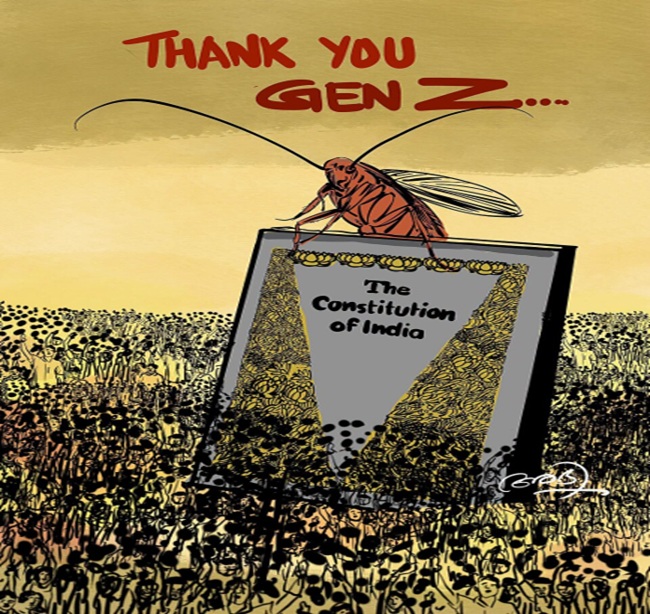
Unrest had been building for much longer, but the spark that lit the fuse back in May was a virtual congregation of Gen Z cockroaches. Chief Justice of India Surya Kant had likened the country’s unemployed youth to ‘cockroaches and parasites’ who attack the system, drain resources, and contribute nothing. The next day, a 30-year-old PR graduate from Boston University, Abhijeet Dipke, wrote a public response: “If the system calls us cockroaches, then cockroaches we will proudly become. Resilient. Unkillable. Everywhere. Presenting the Cockroach Janata Party (CJP).” He did not create the anger––he recognised it, packaged it and gave it a face. Within a week, hundreds of thousands had signed up. Their satirical Cockroach Manifesto offers a glimpse into the mindset and methods that triggered the insurrection now raging across India.
A few weeks later, the ‘cockroaches’ joined university students and others at Delhi’s Jantar Mantar to demand government accountability for a broken education system that has failed India’s youth: the corruption surrounding paper leaks and other systemic irregularities in high-stakes examinations that have jeopardised the futures of millions of India’s youth, as well as the privatisation of education resulting in the shutdown of over 90,000 government schools previously accessible to the poor, the decrepit state of education infrastructure, and the intrusion of Hindutva values (saffronisation) in a once staunchly secular curriculum. Thousands of students from Jawaharlal Nehru University (JNU), Delhi University (DU) and radical left student unions––notably the revolutionary communist AISA and the progressive/communist SFI, AISF and DYFI, among others––as well as older social activists, participated. The protest lasted for over a month, including a 23-day hunger strike, led by activist Sonam Wangchuk until his health seriously deteriorated. The peaceful protesters were beaten, teargassed, and lathi-charged by the Delhi police, but they stood their ground and retained their humour––singing songs, performing theatre, and cheekily inviting ‘police uncle’ to join them and bring food. Rallies erupted across the country in their support. Many involved had been at the barricades for years, for instance in 2020 against the Citizenship Amendment Act (CAA), which, in tandem with the National Register of Citizens (NRC) was seen as a mechanism for excluding Muslim voters, as well as the farmers’ rallies against privatisation.
It culminated in the government ceding to their demands at the end of July, in particular the resignation of education minister Dharmendra Pradhan. But all the groups involved––the left-wing student unions, the wider radical left supporting them, the CJP, and the centre-left INDIA alliance that leads the Parliamentary opposition––had made it clear they had no intention of stopping there. They’re ultimately gunning for Modi, his Home Minister Amit Shah, and the entire corrupt, neo-fascist and ultra-neoliberal BJP regime. The hollowing out of the education system is far from the only abomination this regime has inflicted, and Pradhan was in any case but one cog in the machine. The current rallies demand the resignation of Chief Election Commissioner (CEC) Gyanesh Kumar based on widespread electoral discrepancies that have enabled the regime to cling to power.
Since July, Gen Z have captured hearts and minds across the generations. Glowing tributes have poured in from veteran journalists––to their determination, resilience and liveliness, their nonchalance and insolent humour in the face of repressive authority, as well as their socioeconomic, political, legal and cultural savvy. After attending a rally, Mukul Kesavan wrote, “The young redeem us. The cockroach insurrection isn’t quite the French Revolution, but these lines could have been written for it: Bliss was it in that dawn to be alive, / But to be young was very heaven!” Mitali Saran wrote, “The generation scorned as a bunch of snowflake slackers hit the streets with a clarity, bravery, and endurance that nobody anticipated … They are a different species from the uncles in power, and the uncles now know it … Those who stamped India into fear, silence, and political apathy, have successfully politicised an entire generation, and lost the rote obedience of others … This time, as the protest sign says, you fucked with the wrong generation.”
Now the movement is expanding further. Resistance to the Modi-Shah regime, and the erosion of its legitimacy, spring from far more than the broken education system. The ‘vote theft’ and election fraud that underlie the current phase of the agitation, together with police brutality, media capture and crackdown on independent outlets and dissenters’ indefinite incarceration without trial, signal the breakdown of India’s democracy itself. But the combined onslaught of fast-track neoliberalism and neo-fascist Hindutva supremacy has been equally devastating: measures to disempower the country’s vast Muslim population, Dalits and other marginalised groups, widespread youth unemployment and skyrocketing inequality between the country’s poor and working class, and its super-rich pampered by the regime’s crony capitalism and collusion with corrupt billionaires like Adani, Goenka and Ambani. Tribal and farming communities’ land rights are violated and ecosystems destroyed to make room for their client billionaires’ mining mega-projects. Attempts to serve corporate and imperialist interests by deregulating India’s vast agrarian sector, which employs over 60% of its population, especially the rural poor, are ongoing. The malnourished proportion of the rural population has been rising steadily while ‘surplus’ grain is exported or lies around wastefully, and the regime touts its GDP ‘growth miracle.’ Hundreds of millions in public funds are diverted to erecting grandiose statues and memorials propagating Hindutva values. One must add to that the bowing and scraping before thuggish leaders of the imperialist superpower and its satellites, pandering to their interests at the cost of India’s poor while also completely abandoning India’s longstanding tradition of internationalist anti-imperialism, of which the most horrifying example is its current stance on Palestine.
These are some of the grievances that provoked the ‘million mutinies’ now manifesting as one unified insurrection, which also led me to borrow the title of a book written decades ago by V.S. Naipaul. Many of these issues hark back to the last massive popular agitation that united the country: the struggle for freedom from British colonial rule. It is thus not for nothing that the Modi regime is called the ‘Billionaire Raj,’ and protesters evoke memories, slogans and songs from the freedom struggle.
Frantz Fanon’s words feel apposite here: “When we revolt it’s not for a particular culture. We revolt simply because, for many reasons, we can no longer breathe.” The insurrection has galvanised people from across Indian society. From professors, senior lawyers and journalists to labour unions and disenfranchised poor slum-dwellers. From retired civil servants to schoolchildren (Gen A) in towns and villages protesting against teacher shortages and decrepit educational infrastructure. Urban Indians might interpret Fanon’s words literally, as Indian cities have the world’s highest levels of air pollution. As Ajaz Ashraf wrote in August, never before in his tenure has Modi encountered such widespread resistance that transcends the barriers of age, caste, religious, and regional identities.
But Gen Z remain the leaders. And they’ve been beyond impressive, in particular the women who have become the face of this revolution: audacious, eloquent and brave. Every time they leap over police barricades, every time a single girl (different girls at different times) blocks a police van full of detainees, our spirits rise a little higher. Young women from the leftwing student unions are at the forefront. AISA president and JNU doctoral student Neha Bora has had accolades pouring in for her unique brand of intelligent agit-prop, defiance, and humour––playing whack-a-mole with the Delhi Police, dispatching lookalikes to send the police on a wild goose chase. But she is far from alone. DU student and AISA member Anjali has been omnipresent; here’s her analysis of selective police brutality against women. Danish Ali, another JNU doctoral student and AISA member known for her fiery speeches championing the rights of the marginalised, was hospitalised in critical condition while on hunger strike in July; here’s her perspective on the movement. Aishe Ghosh of the SFI has been a familiar figure on the streets since the 2020 student agitation and CAA-NRC protests, when she was brutally attacked by a masked mob. Ratna Singh is the CJP’s indispensable legal head. The grandes dames of the opposition, too, have taken to the streets––from veteran Marxist Brinda Karat and opposition stalwarts Renuka Chowdhury and Mamata Bannerjee to celebrated writer Arundhati Roy, eminent scholars Jayati Ghosh, Zoya Hasan and Nivedita Menon, the prima donna of India’s alternative cinema Shabana Azmi, and Bollywood star Jaya Bachchan.
The revival of Indian secularism––once sacrosanct, now weakened––is another uplifting feature of the movement. It is visible in the huge Muslim presence, also from outside the student community––from scholars, journalists and actors to street hawkers like Mohammad Irfan, whose intelligence and articulate analysis made him an instant celebrity and leader, acclaimed and quoted across the internet. It is visible, too, in slogans such as Modi jab darta hai, Hindu-Muslim karta hai (“When Modi gets scared, he brings on his Hindu vs. Muslim act”), T-shirts proclaiming “I am Fatima, I am Savitri” worn at public discussions, and repeated demands for the release of political prisoners Umar Khalid and Sharjeel Imam.
Memories of the other India
To many of us of an older generation based abroad for decades, who have never lived in Modified India, all this triggers personal memories that were on the verge of being effaced. Memories of our own childhood in a different India: a secular democracy that, despite its many flaws, still aspired to socialist ideals. Nostalgia for a time when India was a leader of the Non-Aligned Movement, and unwavering solidarity with Palestine and revolutionary Cuba lay at the heart of its anti-imperialist stance. Many have forgotten that India was one of only three non-Islamic nations to vote against the partition of Palestine at the UN General Assembly in 1947, the first non‐Arab state to recognize the PLO as legitimate representative of the Palestinian people in 1974, among the first countries to recognize the State of Palestine in 1988, as well as Cuba after the 1959 revolution. The current drastic change of stance is based equally on the Modi regime’s Hindutva policies and its eagerness to pander to American imperialist interests while stamping out Nehru’s legacy of solidarity with Palestine and Fidel Castro’s Cuba. Only last year JNU Professor Emeritus Zoya Hasan wrote that it was not too late for India to return to its principled stance. But that is not likely under the BJP.
Beyond these personal memories lies the collective memory we inherited from previous generations––of a nation (now a subcontinent), and of a struggle waged before our time.
On the eve of the 10 October protest rally, the All India Students’ Association (AISA) shared the following message:
“In 1942, the British tried to crush the Quit India movement by arresting its leaders before dawn, believing a movement dies when its leaders are taken. It did not. The young carried it forward and ended the Raj. Today, Modi-Shah’s playbook is the same: close the roads, call it illegal, detain people before they speak. So our answer will be the same as of the young of 1942.”
These references to India’s freedom struggle––together with the frequent chanting of its slogans and songs, such as Inquilab Zindabad and Sarfaroshi ki Tamanna––evoke that collective memory. We learnt these songs and slogans from our parents and grandparents who had marched for India’s freedom in, before, and after 1942––as my own mother did. Inquilab Zindabad––Long Live the Revolution––was originally popularised by Indian socialist revolutionary and freedom fighter Bhagat Singh, hanged by the British in 1931. The song Sarfaroshi ki Tamanna was written by Bismil Azimabadi in 1921, in remembrance of the 1919 Jallianwala Bagh massacre. The sense of gratification and collective nostalgia on hearing these resound once again through Indian streets, is overwhelming.
The contrasting legacy of the BJP is well known. Its parent Hindutva organisation, the Rashtriya Swayamsevak Sangh (RSS), not only never joined the Quit India and other popular movements against British colonial rule, it collaborated with the British. Ongoing BJP-RSS propaganda campaigns aim to obscure and revise this ignominious legacy by branding the opposition––the Congress and the Left, which led the freedom struggle––as ‘anti-national’ for their secularism.
Another favourite at left-wing rallies in India, especially since 2019, is the poem Hum dekhenge––We shall see––by Lahore socialist poet Faiz Ahmed Faiz. Written later, in 1979, in fury at Pakistan’s ruling military junta, it too evokes that collective memory––though indirectly, by harking back to the freedom struggle during which Faiz had been the beloved poet laureate of the Indian left.
For these reasons it was especially heart-warming to see the enthusiastic messages and videos from Pakistani youth, with whom we share this collective memory and legacy. One wrote, “There is envy here––not a bitter envy, but a longing. We watch your digital space and think of what we could do if our own digital corridors were as wide. We watch the way your civil society shows up for you, and we dream of a day when the youth of the entire subcontinent can stand together, not as ‘Indians’ or ‘Pakistanis,’ but as a people who have been denied a future by the same, old-world politics.” The Indian youth reciprocated with equally warm messages. Our futures, like our pasts, are inextricably intertwined, and Gen Z is capable of putting the subcontinent on a path to peace like never before.
A day of reckoning
Now the movement is demanding the resignation of CEC Gyanesh Kumar in connection with the massive election fraud perpetrated in 2024: procedural irregularities in Kumar’s unilateral decision-making, as well as the removal of over 130 million names from voter lists under the Special Intensive Revision (SIR). It is alleged that Muslims and other minorities, who have largely voted against the BJP, have borne the brunt, and the BJP reaped the electoral benefits in several states. A host of additional electoral discrepancies has been identified: duplicate voters, fake addresses, impossible numbers registered at a single address, invalid photos, and first-time voters registered multiple times.
And the regime is shitting bricks––as its unprecedented reaction to the October protest rallies demonstrates. Thousands were detained by the police between 9 and 11 October: hundreds of student leaders––from the AISA, CJP, and SFI, to name just a few––as well as veteran opposition leaders, and even an entire contingent of protesting Supreme Court lawyers. CJP leaders Abhijeet Dipke, Saurav Das and Ashutosh Ranka were abducted on arrival at Delhi airport before the protests, and were taken into custody thereafter, as was Neha Bora. Over 250 trains coming into Delhi were diverted or cancelled on 10th October, 57 metro stations blocked, 40,000 paramilitary personnel deployed, detainees beaten and especially women harassed, the internet blocked, and the scheduled central venue of Jantar Mantar denotified as a designated protest site, for the first time in thirty years. All this to guard against consummately peaceful protests.
Undaunted, the protesters promptly showed up at multiple venues every subsequent day, defying the police, addressing press conferences, and giving the godi media (lapdog media) a piece of their minds. They were again attacked and detained in police buses, which hundreds of their comrades surrounded and immobilised. With new rallies erupting constantly, updating further would be a futile exercise. It suffices to say the revolution is alive. Hum dekhenge.
But why is the regime going berserk? One obvious factor is the unified, massive nature of this manifestation of collective unrest, the first of its kind in decades. Earlier ones like the CAA-NRC protests and farmers’ rallies (2020-2021) catered to specific groups’ grievances, now incorporated in the larger movement. The CJP’s creative use of internet memes and political satire to mobilise millions of disenchanted youth, the radical left’s enduring presence at the barricades of India’s ‘million mutinies,’ and the centre-left opposition INDIA alliance’s mass base have finally collectively unleashed a force capable of ousting the BJP. Another major factor is that the movement’s new demands put the regime in a double bind. The agitators will not desist until CEC Gyanesh Kumar resigns. But his resignation would imply that elections conducted under his supervision were rigged to favour the BJP, thus delegitimizing Modi’s current tenure. By continuing the oppressive, brutal measures, the regime aims to prevent the insurrection from spreading, at least until December, when the opposition parties begin preparing for Assembly elections. At that point a familiar bugbear of liberal democracy is likely to rear its head, with various factions attacking each other. This is what the regime reckons and relies on to destroy the movement.
Opposition leader Rahul Gandhi cannot afford to forget that the wave he is currently riding was created by the youth. If he squanders this opportunity, he will lose the support of the youth as well as much of the left that backs them. The latter have not forgotten that it was, in fact, under Congress leadership in the 1990s that neoliberalism was allowed to penetrate India, and set the stage for the ascent of the far right, as it has done across the world. But the Congress’ leftward move under his leadership, and his emerging public image as a battle-hardened streetfighting leader––rather than the coddled scion of a political dynasty––offer hope. The fight against fascism is no joke. Effective resistance precludes sniping at each other and thereby reinforcing the divisive tactics of a threatened regime whose media minions thrive on concocting and spurring ‘internal rift’ within the opposition.
After Rahul Gandhi’s meticulous exposé last year of the multiple levels of election fraud perpetrated in 2024, we’d expected all hell to break loose. But it didn’t. The CEC simply dismissed the allegations, saying the concerns should have been raised “at the right time” during the claims and objections period following the publication of voter rolls––an impossibility, as electronic data was not provided, and it took months for the opposition team to scan over a million printed pages pertaining to a single state!
Nothing much happened after that. It felt as though the country had gone to sleep, lulled into a state of torpor, fear and apathy––as it had, really, for a long time.
Well, the slumbering giant has finally awakened. Gen Z woke it up. Thank you Gen Z, from the bottom of our Gen X hearts.
A day of reckoning with the power-hungry neo-fascists is long overdue. But there is now more hope than ever before that it will come soon––on the streets, at the ballot box––or eventually in the 2029 general election. Over half the country’s population of 1.4 billion is under 30. Gen Z is the largest voting bloc.
Inquilab Zindabad!