
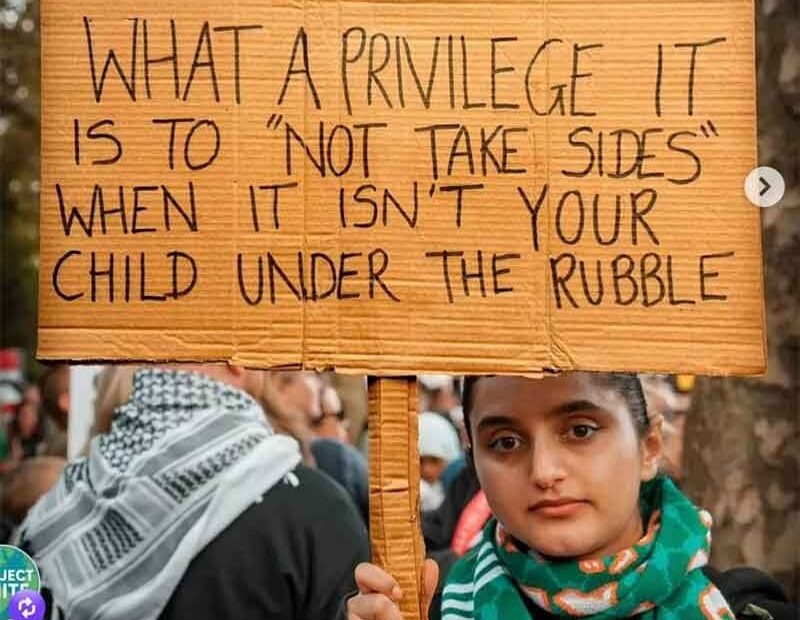
There is something profoundly disturbing about a world that can watch the suffering of an entire population for three years and continue with its business as usual. Gaza is not experiencing a distant humanitarian emergency over which the international community has no influence. It is a human catastrophe unfolding before our eyes, documented by humanitarian organisations, reported by journalists and repeatedly brought to the attention of governments that possess considerable political, economic and diplomatic power. Yet the killing continues, deprivation persists, and the people of Gaza are expected to survive conditions that no human community should have to endure. The question we must confront is no longer simply why Gaza is suffering. It is whether the world has become accustomed to that suffering.
A ceasefire was supposed to offer relief, restore a measure of security and create the conditions for humanitarian recovery. Instead, Gaza remains trapped in a landscape of displacement, destruction and insecurity. The United Nations Office for the Coordination of Humanitarian Affairs reported in October 2026 that Israeli attacks continued to cause civilian casualties despite the ceasefire announced a year earlier. By 19 October, eight children had reportedly been killed and 20 injured in just six days. Since the ceasefire announcement, the reported Palestinian death toll had reached 1,522, with 5,421 injured, according to Gaza’s Ministry of Health figures cited by OCHA. These are not abstractions. They represent human beings whose lives have been taken, families shattered and futures extinguished.
A ceasefire without security
What does a ceasefire mean to a mother who cannot be certain that her children will survive the night? What reassurance can it offer a family living beneath a damaged roof, surrounded by rubble, without adequate food, medicine or sanitation? The diplomatic language of cessation can create an impression that a crisis has passed. For Palestinians, however, the absence of continuous, full-scale bombardment has not translated into safety, dignity or anything resembling a return to normal life.
————————————————————————————————————————–
Read also: UNICEF: Hope amid the Pain — Palestinian Children in Gaza One Year after the Ceasefire
——————————————————————————————————————
The destruction is staggering. A September 2026 humanitarian assessment published by the British government reported that between 77 and 92 per cent of Gaza’s residential units had been damaged or destroyed during the conflict. Up to 90 per cent of the population remained displaced, often living in overcrowded and inadequate conditions. Approximately 2.1 million people inhabit a territory where the destruction of homes, infrastructure and livelihoods has made survival dependent on humanitarian assistance. A ceasefire cannot be considered meaningful if people remain deprived of the material conditions necessary to live.
The cruelty is compounded by the approach of another winter. OCHA estimated in October that approximately 950,000 displaced people were living in sites exposed to medium or high flooding risks, including more than 400,000 facing high risks. Yet available supplies could provide only partial shelter assistance to around 18 per cent of the 294,250 families identified as needing it. People who have already lost their homes are now threatened by cold, rain and flooding. Their suffering is not merely the consequence of past destruction; it is aggravated by the continuing inability to provide adequate shelter and the restrictions and shortages obstructing recovery.
Hunger in a world of plenty
Food insecurity exposes the contradiction at the heart of the international response. The world possesses the resources, agricultural capacity and logistical expertise to prevent mass hunger. Yet in Gaza, food remains uncertain, household purchasing power has collapsed, and humanitarian supplies are insufficient to meet basic needs.
————————————————————————————-
Also read: UN OCHA: Humanitarian Situation Report, 29 October 2026
————————————————————————————–
An October OCHA report recorded a decline in daily cooked-meal production from approximately 695,000 to 614,000 because of funding constraints. Monthly food distributions were covering only about half of minimum caloric requirements, while many families depended on irregular assistance. Nearly half of households surveyed in September reported having gone to bed hungry at least once during the preceding month. These figures describe a population surviving on the precarious margins of subsistence, not a society recovering from war.
Children bear a particularly brutal share of this deprivation. UNICEF reported in October that more than 340 children had been killed and over 600 injured since the ceasefire began. Approximately 800,000 children remained displaced, while an estimated 60,000 had lost one or both parents. Children need food, protection, education, play and the assurance that tomorrow will arrive without another catastrophe. Gaza’s children are being denied these elementary conditions of childhood. Their trauma will not end simply because international attention moves elsewhere.
The international community’s moral failure
Why has this suffering failed to produce an international response proportionate to the catastrophe?
Governments issue statements, express concern and convene meetings. Humanitarian agencies issue warnings that are meticulously documented and repeatedly ignored. Diplomatic initiatives are announced, while the fundamental conditions required for Palestinian survival remain precarious. The distance between declarations and action has become one of the defining scandals of this crisis.
The problem is not that the international community lacks information. It is that knowledge has not consistently translated into effective action. Governments capable of applying diplomatic pressure, reconsidering military cooperation, enforcing relevant legal obligations and demanding unrestricted humanitarian access have frequently chosen caution over confrontation. Political alliances and strategic calculations continue to influence responses to violations of international law.
This is not a failure of humanity in the abstract. It is a failure of political responsibility by identifiable governments and institutions. The distinction matters because indifference must not become an excuse that allows those with power to escape accountability.
International law cannot be invoked selectively. The protection of civilians, access to humanitarian relief and accountability for alleged violations cannot depend on the identity of the perpetrator or the geopolitical value of the state concerned. Governments have obligations under international law; they must act consistently with those obligations rather than treating them as optional principles.
Have we become immune to Palestinian suffering?
There is a danger that repeated exposure to images of dead children, destroyed neighbourhoods and exhausted families will dull the world’s moral reflexes. The extraordinary becomes routine. Yesterday’s outrage becomes today’s headline, and today’s headline disappears beneath tomorrow’s political controversy.
But we must distinguish between the public’s possible exhaustion and the deliberate political choices that allow suffering to continue. Millions of people around the world have demonstrated solidarity with Palestinians. Civil society organisations, humanitarian workers, journalists, students and ordinary citizens have refused to accept the erasure of Palestinian suffering. Their persistence proves that compassion has not disappeared.
The more troubling reality is that public concern has not been translated into sufficient political pressure to change conditions on the ground. Governments can acknowledge the suffering while continuing policies that fail to prevent it. Expressions of sympathy become hollow when they are not accompanied by measures capable of protecting lives.
The media, too, faces a responsibility. Gaza cannot be covered only when a particularly horrific incident occurs. The slow violence of displacement, malnutrition, untreated injuries, psychological trauma and the destruction of education deserve sustained attention. A child who dies beneath a collapsing building is no less a victim than one killed in an airstrike. A patient denied essential treatment is no less deserving of protection than one injured during active hostilities.
Compassion must become action
Gaza does not need the world’s pity alone. Its people need protection, adequate food and medical supplies, safe shelter, freedom from forced displacement, and the restoration of the conditions necessary for dignified life. Humanitarian organisations must be able to operate without obstruction. Restrictions preventing essential relief and reconstruction supplies from reaching civilians must be addressed. Those responsible for violations must face credible, independent accountability.
Reconstruction, moreover, cannot mean merely rebuilding structures while leaving Palestinians permanently vulnerable to renewed destruction. It must respect Palestinian rights, agency and self-determination. The people of Gaza cannot be reduced to passive recipients of international charity while decisions about their future are made elsewhere.
The ultimate test of international solidarity is not the eloquence of a declaration but whether it changes the circumstances of those whose lives are threatened. If governments can mobilise extraordinary resources to defend strategic interests, they cannot credibly claim that protecting Palestinian civilians is beyond their capacity.
The question, therefore, returns to us: have we become immune to Gazan suffering? Perhaps the more urgent question is whether we are prepared to recognise what that immunity would mean. It would mean accepting that some lives matter less, that certain children can be mourned indefinitely without consequences, and that an entire population can be denied security while the world learns to live with the images.
Gaza is still bleeding. Its children are still growing up amid ruins, hunger and uncertainty. The responsibility to respond has not expired with the latest ceasefire announcement, nor can it be discharged through another expression of concern. When suffering becomes routine, indifference becomes complicity. The world must refuse to let Gaza’s agony become normal.
About the author
Dr Ranjan Solomon
Ranjan Solomon is an author, researcher, and freelance writer focused on global and national justice. Over a 58-year career beginning at age 19, he has worked closely with oppressed and marginalized groups. A central pillar of his human rights advocacy has been his steadfast solidarity with the Palestinian struggle against occupation and apartheid. A regular commentator on socio-political issues, his articles frequently appear in major digital and print media, including Counter currents, The Citizen, The Tehran Times, Mehr News, The Palestine Chronicle, Middle East Monitor, The Wire, Clarion India, Janata Weekly, The Rift, Muslim Mirror, Amoy, and The Print. Contact him: ranjan.solomon@gmail.com.