
By Sõzarn Barday
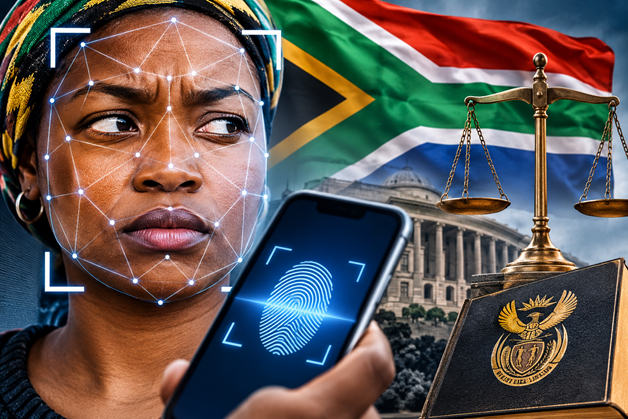
Imagine being told that you can no longer use your mobile phone unless you surrender your fingerprints or allow your face to be scanned.
Not because you have committed an offence. Not because there is evidence that you have participated in fraud. But because the ability to communicate, access banking services and participate in an increasingly digital society may soon depend on handing over the most personal markers of your identity.
This is the uncomfortable constitutional question raised by the Independent Communications Authority of South Africa’s (ICASA) proposed amendments to the National Numbering Plan Regulations.
Under the proposed framework, mobile subscribers would be required to undergo biometric verification, including fingerprint or facial recognition, against Department of Home Affairs records. The requirements would extend to new and existing subscribers, with verification required in circumstances including SIM activation, reactivation and SIM swaps. The proposal also introduces a limit of five mobile numbers per subscriber, per network.
ICASA argues that these measures will strengthen subscriber identification and combat SIM-swap fraud. These are legitimate objectives. South Africans deserve protection against financial crime, identity theft and the unauthorised takeover of their mobile numbers.
But a legitimate security objective does not automatically justify an intrusive regulatory response.
The question is not whether fraud should be addressed. It should. The question is whether the state can make access to an essential communication service conditional on the collection and processing of highly sensitive biometric information.
And what happens when privacy becomes the price of participation in society?
The constitutional cost of connectivity
A mobile number is no longer simply a means of making telephone calls. It is connected to our bank accounts, employment opportunities, personal correspondence, digital identities and access to government services. For many South Africans, it is also an essential link to social grants and financial survival.
Losing access to a mobile number can therefore have consequences that extend far beyond telecommunications.
Section 14 of the Constitution protects the right to privacy. POPIA also recognises biometric information as sensitive personal information deserving of particular protection.
Unlike a password, a fingerprint cannot simply be changed following a data breach. A compromised password can be reset. A person’s biometric identity cannot be so easily replaced.
This raises a fundamental question of proportionality: is it reasonable to require biometric verification on such a broad scale when the stated objective is to address specific forms of telecommunications fraud?
Where refusing verification could ultimately result in losing access to a mobile connection, the notion of meaningful consent becomes particularly difficult.
Can someone genuinely refuse when doing so may compromise their ability to work, bank or communicate?
Privacy cannot become a right that exists only for those who can afford to exercise it.
When identity and infrastructure converge
There is another concern that deserves greater public attention: the growing relationship between personal identity, private telecommunications infrastructure and government databases.
The proposed verification process would establish a closer operational relationship between mobile network operators and Home Affairs identity records.
This does not, by itself, authorise government to intercept private conversations or read personal messages. However, it raises important questions about institutional boundaries, data governance and the future use of interconnected identity infrastructure.
Who can access the information? How is it transmitted? What happens when a verification system is compromised? What safeguards prevent information collected for one purpose from being used for another?
These are not speculative or unreasonable questions. They are essential questions of digital governance.
The international experience also offers important lessons. The use of digital identification, biometric technologies and surveillance infrastructure in contexts such as Palestine has raised serious questions about the relationship between technology, state power and fundamental human rights.
These experiences should remind us that technological infrastructure cannot be separated from the political and legal environments in which it operates. Systems introduced for administrative or security purposes require safeguards that extend beyond assurances of efficiency.
The question must always be who controls the infrastructure, who has access to the information and what protections exist against its misuse.
The concern is not that South Africa’s proposal is equivalent to surveillance practices elsewhere. It is that no country should wait until its digital infrastructure becomes difficult to scrutinise before asking these questions.
A regulatory framework should not depend solely on assurances of good intentions. It must be designed to withstand institutional failure, unauthorised access and changing political circumstances.
Creating a security risk in the name of security
Perhaps one of the greatest contradictions in the proposal is that a measure intended to protect citizens against identity-related fraud could introduce additional security vulnerabilities.
Biometric information is valuable precisely because it is difficult to replace once compromised.
The proposed framework would introduce biometric verification across a telecommunications market exceeding 117 million mobile subscriptions. That is a substantial national undertaking.
Every stage of the process, from collection and transmission to verification and retention, creates security responsibilities.
POPIA places obligations on responsible parties to protect personal information against unlawful access, loss and misuse. But the public deserves clarity about the specific safeguards that will govern this infrastructure.
The proposal’s requirement to delete biometric records within 30 days after account deactivation does not eliminate the risks associated with collection and processing while an account remains active.
The more fundamental question is whether such extensive collection is necessary in the first place, and whether less intrusive measures could achieve the same security objectives.
The people digital regulation could leave behind
There is also a socioeconomic dimension that cannot be ignored.
South Africa remains a deeply unequal society. Many people depend on prepaid mobile services and informal retailers for affordable connectivity.
Introducing compulsory biometric verification across these channels raises practical questions about accessibility, infrastructure and exclusion.
What happens when Home Affairs systems are unavailable? What happens when biometric verification fails? What happens to an elderly person, someone with a disability or someone living in a rural community without convenient access to an appropriately equipped verification point?
Digital transformation should expand participation in society, not create additional barriers to it.
A regulatory framework cannot assume that every citizen has equal access to the infrastructure required to comply.
Regulation must address fraud, not presume guilt
The proposed restriction of five mobile numbers per subscriber, per network also deserves scrutiny.
There may be legitimate reasons why individuals require multiple mobile numbers, particularly for business and professional purposes.
Limiting the number of connections an individual can hold does not, by itself, dismantle organised fraud networks or address the underlying weaknesses that enable SIM-swap fraud.
Regulation should target harmful conduct through evidence-based interventions rather than impose blanket restrictions without adequately demonstrating their necessity and effectiveness.
What kind of digital future are we building?
The implications of this proposal extend beyond telecommunications.
As South Africa becomes increasingly dependent on digital identity systems, interconnected databases and biometric technologies, the protection of personal information becomes inseparable from the protection of individual liberty.
There is nothing inherently wrong with technological advancement. Nor should biometric technology be dismissed where it can genuinely improve security.
But technological efficiency cannot become a substitute for constitutional scrutiny.
South Africa’s constitutional democracy is founded on the principle that power must have limits. Those limits do not disappear because a regulatory intervention is presented as necessary for public protection.
ICASA must demonstrate why existing safeguards and more targeted security interventions are insufficient, how biometric information will be protected, who will have access to it and what meaningful alternatives will exist for people who cannot successfully complete verification.
Public consultation must also mean more than inviting submissions. It must mean genuinely considering whether the proposed measures are necessary, proportionate and consistent with constitutional rights.
Ultimately, privacy is not a privilege reserved for those with something to hide. It is a constitutional protection that exists because individuals should not have to surrender control over their identities without adequate justification.
We should be careful about the precedents we establish in the name of security. Once biometric identity becomes a routine condition for accessing essential services, the implications extend far beyond the original purpose for which that information was collected.
A person’s face is not a password. A fingerprint is not a disposable identification number. And access to communication should not become an open-ended invitation to collect the most sensitive markers of a person’s identity.
South Africa can pursue a safer telecommunications environment without abandoning the constitutional principles that underpin its democracy.
A secure digital future should not require citizens to choose between protecting their personal information and participating in society.
Security matters. But so does the freedom of the people it is supposed to protect.
Sõzarn Barday is a lawyer and author who writes on human rights, international law and public policy. The views expressed are her own.