

By Ramzy Baroud
There is no functioning political arrangement, no meaningful transformation of conditions on the ground, and no ceasefire worthy of the name.
An established maxim of Islamic jurisprudence, known in Arabic as ma buniya ‘ala batil fa-huwa batil, holds that “what is built upon falsehood is itself false.”
A related jurisprudential principle maintains that “if the foundation is invalid, what follows from it is also invalid.”
Few places in the world today illustrate the enduring relevance of this wisdom more starkly than Gaza.
Consider the political framework imposed on Gaza in the name of peace.
We continue to speak of a ceasefire, of US President Donald Trump’s Gaza plan, and of UN Security Council Resolution 2803, adopted on November 17, 2025, which endorsed the plan and lent international legitimacy to the political arrangements that were supposed to follow.
Yet, in reality, there is no functioning political arrangement, no meaningful transformation of conditions on the ground, and certainly no ceasefire worthy of the name.
Those who enthusiastically voted for the US-sponsored resolution have yet to acknowledge that they were, at the very least, misled about Washington’s intentions. The organizations and individuals who championed the plan have yet to apologize for their role in deceiving Palestinians, particularly the families of the 1,658 people killed and 6,000 wounded since the so-called ceasefire took effect on October 10, 2025.
Until such a moral reckoning takes place, we will continue to inhabit a surreal reality in which George Orwell’s dystopian dictum, “War is peace,” has become the governing language of international diplomacy.
Consider Israel’s latest invasion of central Gaza.
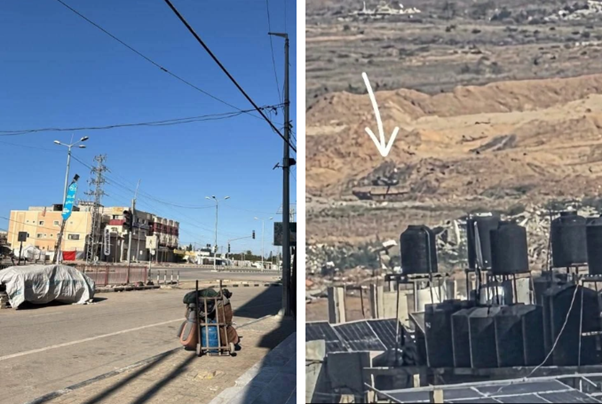
On November 18, Israeli tanks and bulldozers advanced beyond the so-called yellow line into areas designated as blocks 660, 661 and 666, northeast of Nuseirat refugee camp and northwest of Al-Bureij. Under the familiar pretext of a ‘security’ operation, Israeli forces shelled residential neighborhoods, closed sections of Salah al-Din Road and forced thousands of Palestinians to flee yet again.
On that same day, Gaza’s Health Ministry reported seven deaths and 15 injuries over the preceding 24 hours. These were merely the latest additions to an almost uninterrupted daily tally of Palestinians killed and wounded since the supposed cessation of hostilities.
The invasion came as Gaza was still reeling from devastating floods that began on November 6. According to Palestinian authorities, at least 70,000 tents sheltering displaced families were flooded, while UN assessments documented damage to more than 40,000 shelters, including over 9,000 rendered uninhabitable. The floods also claimed lives, including children, leaving thousands of families exposed to cold, rain and further displacement.
Thus, even as Palestinians are told that the war has ended, they continue to die from Israeli bombardment, collapsing buildings, contaminated water and the consequences of a devastated infrastructure.
Some analysts who examined the latest Israeli invasion have offered various explanations for Netanyahu’s renewed onslaught.
Some suggest that he is attempting to provoke a wider confrontation to pressure his political rivals into joining a unity government. Others argue that he is seeking to distract from his mounting domestic political troubles, or that the invasion represents a compromise between launching another war against Iran and taking no military action at all.
These explanations, however plausible, make not an iota of difference to Palestinians, who continue to endure a genocide that never truly stopped, regardless of how insistently the international community invokes the word “ceasefire.”
Hamas and other Palestinian resistance groups continue to call upon the so-called Board of Peace and the agreement’s guarantors to fulfill their obligations, particularly regarding the unrestricted entry of humanitarian aid.
According to Gaza’s Government Media Office, only 79,585 aid trucks had entered the Strip by November 16, compared with the 240,600 stipulated under the agreement. This represents a compliance rate of barely 33 percent.
But Palestinian resistance groups also face the limits of their strategic patience. While their immediate priority remains protecting Gaza’s population and ensuring the entry of essential supplies and reconstruction materials, they cannot indefinitely allow Israel to resume open warfare without resistance.
The question, therefore, is how much longer that strategic patience can endure before the entire arrangement unravels.
Meanwhile, Gaza is condemned to a prolonged catastrophe: a genocide sustained at a lower intensity, punctuated by periodic massacres, compounded by preventable deaths from disease, contaminated water, exposure and flooding, all while the fiction of a functioning ceasefire is meticulously preserved.
What is urgently needed is political accountability from those who were either deceived by, or willingly endorsed, the Gaza plan. Rather than delivering genuine peace, the arrangement has served Israeli and US objectives by buying time to pursue the disarmament of Palestinian resistance, while leaving Gaza’s population exposed to continued military attacks, deprivation and the threat of further displacement.
Equally necessary is moral accountability from UN officials and other international figures who defended the US resolution as a genuine foundation for lasting peace, despite the absence of credible mechanisms capable of compelling Israel to honor its commitments.
Such accountability will not emerge spontaneously. It must be demanded. Indeed, it must be exacted.
Perhaps one of the most consequential successes of the Trump-Netanyahu ceasefire scheme has been its ability to diminish the momentum of international solidarity with Gaza.
Even governments that profess sympathy for Palestinians have embraced the language of a truce, using the appearance of diplomatic progress to justify their own inaction and discourage renewed mass mobilization among their civil societies.
This must change. Otherwise, Israel, emboldened by US support and the complicity of other Western allies, will continue exploiting the illusion of peace until it finds the most opportune moment to unleash another full-scale assault on Gaza, this time with the intention of completing the destruction it began more than three years ago.
– Dr. Ramzy Baroud is a journalist, author and the Editor of The Palestine Chronicle. He is the author of eight books. His latest book, ‘Before the Flood,’ was published by Seven Stories Press. His other books include ‘Our Vision for Liberation’, ‘My Father was a Freedom Fighter’ and ‘The Last Earth’. Baroud is a Non-resident Senior Research Fellow at the Center for Islam and Global Affairs (CIGA). His website is www.ramzybaroud.net
“Reprinted from…”https://www.palestinechronicle.com/war-is-peace-the-gaza-truce-is-a-lie-and-israel-intends-to-finish-the-job/