
By Iqbal Jassat
More than six weeks after video footage of Gavin Katz’s public tirade on Grant Avenue in Norwood went viral, a troubling silence hangs over South Africa’s law enforcement and constitutional bodies.
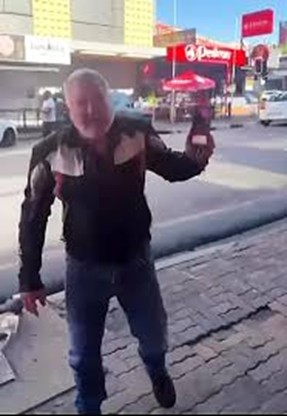
The facts of the October 13 confrontation outside The Ahsan Store are not hidden behind closed doors or obscured by conflicting testimonies; they are recorded in plain sight, circulating widely in the public domain.
Yet, despite blatant abusive behaviour, public indecency, and overt threats of violence, there has been no known official action, arrest, or public response from the South African Police Service (SAPS), the National Prosecuting Authority (NPA), or the South African Human Rights Commission (SAHRC).
What transpired on that Johannesburg street was not a simple neighbourhood squabble or a moment of ordinary road rage. It was an explicit, ideologically driven display of pro-Israel aggression weaponised as anti-Palestinian and anti-Muslim hostility.
Confronted with the peaceful display of a Palestinian flag outside shopkeeper Muhammad Patel’s business, Katz launched into a tirade demanding its removal. In the footage, he equates Palestinians with terrorists, hurls unfounded accusations of tax evasion at a Muslim business owner, issues threats, and descends into vulgarity by exposing his bare buttocks in public.
Later, rather than demonstrating genuine contrition, Katz took to social media to post images of his South African and Israeli passports, framing his confrontation through a lens of uncompromising Zionist belligerence.
To treat this outburst as an isolated lapse in manners is to ignore its unmistakable political and racialised character. In South Africa, a country whose own liberation struggle forged deep solidarity with the Palestinian people, the Palestinian flag is a recognized symbol of resistance against apartheid and oppression.
Attempting to bully a Muslim shopkeeper into removing it on a South African street—while branding an entire people as terrorists—is an act of targeted intimidation rooted in anti-Palestinian animus and Islamophobia.
It seeks to import the violent logic of occupation onto the pavements of Johannesburg, policing who is allowed to express solidarity and whose identity is tolerated in public spaces.
This was not even the first such flashpoint in Norwood. Just weeks earlier, local businessman Rodney Plett was caught on camera in a similar confrontation over Palestinian solidarity in the same suburb. Following both incidents, familiar patterns of damage control emerged. Bodies such as the South African Jewish Board of Deputies (SAJBD) moved to condemn the behavior while insisting that men like Katz and Plett are unrepresentative outliers acting purely as individuals.
As commentator Ebrahim Fakir pointed out, this reflex to “condemn the person while shielding the ideology” conveniently sidesteps the broader political climate that emboldens such public hostility.
However, the deeper failure now lies with the state. Private apologies—especially those widely viewed as reluctant damage control after being caught on camera—are no substitute for the rule of law.
Shopkeeper Muhammad Patel did what every law-abiding citizen is urged to do: he refrained from retaliatory violence and laid a formal criminal complaint at Norwood SAPS.
Civil society organisations, including the Media Review Network, went further, publicly calling on the NPA to investigate Katz not only for crimen injuria, intimidation, and public indecency, but also for potential violations of the Regulation of Foreign Military Assistance Act given his public display of Israeli credentials.
Yet, weeks later, the public is met with an institutional void. Norwood SAPS has offered no public confirmation of an arrest or the status of the docket. The NPA has given no indication that the matter will be enrolled in court. Meanwhile, the SAHRC—a Chapter 9 institution mandated to protect human dignity and combat hate speech and discrimination—has made no public move to initiate an inquiry, standing in stark contrast to the urgency with which other high-profile incidents of racial abuse are rightly pursued.
This inaction carries severe consequences. South Africa’s constitutional democracy rests on the promise that the law applies equally to all, and that public spaces belong to every resident regardless of faith, background, or political solidarity.
When overt, documented harassment of a Muslim trader goes unanswered by the police, prosecutors, and human rights watchdogs, it sends a dangerous message: that anti-Palestinian hostility and Islamophobic intimidation carry no real legal cost.
Accountability cannot be selective, nor can it be outsourced to social media outrage. With video evidence already in the public domain, the burden is squarely on SAPS, the NPA, and the SAHRC to break their silence.
Until they demonstrate that threats of violence and hateful abuse on Grant Avenue will be met with the full force of the law, institutional inaction will remain complicit in normalising a climate of impunity.
Iqbal Jassat
Executive Member
Media Review Network
Johannesburg
South Africa