
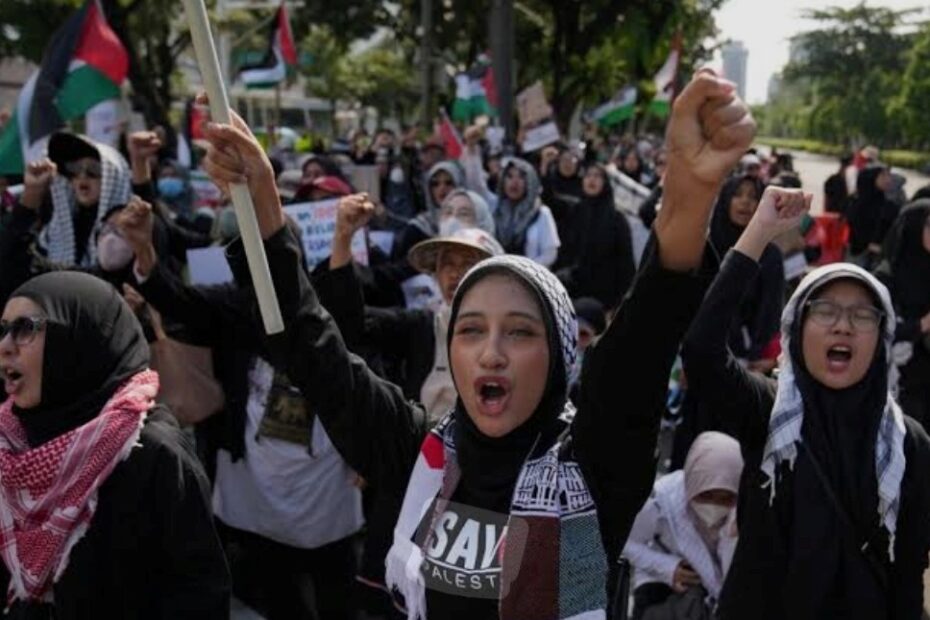
Quds Day: Solidarity Protests
Pic Courtesy: Al Jazeera
By Hassen Lorgat
The war on Iran by the US and Israel may have pushed the Palestinians from the front pages, but it is integral to the plight of Palestinians, which the reader must keep in mind at all times, as they are being killed daily in the Gaza Strip and the West Bank as I write.
Ironically, it is Leo Brent Bozell III, the newly appointed US Ambassador to South Africa, who inevitably brought back the question of Palestine. Among other things, he has stated that he does not care what South African courts say regarding the “Kill the Boer” song. But even before his arrival, he laid out his agenda for South Africa:
- Drop the ICJ case against Israel.
- Break ties with Hamas and Iran.
- Stop the killing on white farms and end the “Kill the Boer” chants.
- Adopt US-friendly economic policies.
What is clear is that he is firmly in Israel’s corner, and he has explicitly targeted the African National Congress (ANC), its relations with Hamas, and its support for Palestinian liberation and nationhood. Bozell identified the ANC government’s support for Hamas as a significant issue in US-South Africa relations, particularly following October 7, 2023. However, these agendas are not new, and the ambassador is not alone.
In 2024, Tony Leon, former DA leader, accused the ANC of moral blindness when it comes to Hamas, which for him is a terrorist organisation. Furthermore, he argues that the ANC prioritises an anti-imperialist narrative over consistent human rights principles, which impedes a coherent foreign policy.
What can easily get lost is that the media, generally speaking, imbibed some of these sentiments, willingly at times or subconsciously. To be fair, it is largely mainstream media with a right-wing or conservative bent that keeps beating this drum: “Hamas must disarm and so on” or “Hamas is the problem” and so on, ignoring that there are other armed resistance groups fighting alongside them and that they are not there alone. In their reporting, they do not assert the basic fact that since the so-called Trump ceasefire, more than 600 Palestinians have been killed in the Gaza Strip since the US-brokered ceasefire began on October 10, 2025. Despite the agreement intended to end hostilities, credible media reports of daily Israeli attacks, including airstrikes and artillery fire, have continued, with casualties reported across various parts of the Strip.
It begs the question: who is Hamas? The acronym Hamas stands for Harakat al-Muqāwamah al-ʾIslāmiyyah (حركة المقاومة الإسلامية), which translates to the “Islamic Resistance Movement.” In the West, it is frequently framed as the “prime evil.”
The organisation is often held to different standards than Israel in global media. Drop Site News recently highlighted correspondence from Rami Ruhayem, a BBC Arabic correspondent, to BBC Director General Tim Davie. Ruhayem argued that the BBC’s reporting reveals inconsistent language: the broadcaster liberally used words like “massacre,” “slaughter,” and “atrocities” for Hamas’s actions (such as the Supernova festival) but avoided them when describing Israeli actions that caused large-scale civilian deaths.
Furthermore, Ruhayem noted that the BBC regularly omits historical context, such as apartheid, ethnic cleansing, and settler-colonialism, preferring a watered-down analysis that favours the aggressor.
Headlines often omit Israel’s role as the perpetrator (e.g., “Father loses 11 family members”) or use caveats like “reportedly” when attributing attacks to Israel, while adopting Israeli euphemisms such as “evacuate” for the forcible transfer of civilians and framing the total siege of Gaza in neutral terms.
Reporting Palestine
Media coverage generally underreports Palestinian perspectives, often influenced by well-organised Zionist lobby groups globally and in South Africa. Hamas, as one part of the Palestinian liberation movement, receives the most negative press. They are cast as the “bad Palestinian,” and their views are rarely heard unless they are the subject of an attack or severe criticism. It appears that South African media dutifully echo the Global West narratives about so-called rogue states like Iran, Venezuela and others.
Whatever happened to the free-speech South African liberals who once defended the belief articulated by Voltaire: “I disapprove of what you say, but I will defend to the death your right to say it”?
Their silence regarding Palestinian voices—and Hamas’s specifically—undermines their commitment to the principle that free speech is a necessary check on power. This absence of a fight for a plurality of voices suggests a condonation of censorship that leads to a closed society.
The commitment of the liberal opposition to free speech has been inconsistent. Two years ago, the Democratic Alliance (DA) fired and hounded out one of its rising stars, Ghaleb Cachalia, for tweeting: “I will not be silenced. Israel is committing Genocide. Full BLOODY stop.”
In response, the then DA leader John Steenhuisen called this “selfish conduct” for breaking party ranks. As I write, the DA criticised its rival Gayton McKenzie from the Patriotic Alliance for “Minister Gayton McKenzie’s decision to overturn South Africa’s official Venice Biennale submission after a lawful, independent selection process had already been concluded.” In addition, the party asked that the decision be overturned and that they would complain to the Public Protector. They affirmed support for the “courage to express political and social truths through creative expression.”
Corporate Power and the Limits of Transparency
It is not only around Palestine or Hamas that we find that these positions and commitments are limited when it comes to corporate power. The Democratic Alliance, for its part, after October 7, spoke harshly against Hamas but softly on its supposed support for a two-state solution. However, these doyens of liberalism—the DA—stumbles when they meet corporations. According to their values and principles, they neglect the influence of corporate power. Their commitments to an “open society” on transparency and freedom of information appear to be limited to the scrutiny of governmental power alone.
A truly open society must include scrutiny of corporate lobbying and the privatisation of information. In the era of AI, corporations like Amazon, Microsoft, Alphabet (Google), Apple, and Meta dominate public policy and data ownership.
Obtaining accountability is tough for civil society groups as it not only demands that the power holders be “open to interrogation,” but that community groups and activists must develop capacities—the know-how—of how to keep them accountable. My own work in using Chapter 9 bodies (SAHRC, Public Protector, Commission for Gender Equality, etc.) and the BCCSA and the Press Council confirms that this is an uphill struggle.
Thus, the overemphasis on information access on its own will not crack it. Without addressing structural inequalities—disparities in education, resources, and media access—transparency remains a “tick-box” exercise rather than a tool for genuine accountability.
Manufacturing the Narrative
I will look at some of these attacks which I believe is a longer and sustained strategy that predates October 7, but after this date, the attacks on Hamas rose sharply.
It is widely recognised by investigations, including those by Al Jazeera, that human rights violations occurred on October 7. The documentary October 7: Forensic Analysis details killings on that day, apportioning blame to both Hamas and the IDF based on evidence, while finding certain claims repeated by Israeli politicians to be false or untrue.
The strategy to delegitimize Hamas often involves “manufacturing” and “amplifying” messages through elite voices. In South Africa, this was evident in the backlash against the government’s ICJ case.
A notable example is the “Zomlot trap,” where the BBC invited Husam Zomlot, the Palestinian Ambassador to the UK, to a studio and immediately demanded he condemn Hamas. As an opening prayer to a feast, he was asked to condemn Hamas for the action of the group and other Palestinian liberation groups on October 7. What this ritualistic condemnation of Hamas sought was to erase the history and context of occupation and incremental genocide.
Zomlot’s response must be compulsory study in media and ethics studies. He condemned the framing, the implicit racism in the question, and the obsession with the blame game, even as Palestinians were killed daily. In that same period, Israeli spokespeople and their apologists were never asked to condemn the genocide, whose overwhelming victims—over 75,000 directly killed and more than 100,000 under the rubble—were women and children.
Similarly, the Irish rap group Kneecap faced a Zionist backlash after projecting “Free Palestine” at Coachella. Despite the group stating in early 2025, “We do not, and have never, supported Hamas or Hezbollah; we condemn all attacks on civilians,” Canada banned them from entry, accusing them of supporting “terrorist organisations.” More recently, the group, through its manager Dan Lambert, has since argued that such accusations aim to undermine the right to resistance for oppressed peoples. They criticise media “gotcha moments” (like “do you condemn Hamas?”) as a double standard not applied to powerful states, urging instead for understanding of Palestinian resistance after decades of occupation.
The Attack on South Africa’s ICJ Case
As I noted earlier, the new US Ambassador’s agenda aligns with a global right-wing movement, both domestically and internationally.
Key figures driving this narrative include Joel Pollak of Breitbart News and the South African Zionist Federation (SAZF). They consistently dominate media coverage by framing Hamas—an Islamist party—as fundamentally incompatible with Western democracy.
A central pillar of their attack involves dismissing South Africa’s case at the International Court of Justice (ICJ). They claim the case was funded by Iran, an allegation the South African government firmly rejects. Instead, they portray the country as functioning as the “legal arm of Hamas.”
These critics have also launched personal attacks against former Minister of International Relations and Cooperation, Naledi Pandor. They baselessly assert that she had prior knowledge of the Hamas attacks and that she communicated with Iran in their aftermath.
Within this ecosystem, Zev Krengel of the South African Jewish Board of Deputies (an affiliate of the SAZF) has been given a platform to share these views. For instance, he appeared on the public broadcaster SABC on October 24, 2023, where his assertions went largely uncontested. You can view the interview here.
Despite this media campaign, some voices, like journalist Paula Slier, suggest that threatening the Palestinian NGOs that provided the knowledge of their experiences with sanctions may be a strategy to undermine the ICJ case, allowing the genocide to continue.
In response, DIRCO’s (Department of International Relations and Cooperation) Crispen Phiri ably pushed back against these narratives. He notes that these unverified accusations are not based on fact but are part of a political agenda designed to function as propaganda.
Hamas: A brief history
Hamas was founded during the first Intifada in 1987. Its unhappiness with Fatah led to Hamas winning the January 2006 legislative elections. In 2017, Hamas revised its charter, accepting a Palestinian state within the 1967 borders while upholding armed resistance as a legitimate right.
Mainstream media often ignores that the Likud-led Israeli government historically encouraged the formation of Hamas in the 1980s as a counterweight to the secular PLO to prevent Palestinian nationhood. Today, Likud’s foundational platform rejects Palestinian sovereignty “between the Sea and the Jordan River.” In 2024, the Knesset voted to do everything possible to stop Palestinian statehood.
Conclusion
I conclude where I began: at the intersection of Iran and Palestine. It appears the actions of the Israeli and U.S. administrations have unified the Iranian people rather than effecting regime change. On March 13, 2026, millions participated in Al-Quds Day rallies despite ongoing bombings, with President Pezeshkian and security chief Ali Larijani appearing in public to show solidarity with Palestine and condemn the attacks on Iran’s leadership. Initiated by Ayatollah Khomeini in 1979 to express international Muslim solidarity and oppose the occupation of Jerusalem, Al-Quds Day has since galvanized the movement, serving as a central pillar of Islamic identity and a universal call to action.
A just solution requires confronting hard truths, and the relentless vilification of Hamas impoverishes our discourse. Hamas emerged from specific historical conditions: the Israeli occupation and the collapse of the peace process. Whether one agrees with them or not, they won an election before Israel decided to blockade the voters, the people of Gaza, for their choice.
We must recognise that it is Israel—historically and now more vigorously under Netanyahu’s rule—that actively opposes Palestinian sovereignty and statehood, which in turn further fuels resistance. It is probably appropriate to conclude here that the international community maintains a double standard by penalising Palestinian resistance (like BDS and Hamas) while ignoring illegal Israeli settlement expansion that undermines Palestinian sovereignty.
The Zionists and their allies’ twin strategy of banning only BDS peaceful protests (in the US, Europe and elsewhere), the shunning of Palestinian groups while tolerating the violence of settlements and the crude violence of the settlers, goes underreported even if they violate international law. The demand for Hamas to disarm in this phase of the so-called ceasefire, whilst leaving Israel well-armed, is not only hypocrisy but complicity in the ongoing genocide. We see this hypocrisy most clearly in the nuclear arena; the world demands that Iran be denied nuclear energy, yet the call for a nuclear-free Middle East inexplicably excludes Israel’s Dimona facilities from any public discussion or international scrutiny.
Hamas is not a banned organisation in South Africa, and acting as if it is banned or illegal weakens our democracy. The South African government has confirmed in Parliament that it does not consider Hamas a terrorist organisation, in line with the United Nations. We have learnt from our experience of activism that when workers and communities routinely express their dissent through protest and petition, they make new ideas acceptable and expand public debate. This constant engagement also builds a resilient “civic or democratic muscle” of organisations and media, which atrophy without regular use.
When right-wing groups exercise this muscle—they occupy the public spaces on radio, TV and their own social media and more increasingly podcasts—whilst at the same time learning to get in step with the toyi-toyi, we lose out. They have occupied the space largely because we are absent.
As Nelson Mandela advised, to achieve peace, one must talk to one’s enemies, not just one’s friends. Assassinating those that one does not agree with only engenders more anger and violence and radicalises movements rather than moderating them. It may be appropriate to add that the founding leader of Hamas, Sheikh Yassin, was assassinated on March 22, 2004, in Gaza City after Fajr (dawn) prayers, when an Israeli AH-64 Apache helicopter fired missiles at his wheelchair as he left a mosque in Gaza after prayers. Sheikh Yassin was a quadriplegic. Nine other Palestinians were killed with him in this attack.
There was a bit of sanity around Hamas even in the US administration. We recall that even Barack Obama, in his 2009 Cairo speech, recognised that Hamas has a role to play in fulfilling Palestinian aspirations. If we remain silent and allow the media to sideline these voices, we leave the Palestinians to suffer the ongoing genocide alone. History will judge us for our silence.