
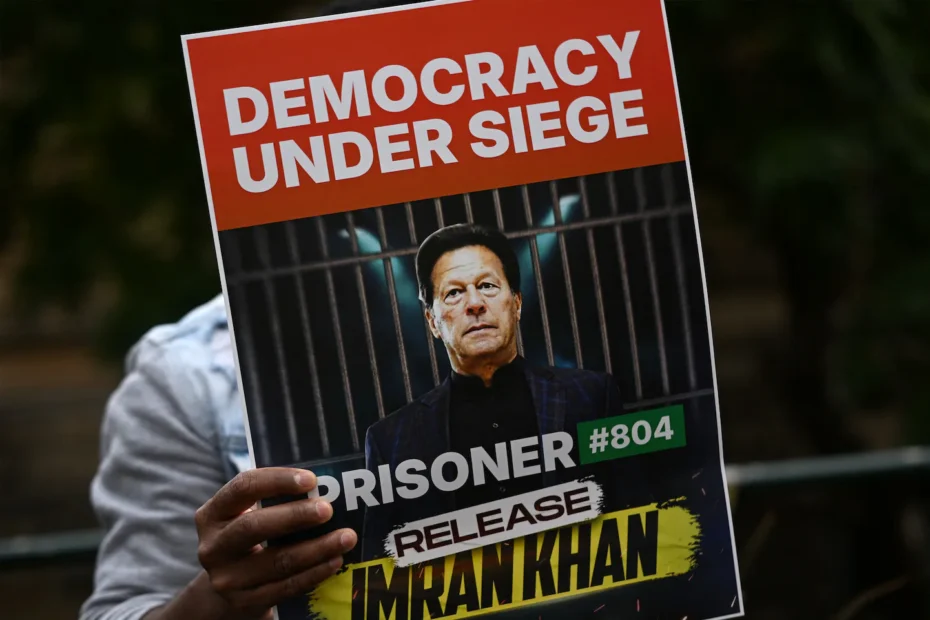
From Cricket Legend to Prisoner No. 804
By RANA AYYUB
At a Muslim community evening in Long Island, Ahmed Bilal, a young mechanic visiting friends, scrolled through his phone, the last hundred videos he had posted on TikTok were all about the same man: Imran Khan. “I would give my life for him,” Bilal said as his friends cheered for him.
At home he keeps every magazine cover featuring Khan carefully framed on the wall. He often dresses in the same white pathani suits that Khan favors at political rallies. When Khan led Pakistan to victory at the 1992 Cricket World Cup, Bilal was barely three years old. The Imran Khan he knows is not the cricketer of the 1980s but a mythical legend who circulates endlessly through social media clips and diaspora gatherings at Times Square
At one of the gatherings in February this year , his supporters braved single digit weather to storm the streets of New York. Some of Khan’s supporters share common love for Donald Trump with posters at American rallies saying “Two great leaders fighting for their nations”
Among Pakistanis scattered across Britain and the United States, Khan’s political absence and a sudden disappearance from the public eye in Islamabad has only deepened his appeal. When tensions between the United States and Iran escalated last week, Khan’s supporters circulated an old clip of him warning that a war between Washington and Tehran would destabilize the world. (instagram.com/reel/DVlO2mVDW64/?igsh=MW82ZzRiMWVwaWpidw==)
Youtubers and tik-tokers mocked Pakistan’s current prime minister, Shehbaz Sharif, who had publicly nominated Donald Trump for the Nobel Peace Prize.
It is an unusual afterlife for Imran Khan who currently sits in a prison cell in Pakistan with hardly any news, disappeared from the news cycle. Over the last six months, X has been the subject of viral trends #WhereIsImranKhan, when rumors of his death went wild. (
|
35 MILLION+ people reached — the world is roaring. Imran Khan has been held in 30-day total isolation: no family, no lawyers, no proof he’s alive. His sons plead for a single photo. Global voices demand answers. This must end. #WhereIsImranKhan
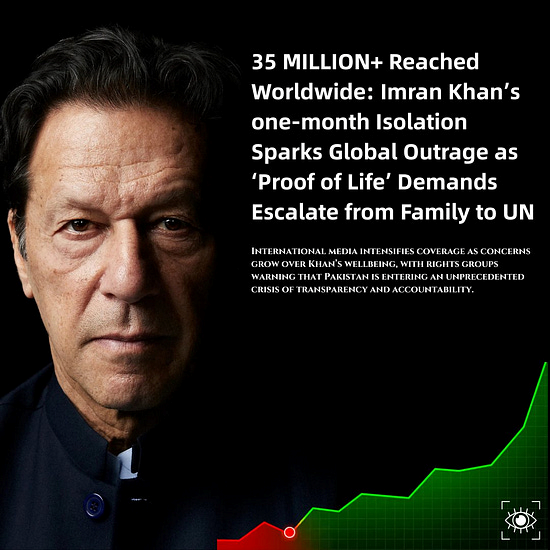
The Pakistani regime is trying to silence a man with close to 60 million followers across social media platforms in the age of reels and tiktok trends where he is an icon. Imran Khan is the the seventh most followed world leader on twitter
Months before his arrest, a twitter space by Imran Khan set a record with the highest number of participants (https://www.indiatoday.in/world/story/ex-pakistan-prime-minister-imran-khan-record-twitter-space-pti-1940008-2022-04-21)
It was no surprise then that ex wife Jemima Khan believes that hs tweeted to Elon Musk that the government is throttling his presence on X to make sure that his message does not reach his supporters.
|
Since his arrest in 2023, Khan — once the country’s most recognisable public figure — has been confined in a high-security jail outside Rawalpindi. Courts have handed down multiple convictions against him, producing sentences that together stretch for decades.(https://www.france24.com/en/asia-pacific/20251220-pakistani-court-sentences-former-pm-imran-khan-wife-17-years-corruption-case) The attempt to silence his presence might not have been very successful although the momentum might have thinned marginally.
His prison number, 804, has become a slogan. Supporters print it on jerseys and T-shirts sold online through platforms such as Amazon and Etsy , the number functions as a kind of political shorthand — proof that the man once celebrated as Pakistan’s greatest sporting hero has become its most famous prisoner.
Few political figures have lived as many public lives as Imran Khan: playboy cricketer, global celebrity, populist reformer and now perhaps the world’s most recognizable jailed politician.
Long before he entered politics, Khan was already a legend. In the 1980s he was among the most charismatic figures in international cricket — tall, Oxford-educated and comfortable in London’s elite social circles. British tabloids, fashion magazines treated him less like an athlete than a movie star, chronicling his romances and nightlife with enthusiasm. From Newsweek to Society, Esquire, Time, sports magazines of the time to hundreds of Urdu and English magazines in Pakistan, Imran Khan was the hearthrob of a millions in the subcontinent.
Rana Ayyub’s Newsletter is a reader-supported publication. To receive new posts and support my work, consider becoming a free or paid subscriber.
His fellow politician, Benazir Bhutto, the former prime minister of Pakistan studied with him at Oxford, but met a more tragic fate, she was assassinated at a political rally in in the same city where Imran Khan is lodged in prison. Imran Khan too had survived an assassination attempt before he was arrested in November 2022.
Not all the attention, Imran received was was flattering. In the late 1990s a court in Los Angeles ruled that Khan was the father of Tyrian White, the daughter of socialite Sita White — a claim he has long disputed.
Yet the image that ultimately defined him came from the cricket field. In 1992, when he captained Pakistan to its first and only World Cup victory, For millions of Pakistanis he became something larger than a sportsman: a symbol of national pride.
The fame eventually evolved into political ambition. In 1996 Khan founded the Pakistan Tehreek-e-Insaf, promising to challenge corruption and build a welfare state inspired by the ideals of Pakistan’s founder, Muhammad Ali Jinnah. For years the project seemed improbable. Critics dismissed him as a celebrity dabbling in politics, and his party struggled to win seats.
But Khan persisted. His anti-corruption , anti imperialist message resonated with younger voters frustrated by dynastic politics and economic inequality. By 2018 he had achieved what once seemed unlikely: he became Pakistan’s prime minister. Khan’s appeal was not confined to Pakistan. I remember watching his speech at the United Nations General Assembly in 2019 while sitting with a Middle Eastern ambassador in Johannesburg. When he finished, the room fell silent before she stood up and applauded. To many in the global Muslim world, Khan was speaking not just as a Pakistani politician but as a critic of the international order.
Power proved more complicated than opposition. Imran Khan’s election campaign was heavily built on a promise to create a “Naya [New] Pakistan,” . He promised the people of Pakistan that the country would be rid of corruption and he would fix the economy of the country in 90 days. (https://gulfnews.com/world/asia/pakistan/imran-khan-promises-good-tsunami-to-end-pakistan-graft-1.957025)
However by 2019, his government had to be bailed out through a $6 billion bailout package from the International Monetary Fund (IMF)
His personal life continued to fascinate the public as well. His third marriage, to the spiritual figure Bushra Bibi, deepened the aura of mysticism that increasingly surrounded him. Bushra was married with children when she became his spiritual healer and ‘sacrificed’ her personal life to marry Imran Khan as part of some ‘prophetic vision’. (https://theprint.in/opinion/imran-khans-signs-to-guide-life-seems-like-mental-illness/36783/)
Khan claimed that he saw his wife only on the night of his marriage, a far cry from his flamboyant marriage and relationships in earlier life.
Pakistan’s powerful military, long considered the country’s ultimate political arbiter — had once been seen as quietly backing Khan’s rise. But by 2022 that relationship had fractured, turning one of the establishment’s former allies into its most vocal critic. In 2022 Khan was removed from office through a parliamentary vote of no confidence — the first Pakistani prime minister to fall that way.
The rupture exploded into the open in May 2023. At a court hearing, in may 2023 Pakistani paramilitary rangers broke through glasses to arrest a visibly unaffected Imran Khan; visuals played on Pakistani TV and for an international audience on CNN.
Protests erupted across Pakistan. What followed shocked even seasoned observers: crowds stormed army buildings, torched vehicles and ransacked the residence of a senior military commander in Lahore.
The backlash was swift. Thousands of Khan’s supporters were detained and his party’s organisational structure was largely dismantled.
For a politician who once dominated the country’s airwaves, the change was stark: news broadcasters were effectively barred from broadcasting the name, image or speeches of Imran Khan. Several journalists seen as sympathetic to him faced investigations and legal cases.
If the state hoped that silencing him on television would diminish his influence, the internet complicated that calculation.
In December 2023, months after his arrest, the Pakistan Tehreek-e-Insaf produced what it described as the first AI-generated political speech by an imprisoned leader. Using audio from past recordings and a speech written in prison the party created a digital reconstruction of Khan delivering a message written from prison.
Within hours the video had close to 6 million views. (https://www.aljazeera.com/news/2023/12/18/pakistans-imran-khan-delivers-ai-generated-speech-to-campaign-from-prison)
Even in physical confinement, Khan remained omnipresent.
On diaspora social media, images of Khan sometimes appear alongside those of Zohran Mamdani — two Muslim political figures separated by a generation and very different political contexts. Khan has likely never met Mamdani and there is little evidence that one has influenced the other. Yet in the imagination of online supporters they sometimes represent a shared narrative: outspoken Muslim figures challenging established power in the West.
Meanwhile Khan’s family has sought to internationalise his case. From London, his sons Sulaiman and Kasim have spoken to Western media outlets, asked for a visa to visit their father in Pakistan, urging greater scrutiny of the circumstances surrounding their father’s imprisonment.
For a man once photographed constantly, absence has become its own form of presence.
Pakistan has removed powerful leaders before: through exile, prison and even execution. But the attempt to sideline Imran Khan is unfolding in a different era. In the digital age, confinement does not necessarily produce silence. His prison number circulates across continents, his speeches reappear through artificial intelligence and his image travels through an audience that refuses to forget him.
The nuclear armed Pakistan may have jailed its most famous cricketer-turned-politician with the all power military successfuly managing to throttle dissent. Erasing him, however, has proved far more difficult.
Rana Ayyub’s Newsletter is a reader-supported publication. To receive new posts and support my work, consider becoming a free or paid subscriber.