

Poem by Hassen Lorgat
they placed him above granite
and remade him in bronze—
the Deadstone of the man
who only wanted a water feature in his garden
but claimed the Victory Falls.
It is good that Zimbabwe has not de-platformed him,
but I want them to state clearly
that he was the first—
or maybe one of the first—white men
to find black people enjoying this wonder of the world.
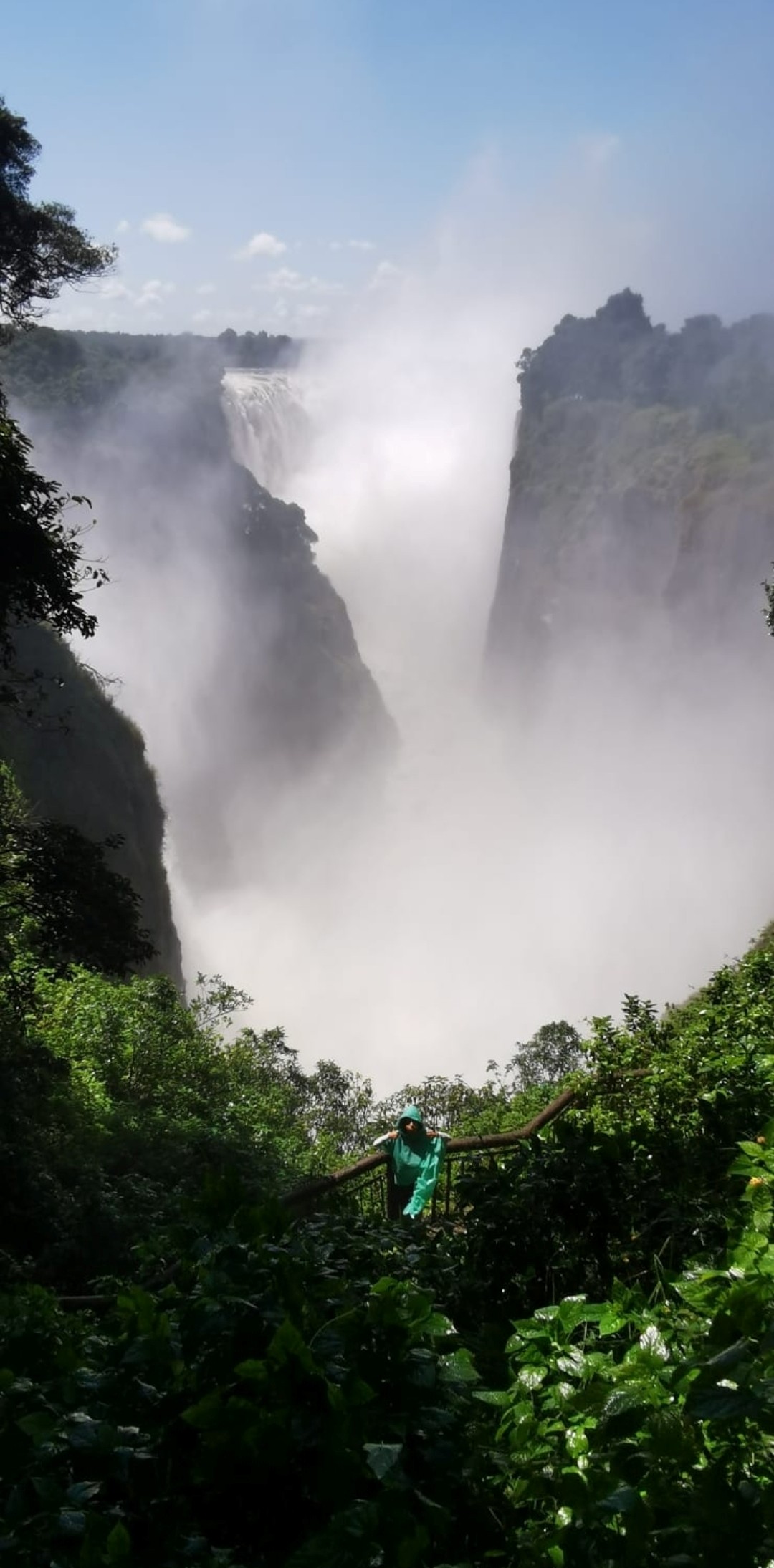
The indigenous people in the multitudes of tongues revered the waterfall as
Mosi-oa-Tunya in Kololo or Lozi—
The Smoke That Thunders—
whilst the Tonga people called it
Shungu Namutitima: The Water That Boils.
It was that diligent servant of Empire in 1855—the Scotsman, David Livingstone—
who christened it Victoria Falls in honour of their Queen Victoria,
a person who had not yet set foot in the country.
When his statue was launched the poems and songs paid tribute:
Tennyson in particular was useful—
not once nor twice in our fair island story,
the path of duty was the way to glory.
The irony of finding something that existed was colonial chic.
The irony never dawned upon them.
They were there to celebrate a great Christian missionary,
an Empire Builder—
the famous Broadcaster of Empire, an African broadcaster, Rene Caprara,
extolling Livingstone’s virtues at the statue’s launch in 1934,
his master’s voice read:
On the 16th of November 1855,
he saw afar a great white cloud rising into the sky and he heard a mighty sound.
It was ‘The Smoke that Thunders’.
Hurrying forward, the first European to behold the greatest river wonder of the world,
stood in awe on the very spot where I am now standing and speaking to you.
He then paused and broadcast the amplified roar and thunder
of the Victoria Falls
to millions across the British Empire,
the Union of South Africa,
Great Britain,
and the United States.
Not far away, the Tonga people
went along doing what they did for years:
fished, and planted,
young ladies washed the clothes,
and they prayed that their great Zambezi
would not fall foul of the visitors.
The rise and fall
of these waters
tell their story
long before the white man came
to discover it.
Hassen Lorgat