
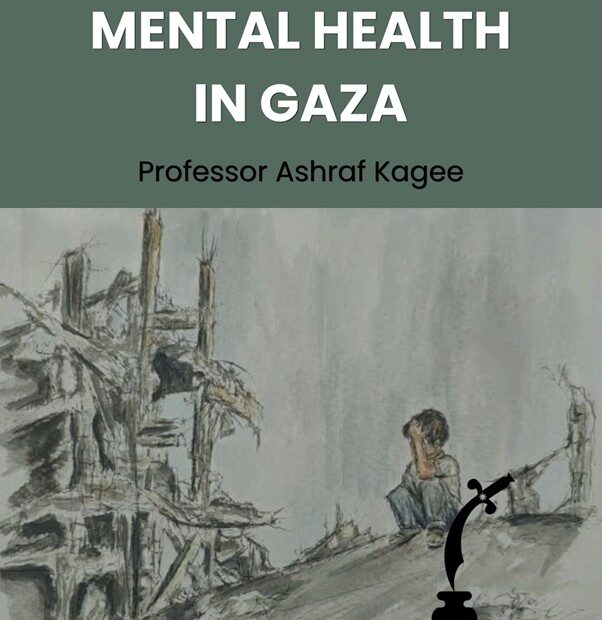

It requires no imagination to understand that grief, fear, terror, anxiety, and trauma characterise the experience of the more than two million people in Gaza. The existential threat posed by the Gaza genocide goes beyond individual psychological trauma. In addition to the direct physical killing such as massive bombardment and targeted killings there was also deliberate starvation, deprivation of water and sanitation, and the destruction of the health care system. Forced evacuations, malnutrition, starvation and the spread of contagious diseases have formed part of almost everyone’s lived experience in Gaza.
By all accounts the Israeli military was aided and abetted by Western governments, mainly the United States, but also several in Western Europe, who providing funding, military materiel and diplomatic protection even while mass murder ensued. The destruction of Gaza is a consequence of the trajectory of world politics and colonialism, not an accident of history. The current genocide is a continuation of a decades-long campaign to ethnically cleanse Palestine of its people.
While psychological interventions no doubt have their place in the rebuilding work, it is the social fabric that also has to be restored. But even restoration is an inaccurate term as it suggests returning to a prior state, presumably one of normality. The reality is that the situation in Palestine before the genocide was one of dispossession, siege and occupation, not normality by any reasonable societal standards.
The Nakba is ongoing and the genocide is the latest manifestation of this colonial oppression. Trauma in Gaza is not past but continuing, even after the socalled “ceasefire” was declared.
Colonial trauma and psychological trauma converge to yield a situation in which the people of Gaza are locked in a relationship with their oppressor, the Israeli state, unable to leave, yet continually haunted by grief, loss, fear and the rage of being colonised.
Children and youth make up the majority of the population in Gaza and for them the future is bleak. They will carry into adulthood and beyond the psychological and, for many, the physical scars of having endured a genocide.
This Friday talk presents the work of the Gaza
Community Mental Health programme and raises some points about providing mental health services in Gaza.
April 2026
Pre-khutba talk by Ashraf Kagee
Assalaamu-alaikum brothers and sisters. I’d like to thank the mosque committee for inviting me to speak today. I’ve been asked to speak about mental health in Gaza and I want to do three things in this talk.
I’d like to tell you about the work of the Gaza Community Mental Health Programme, which is an NGO that I have been working with over the past several years.
Then I’d like to discuss some conceptual issues that have come up in doing mental health work in Gaza. And then I’d like to share some thoughts on the present crisis.
My work in Gaza started about ten years ago when I attended a conference hosted by the the Gaza Community Mental Health
Programme. This is a non-profit civil society organisation established in 1990. I had been doing some research on trauma among South African former political detainees and I presented a paper on my work at this conference.
The Gaza Community Mental Health Programme seeks to improve the Palestinian community’s mental health by providing counselling, psychotherapy and psychiatric services. It offers training, conducts research, and advocates for the rights of people — men, women, children, who are survivors of violence and human rights violations.
In addition to psychiatric treatment, counselling and psychotherapy, they also provide other rehabilitation services, such occupational therapy and physiotherapy. These are quite important services given the large number of people in Gaza who live with spinal cord injury, traumatic brain injury and amputations following the Israeli attacks over the past many years, not to mention of course the genocide that began in 2023 and is by all accounts not over.
The mental health conditions that are treated by the staff at the GCMHP include depression, anxiety, posttraumatic stress, attention deficit disorder, substance use, grief, and suicidal behaviour – suicidal thoughts and attempts.
Just to say, suicide is a huge taboo in this very religious society, and the fact that it has occured indicates the high level of mental distress in Palestinian communities. People have lived with trauma because of repeated Israeli aggression since the nakba in 1948.
A young person of 18 would have survived several attacks from Israel – in 2008, 2012, in 2014, and of course the genocide that we have all been watching since October 2023.
Let me tell you about posttraumatic stress because it’s clearly relevant to the context of Gaza. If someone is exposed to an event where they are threatened or injured, such as a violent attack, there are certain psychological responses that can occur, not to everyone, but to many people.
These psychological responses or symptoms are things like unwanted and upsetting memories of the event, nightmares, flashbacks, emotional distress, constantly being on the lookout for danger, being startled by loud noises, and not being able to focus or concentrate on things such as schoolwork, or one’s job, or performing daily tasks. It is a hugely distressing condition, and many people are unable to work or concentrate at school. There are specific psychological treatments for these symptoms that can be quite effective. There are specific psychological treatments for these symptoms that can be quite effective.
But I am sure you can spot the problem. How post is post-traumatic stress when attacks from Israel have been ongoing over the years, when there are military drones buzzing overhead even during times when there are no attacks, when the borders are closed and patrolled and when the threat of the next attack is always present.
This is not post-traumatic stress. It is a kind of stress that is continuous and its source is living under occupation, under the blockade and in the present moment enduring a genocide.
For the past several years I have been assisting the Gaza Community Mental Health Programme by training clinical staff in psychological treatment and doing clinical supervision which involves going through cases with clinicians and deciding on the best form of treatment for people with specific mental health conditions. There is quite a lot of research on cognitive psychotherapy showing that it can be quite effective in reducing depression, anxiety, and other conditions.
The second set of activities that I have been engaged in is research capacity building. Part of the mission of GCMHP is to develop scientific knowledge that is relevant to the local context.
This work has taken the form of providing training in research methods and data analysis, helping to think through research questions relevant to the context, assisting with developing research protocols, conducting training in research ethics, and developing academic writing skills.
Some of the staff at the centre have been appointed as research associates at my institution, Stellenbosch University. This means that they have access to online journals in the library, access to the university’s research ethics committee, and access to statistical programmes for data analysis. It is a way of making our resources available to researchers in Gaza.
Over the years we have conducted several research projects on pressing issues such as suicidality, risk factors for substance use, the effects of living under siege on mental health, and ways of decolonizing the psychology curriculum in the context of Gaza.
An important point here is that the research agenda has been informed by local needs, articulated by researchers who live in Gaza, and who have been first authors on scholarly publications. This decolonial politics of scholarship rejects tourist approaches to research, which is when foreign scholars use data from resource-constrained settings for their own research objectives.
Now, let me turn to some of the conceptual and ideological issues that have come up in the work that we have been doing.
The first conceptual matter is whether one can and should provide psychological help to people when the source of their distress is political in nature: the violence of the occupation, dispossession of their land, imprisonment, torture, mass murder.
A sceptic might say that we are helping people to adapt to a dysfunctional system of siege, constant attacks and genocide, that we are trying to delude people into a state of normality in a context that is by all accounts abnormal. But the reality is that people’s distress is very real and very severe.
We always say that Palestinians have courage and fortitude. This is true but people are also suffering enormously with trauma, grief and the horror of watching helplessly as their friends and family have been murdered in their thousands.
And so if we can successfully treat depression, for example, so that a mother can better attend to her children’s needs, if we can reduce anxiety in children so that there are fewer bed wetting episodes and so that they can concentrate on their schoolwork, if we can reduce substance abuse among adolescents, if we can reduce nightmares and flashbacks and startle shock responses it gives people the opportunity to live with less suffering.
If we can reduce distress and provide people with coping skills then this can improve quality of life even under the blockade, even under the most horrific conditions that the people of Gaza are living through now. But we do this keeping in mind that the political status quo must change and that a just peace is necessary in Palestine. We need to keep in mind that this is a political problem, a problem of human rights, not a psychological problem, even though it has psychological implications
The second conceptual matter is how we frame psychological problems experienced by people in Gaza. Are these conditions such as depression, anxiety and traumatic stress things that are only inside people’s heads? Instead of the medical model that seeks to pathologise people, we use an approach called the biopsychosocial model that says that when someone has a mental health condition, there are a few processes happening.
There are biological factors such as genetics and neurotransmitters. There are psychological factors such as cognitions, mood, personality, behaviour. And there are also social factors at play, contextual factors, political factors, human rights factors that affect people. And I’m referring here to the occupation, blockade, military assaults, dispossession of their land, and now genocide. A critical approach to psychology – a psychology of liberation – engages with these matters and provides treatment based on empathy and compassion, and by applying expert clinical skills.
A third conceptual matter that I would like to raise is the notion of psychological resilience. This is a term that makes me quite uncomfortable because it suggests that what people need to do is to bounce back from a stressful experience, that they must develop mental toughness to overcome this adversity, and it suggests that they can succeed against all odds. Such a framing places the emphasis on the individual rather than recognizing the problem as rooted in an oppressive social and political system.
The concept that is much more applicable in Gaza is steadfastness or sumud, which is a living frame of reference that speaks to narratives of Palestinian solidarity and perseverance. Sumud emphasizes the need to retain a strong connection to the land of historic Palestine, a refusal to leave Palestine, and it encourages the active undermining of Israeli oppression and the blockade.
Sumud as a concept is rooted in struggle, wellbeing, resistance, dignity, justice, and harmony. It is also an analytical lens to diagnose power relations and enhance critical consciousness. We can think of sumud as both a psychological asset and a religious or spiritual resource. So, what are the sources of strength for Palestinians? Well, family, community, religious faith, steadfastness, and support and solidarity from the international community. But since October 2023 there has been the destruction and horror and mass murder and grief that we have all witnessed on the news.
So let me say a few things about the genocide.
We’ve all seen the carnage, the terrified faces of the children, the starvation, the destruction of homes, hospitals, schools, universities, the mass graves, and the murder of thousands and thousands of people. We’ve all heard of amputations being done without anaesthetics. Forced evacuations, malnutrition, and the spread of contagious diseases have formed part of almost everyone’s lived experience in Gaza.
When the genocide started I would check in with colleagues and friends every day, just to find out if they were still alive. They have been running for their lives, seeking refuge. Their homes have been destroyed. They have lost family members in the attacks, and some of the students in the training programme at the Center, students whom I have taught, have been killed since the beginning of the genocide. Grief, fear, terror, anxiety, and trauma are common.
And you can imagine, for example, the horror of someone with a psychotic condition such as schizophrenia, who has hallucinations and delusions but has no access to medication to control these symptoms, who hears bombs going off, drones buzzing and buildings collapsing around them. Imagine the horror of that experience.
People in Gaza live under an existential threat, a threat of annihilation, a threat of complete destruction of their society. In the context of the genocide new terms have been introduced to refer to the specific types of destruction perpetrated by the Israeli military:
Urbicide, the deliberate destruction of the urban environment to make it uninhabitable
Domicide, the destruction of housing to prevent the return of residents
Scholasticide, the systematic killing of academics and the destruction of all universities and schools to erase intellectual and educational life
Ecocide. the destruction of the environment, including agricultural land and water resources that are needed for survival
Sociocide, the destruction of the social fabric, institutions. and community life
Medicide. the targeting of healthcare systems by attacking hospitals. medical staff. ambulances
The doctors, surgeons, psychiatrists, psychologists and counsellors in Gaza are themselves wounded healers who need support. The so-called ceasefire that we have seen is not really a ceasefire. People are still being killed today by the Israeli military.
Right now, the people of Gaza continue to need practical and logistical support — food, water, fuel, medical care. These needs are urgent and immediate. We don’t know when or how this situation is going to end but what we do know is that the people of Gaza also need psychological support, ways to process their grief, trauma, and loss, the horror of what they are currently going through.
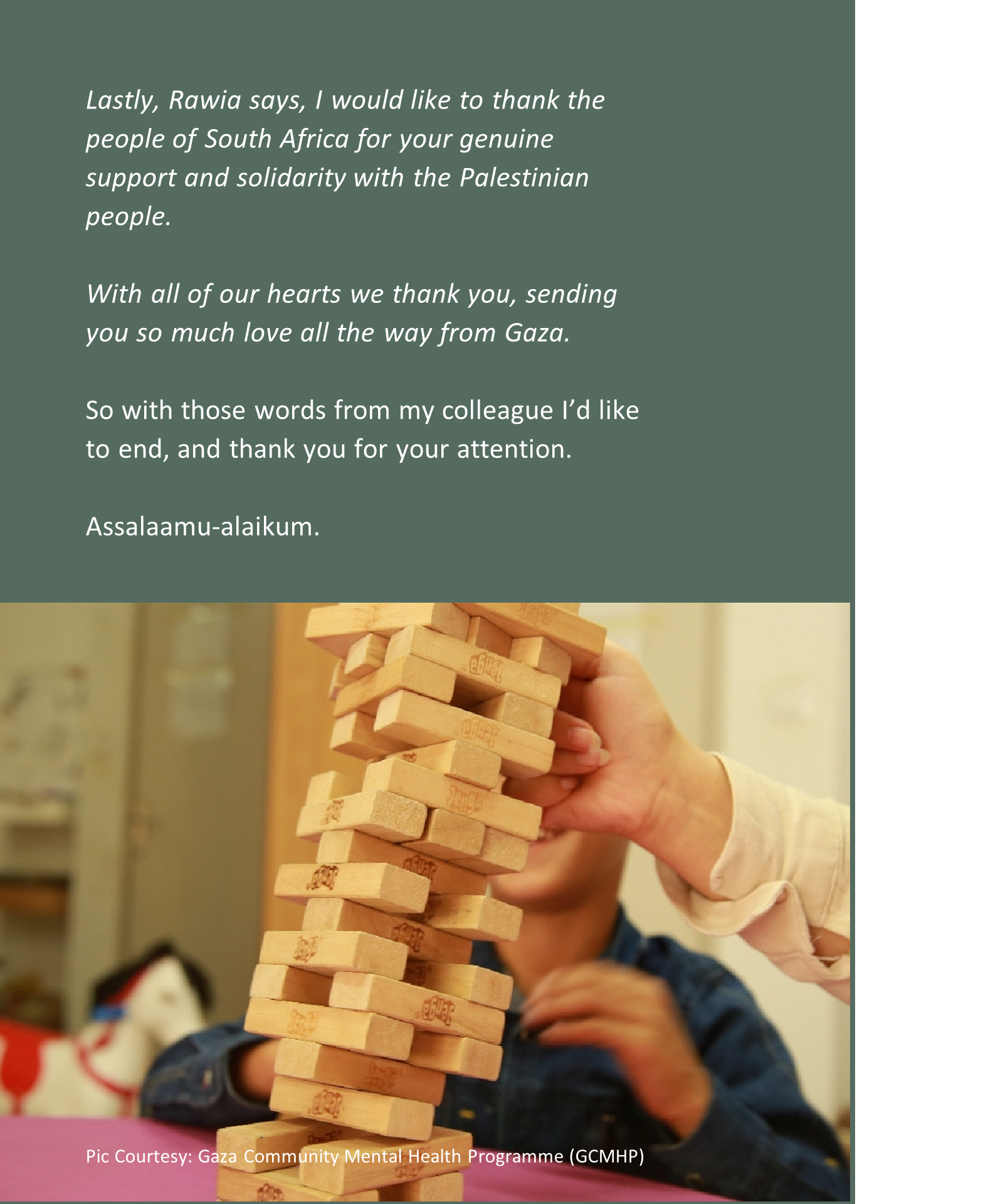
The Gaza Community Mental Health Center Programme continues to operate and serve the people of Gaza. They do their work in tents and makeshift shelters so that men, women and children can continue to receive counselling and psychological support for grief, trauma, loss, and the horror of what they have experienced.
So what is recommended going forward? Obviously, an end to Israeli aggression and the protection of people. In the context of providing humanitarian aid, it is necessary for mental health to remain integrated into health, education, protection, and shelter responses. There are likely to be people who have symptoms of severe traumatisation for which psychological and psychiatric treatment are in fact indicated.
Alongside such approaches, there are obvious interventions such as uniting family members, ensuring their physical safety, rebuilding housing structures, and recreating the fabric of society in a range of sectors especially health care – hospitals and clinics. But also rebuilding schools and universities, mosques, churches and other religious institutions, providing social services, and memorialising the thousands of people who were murdered in the form of burial grounds, monuments, community activities.
The way forward is unchartered because the world has not seen such carnage in recent decades, but mental health professionals have an important role to play in helping families and individuals find new ways to manage their survivorship following the genocide.
There is no such thing as going back to normal because things have never been normal in Palestine, not since 1948. Going forward a nuanced approach is necessary that balances the need not to pathologize people at a population level but also to be alert to those who report symptoms of mental distress for which psychological or psychiatric treatment is indicated.
I want to end with the words of a colleague, whose name is Rawia Hamam and was living in the Bureij refugee camp, south of Gaza City because her house was destroyed by Israeli bombs.
I asked her to send me a message that I could share with you.
My colleague Rawia says:
As a mother I still worry for the safety of my family. My daughters and my son continue to be terrified. They cannot sleep easily.
They feel as if they are tied up and someone is suffocating them and beating them brutally without the ability to defend themselves.
Many children ask their parents if this is just a nightmare and ask to be given a sedative to sleep and to wake them up when this is over or to find themselves already in heaven.
Rawia says, what we need from you (and she is talking to us) is to talk about those massacres.
Talk about how the international community has not been able to protect us. Boycott the occupation products, their companies and everything that is related to them.

Contact details
Physical Address: 65 Foyle Ave,Crosby, Johannesburg
Postal Address: PO Box 291760, Melville, 2109
Phone: +27 11 837 3220
WhatsApp: +27 67 436 6303
Email: info@mediareviewnet.co.za mediareviewnetwork48@gmail.com Website: www.mediareviewnet.com
Account details

Bank: First National Bank (FNB)
Account Name: Media Review Network NPO
Account Type: Islamic Business Cheque
Account Number: 62351880896
Branch: Fordsburg Branch Code: 252505
NPO Reg No: 060-018-NPO
PBO Ref No: 930018793