
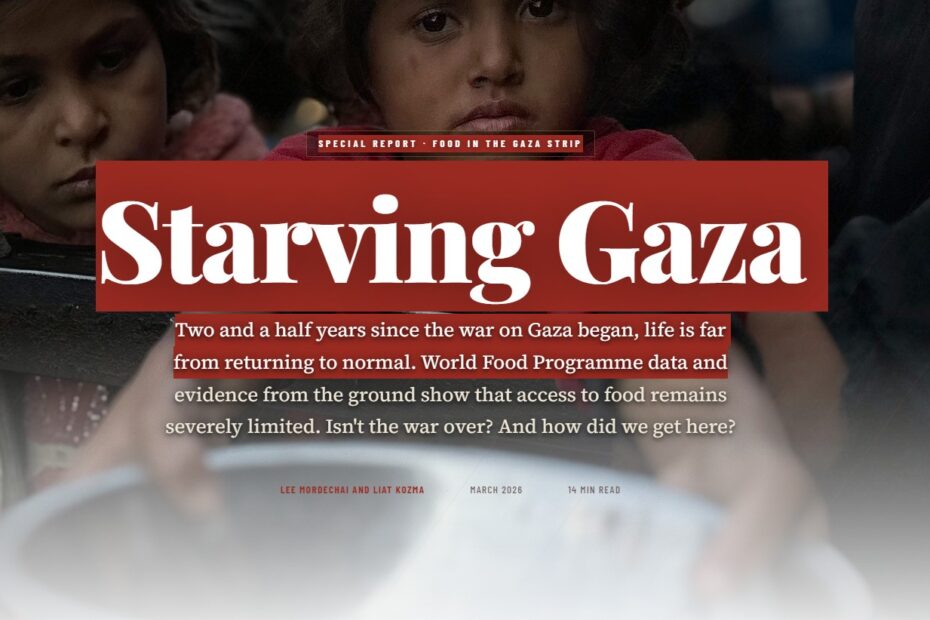
Two and a half years since the war on Gaza began, life is far from returning to normal. World Food Programme data and evidence from the ground show that access to food remains severely limited. Isn’t the war over? And how did we get here?
Queue for humanitarian aid in the Mawasi area, 23.12.25 (Photo: Doaa Albaz, Activestills)
We aim to trace here a chronicle of starvation, from the beginning of the war to spring 2026: from the declared intent, through the sustained practice of siege, to the consequences for family life — the young man walking kilometers in hopes of securing a sack of flour, the mother gathering weeds to feed her family, the teenager going to sleep hungry, and the toddler who has never seen an apple. We also examine here how hunger is measured and what the international indicators are based on.
Even before the war, the Gaza Strip was one of the most densely populated areas in the world. The Strip’s domestic production capacity was very limited. Only a small fraction of its territory was allocated to agriculture — and the Strip therefore relied on external imports and humanitarian aid.
Since 2007, Israel has imposed a blockade on the Gaza Strip and exercises de facto control over its entry points, using this to restrict — sometimes more, sometimes less — the supplies entering the Strip. During the war, this control led to outright starvation, causing the deaths of at least 463 people, many of them children. The declared purpose of the starvation policy was to pressure Hamas: there is no evidence that this policy achieved its goal, but there is extensive evidence that it brought the Strip to a famine of unprecedented proportions.

“It is a man-made disaster, a moral indictment – and a failure of humanity itself”
UN SECRETARY-GENERAL ANTONIO GUTERRES, ON THE UN IPC FOOD SECURITY REPORT ON GAZA, AUGUST 22, 2025
A Chronicle of Hunger
Key events: From the outbreak of war through spring 2026
The first ten days of the war
In response to the Hamas attack on October 7, Israel imposes a total blockade on the Strip. Defense Minister Yoav Gallant declares: ‘There will be no electricity, no food, no fuel — everything is closed. We are fighting human animals and we are acting accordingly.’ The blockade is lifted after ten days.
The entry into Gaza
A wave of hundreds of thousands of displaced people moves south. Rolling destruction of civilian infrastructure, including food shops, bakeries, and water reservoirs.
A brief respite
Alongside the release of Israeli hostages and Palestinian prisoners, a temporary entry of aid into the Strip was permitted, which ended when the ceasefire collapsed on December 1.
Israel adopts a new approach to the Palestinian population in Gaza
A complete halt of aid to the northern Strip, where tens of thousands of people remained.
A longer respite
During the second ceasefire, large-scale aid entry was permitted for six weeks.
Aid entry halted
Still during the ceasefire, Israel announces a complete halt of aid and goods entering the Strip. COGAT claims the existing stockpile in the Strip is sufficient for human sustenance. The total blockade lasts two and a half months.
Humanitarian aid turns lethal
Israel launches four food distribution compounds, all located far from population centers. These would later become death traps.
Sharp rise in starvation deaths
After two and a half months of total blockade and because the GHF solution provides only partial relief, the UN declares famine in the Strip, and images of skeletal figures are published worldwide, increasing the pressure on Israel.
Criticism of the Gaza Humanitarian Foundation
International pressure leads to an increase in aid entering the Strip.
Another respite?
Alongside the release of the last Israeli hostages and thousands of Palestinian prisoners, more food is allowed into the Gaza Strip — with a preference for commercial trucks over humanitarian aid.
STATED INTENT
In Their Own Words: Statements by Senior Israeli Officials
On October 9, 2023, then-Defense Minister Yoav Gallant declared a complete closure of the Gaza Strip to food, electricity, and water. Since then — whether as a means or an end in itself — Israeli ministers and members of Knesset have continued to state that the consequences of the siege — famine, and death from starvation and disease — are legitimate and even desirable. These statements were published repeatedly in Israeli media and on social networks, with almost no public criticism. These declarations and the lack of opposition to them by state institutions within Israel attest to the intentions of many actors within the civil service.
STATED INTENTIONS
What Israeli Leaders Are Saying
Filter by topic, role, and year. Hover over a card for the full quote, or click to keep it open.
“no electricity, no food, no water, no fuel”
“Without hunger and thirst”
“don’t give them a drop of water — let them die”
“important and correct”
“food and aid depots in Gaza should be bombed”
“no water hydrant will be opened”
“not be allowed into Gaza under any circumstances”
“Severe epidemics in the south of the Gaza Strip will bring victory closer”
“a grain of wheat”
“I will starve the residents of Gaza, yes, that is our obligation”
“not receive a drop of water or a single battery”
“no non-combatants in Gaza”
“it may be just and moral”
“no humanitarian aid will enter Gaza”
“any crumb or grain”
“not a gram of humanitarian aid”
“don’t allow water in”
“destruction of all water, food, and energy sources”
“no reason to allow even a gram of food or aid”
“simply not true”
LIFE AND DEATH IN WARTIME
Humanitarian Aid to Gaza
How does one measure the nutritional status of two million people? A comprehensive survey of the entire population — using hospital or clinic data, for example — is impossible under wartime conditions. Only the most severe emergencies reach the hospitals, the clinics that still exist operate under field conditions, and the many displaced people have difficulty reaching them. The World Food Programme therefore monitors prices of basic food products and conducts periodic surveys among thousands of families, based on several basic questions: When did you last eat animal protein? How many times in the past month did you go to sleep hungry?
In practice, most public attention — when there was any — focused on the number of trucks entering the Strip, an approach that shifted the discourse from hungry human beings to logistics. One measure for estimating the amount of food available in the Strip is the number of trucks authorized to enter it each day. This is a very crude measure: it does not tell us what the trucks carry (flour? water? snacks? tents?), nor where they end up inside the Strip. Moreover, while Israel counts trucks, humanitarian organizations warn that since the start of the war, trucks have been allowed to enter the Strip only partially full, and therefore estimates of aid volume need to be adjusted accordingly.
In this article, we delve deeper into the details that shaped the nutritional reality of Gaza’s residents over the past two and a half years, a period characterized by volatility — sometimes extreme — over which the vast majority of Gazans had no control. To understand this volatility and its consequences, we will look at the numbers of trucks entering Gaza, follow the journey of one such truck on its way to Gaza’s hungry people, examine how food prices shifted sharply and made food less accessible, and explore the impact of all this on what an average family ate from the onset of the war through early 2026.
PART I
The Lifeline: Truck Entries
ENTRY POINT
Ups and downs in humanitarian aid
Five phases shaped by war, diplomacy — and one total blockade.
Data comes from the Israeli side — international figures are lower, sometimes significantly so.
PHASE 5 · PARTIAL REOPENING
Each icon = one truck per day
PHASE 1 · THE WAR BEGINSOctober 2023
~10 trucks / day
The first convoy enters on October 21, after 14 days of total blockade, with only 20 trucks. By the end of the month, a total of 241 trucks will have entered — about 10 per day on average since the outbreak of hostilities.
241 trucks total · ~10/day from October 7
PHASE 2 · FLUCTUATIONS IN AID VOLUMENovember 2023 – January 17, 2025
~163 trucks / day
The number of trucks entering the Strip increases following international pressure, but remains far below the Strip’s needs — which loses during this period most of its domestic production capacity and most of its food warehouses.
Average ~163 trucks/day · 14 months · multiple crossings
PHASE 3 · THE SECOND CEASEFIREJanuary 18 – February 28, 2025
~600 trucks / day
The ceasefire allows hundreds of trucks to enter daily, bringing relative relief and even allowing for some stockpiling. This reality will not persist.
16,800 trucks in Feb. 2025 · ~600/day · three crossings open
PHASE 4 · TOTAL BLOCKADEMarch – May 18, 2025
0 trucks / day
A total blockade on the Strip. Zero trucks. The World Health Organization and Doctors Without Borders warn that the population faces famine. Food stocks are depleted and children begin dying of malnutrition.
0 trucks · 79 days · all crossings closed
PHASE 5 · PARTIAL REOPENINGMay 19 – October 2025
~120 trucks / day
Aid resumes, but falls far short of the population’s needs. Most aid is distributed through GHF compounds, which are located far from population centers and open for less than half an hour per day.
Average ~120/day · data through October 2025
AID BLOCKADE
Aid — partial and temporary
Aid trucks entering the Gaza Strip since October 7, 2023. Data according to COGAT, available only through Oct. 2025 — UN figures are lower, sometimes significantly so.
PART II
The Road to the Plate
A TRUCK’S JOURNEY
Human and logistical hardships
Many trucks never reach their destination. Entry authorization for a truck does not indicate that its food reached those who need it.
Stop 1
The Border Crossing
The truck crosses into Gaza through one of the few crossing points still operational. After weeks of negotiations and security clearances, the cargo — flour, rice, canned goods, and medical supplies — is authorized to pass. Every truck that makes it through represents a bureaucratic victory measured in tons of survival.
Stop 2
Destroyed Roads
The truck struggles along a dirt trail pockmarked by months of bombardment. Roads have become a mix of rubble and sand. What was once a twenty-minute drive now takes hours, as drivers navigate between debris, collapsed buildings, and warnings of unexploded ordnance.
Stop 3
Looters on the Road
An armed gang blocks the route and attempts to seize the cargo. Desperate hunger has created anarchy along the aid corridors. Drivers face impossible choices — surrender supplies meant for thousands, or risk their lives. Some convoys lose part of their cargo; others are robbed completely. In some cases, organizations are forced to pay thousands of shekels in protection money.
Stop 4
Military Checkpoint
The truck arrives at a military checkpoint. Soldiers check documents, scan the cargo, and interrogate the driver. Delays stretch from minutes to hours. Some trucks are denied passage, their contents spoiling in the heat while authorization is debated through layers of command.
Stop 5
The Distribution Point
The truck finally reaches a cleared plot of land near a destroyed school. Aid workers begin unloading and sorting supplies into family rations. Word spreads quickly among the nearby displacement camps — people start walking toward the site before the first box is opened.
Stop 6
Not Enough for Everyone
Displaced families line up before dawn, but supplies run out long before the line ends. Mothers leave empty-handed. Children who walked for hours return with nothing. A single truck cannot feed a population of hundreds of thousands. The arithmetic of hunger is merciless — and tomorrow there may be no truck at all.
PART III
The Cost of Survival
Food availability in the Gaza Strip since the beginning of the war has several notable characteristics:
- Shortage of basic food products.
- Volatility between relative availability and severe scarcity.
- A combination of both led at times to sharp price spikes, leaving many in the Strip without food.
The price of survival
How have the prices of basic necessities in the Gaza Strip changed over the past two and a half years?
The baseline
A sack of flour, a month of life
Before October 2023, a 25 kg sack of wheat flour cost about 47.5 NIS. By the summer of 2025, that same sack cost 1,500 NIS in Gaza’s markets. Flour is the foundation of everything: dough, bread, the meals that hold families together.
Oil
Without oil, there is no cooking
Three liters of sunflower oil climbed from 31 to 225 NIS. Oil is an essential but invisible staple: without it, you cannot fry, bake, or add flavor to food. Families were forced to cook in plain water, or eat dry bread.
Onions
When onions become a luxury
The price of the humble onion — a product so cheap you normally don’t even give it a second thought — surged from 3.20 to 140 NIS per kilogram. Economists track onion prices the way miners track canaries: when the cheapest vegetable becomes unaffordable, the food system has collapsed.
Cooking gas
Burning waste as a cooking fuel
The price of cooking gas surged from 5.90 to 550 NIS per kilogram. In northern Gaza, gas disappeared from the market entirely. Over 60 percent of households burned waste, rubble, and furniture to cook the little they had, filling displacement camps with toxic smoke.
0151303454605May 202420252026
WFP Market Monitor · average market prices, September 2023 – February 2026
What About Other Products?
Select a category and product to view the price trend since May 2024. Hover over the chart for exact figures.
043186212941725May 202420252026NIS×32vs. pre-war price
WFP Market Monitor · Gaza governorate average · NIS
CALCULATOR
What Does This Really Mean?
Calculate what your grocery basket would cost at Gaza 2025 prices
* Price based on median food price increase per WFP data, July 2025 (price peak)
PART IV
Nutrition and Hunger in Gaza
The commodities that vanished from the weekly menu
World Food Programme data reveal how the past two and a half years have depleted the dietary diversity of Gaza’s residents: it examines how many days per week people consumed different products — fruits, vegetables, cereals and legumes, animal protein, and more.
February 2026
Current situation
▼ 32% from pre-war dietary level
Bread & cereals
7.0
Pulses
3.9
Dairy products
2.9
Vegetables
2.0
Fruits
0.5
Meat, fish & eggs
1.3
Oil & fats
5.3
Sugar & sweets
1.6
Days per week · WFP Food Security Assessments, 2023–2026
BEFORE OCTOBER 2023
A table that was full
Each row in the chart on the right represents a food group — bread, vegetables, dairy, protein, and more. Each cell represents one day of the week: seven full cells means that food group was consumed every day. The data is based on periodic WFP surveys that contact many different families each month. Before October 7, an average family in Gaza ate nearly all food groups every week: fresh bread, vegetables, dairy products, pulses — and at least once or twice a week, animal protein as well. The numerical score at the top shows overall dietary diversity — how nutritious Gaza’s diet was relative to recommended levels. Before October 7, the Khalil family from Gaza City ate all food groups every week. Fatima cooked lentil soup, roasted fresh vegetables from the market, and served fresh bread with olive oil — consumed nearly every day. The children drank milk in the evening. On Fridays, the family ate a chicken dish. It was not abundance, but it was a varied and complete menu composed of eight food groups.
SEPTEMBER 2024
Aid arrives, cooking fades
One year into the war, the Khalil family has been displaced to Rafah and then to the Mawasi, where they receive partial aid. Pulses consumption rises above pre-war levels due to WFP distributions, but oil — a cornerstone of Palestinian cooking — has dropped to half of pre-war consumption. Fresh dairy products have nearly disappeared. The family hasn’t seen fresh milk in weeks. Cooking gas is so scarce that many meals are eaten uncooked. The way people eat is changing.
Average across 5 governorates. Source: WFP Market Monitor, November 2024.
NOVEMBER 2024
The floor gives way
November marks the deepest collapse to date. Protein consumption drops to nearly zero. Dairy consumption crashes to roughly once every ten days. Sugar has almost entirely disappeared. Oil, once a daily staple, is consumed less than twice a week. In the second year of the war, the Khalil family’s menu has lost nearly all diversity. Only cereals and pulses remain.
Average across 4 governorates (Rafah was not surveyed in Nov. 2024). Source: WFP-0000163207.
DECEMBER 2024
Small signals, same crisis
December shows small fluctuations — a new wave of aid reaches certain areas. In the central governorates, dairy consumption rises slightly as powdered milk arrives. There is a small uptick in vegetable consumption. But these are background noise against a catastrophic baseline. Oil remains below half its pre-war level. No protein. No fresh food. Three-year-old Layla does not remember what an apple looks like. Every small addition feels significant only against the empty plate.
Average across 5 governorates. Source: WFP-0000164123 (FSA January 2025, corrected December 2024 data).
JANUARY 2025
The ceasefire arrives
On January 19, 2025, the ceasefire takes effect. Aid convoys stream into the Strip. Within days, the data shifts: dairy climbs from near-zero to once every five days. Vegetable and fruit consumption returns, albeit in very limited amounts. Oil approaches two days per week. For the first time since August, the Khalil family receives powdered milk. This is hope — fragile, partial, and very welcome.
Reflects the ceasefire that began on January 19, 2025. Average across 5 governorates. Source: WFP-0000164964.
FEBRUARY 2025
The best month since the war began
February 2025 shows the highest figures since the war began. Dairy consumption jumps to once every two days — families report fresh milk and powdered milk through both aid distribution and on the market. Vegetable consumption reaches twice a week. Oil returns to nearly four days per week, approaching pre-war consumption levels. Sugar recovers to near its previous levels. One day, father Walid takes the children to the market in Gaza City. If you ignore the terrible destruction around for a moment, you can briefly forget the horrors of war.
Ceasefire fully in effect. Average across 5 governorates. Source: WFP-0000164964. Oil and sugar data were not reported in subsequent FSA rounds.
APRIL 2025
Bread and beans
The ceasefire ended in March. Food in the Strip is dwindling, but there is still enough to eat cereals and pulses. Dairy consumption falls back to one day per week. Protein — fish or meat — disappears again: zero. The family survives on flour rations and canned beans, which require standing in long lines that sometimes end in nothing. The temporary recovery in February already feels like a distant dream.
MAY 2025
The blockade continues
The blockade continues into May. Dairy products disappear again. Seven-year-old Ahmed gives up and hands his little sister the last cup of milk made from the expired powder that Walid managed to buy. Vegetable consumption plummets to half a day per week. Fruits vanish from the menu. Even cereal supplies themselves begin to crumble as flour shipments are halted, dropping to six days per week. Protein remains at zero. For the Khalil family, hunger becomes a daily condition.
JUNE 2025
The absolute nadir
The GHF compounds begin operating, but the nutrition they provide reaches only those capable of walking kilometers in the dark and then competing for food boxes against thousands of other starving people. Dietary diversity hits its lowest point. Cereals drop to four days — families eat them only once every two days. The weekly menu consists of bread when available, lentils when not. Four out of six core food groups have effectively ceased to exist. Little Layla is found to be suffering from malnutrition and receives regular treatment at the nearest medical tent. This is famine.
AUGUST 2025
Surviving, barely
The third month of GHF operations, supplemented by independent humanitarian aid that is permitted to enter the Strip — in limited quantities. Cereal consumption recovers slightly to nearly five days per week, but everything else remains near zero. Dairy — once every ten days at best. Protein — 0.1, virtually nonexistent. WFP data indicates that 95% of households go to sleep hungry. The Khalil family eats one to one and a half meals per day. Their eldest son Lutouf, fourteen years old, has not eaten protein in weeks. The IPC classifies their governorate as Phase 5: Catastrophe.
OCTOBER 2025
First real improvement
Aid supply increases across all governorates. Dairy consumption reaches nearly three days per week — the highest since the January ceasefire. Vegetables and fruits return to half a day per week. Protein appears — barely, but it appears. For the Khalil family, this means eggs perhaps once or twice a month and a handful of greens in the soup. Oil rises to nearly four days. Layla has recovered somewhat and gone back to playing outside the tent.
NOVEMBER 2025
Slow recovery
Vegetables climb to a day and a half per week — triple the August level. Dairy — nearly three days. Protein stabilizes at half a day. The numbers remain a fraction of pre-war levels, but they are heading in the right direction. Oil returns to four days and more. The family goes through days without protein, but not weeks. The children’s weight begins to stabilize.
JANUARY 2026
The best month
January shows the strongest recovery to date. Dairy — three days per week. Vegetables — more than two days. Protein — more than one day per week, for the first time in months. Oil — five and a half days. And yet even now — the best month in the past two years — dietary diversity is only about two-thirds of pre-war levels. The path ahead is still long.
FEBRUARY 2026
Stable, but lacking
The numbers stabilize. Cereals every day, dairy nearly three times per week, vegetables twice. Oil — more than five days. But fruit — only half a day per week, protein — a day and a quarter. Before the war, both appeared nearly every day. A full rehabilitation of Gaza’s food system will take years — assuming the ceasefire holds. It has not always held in the past.
PART V
Consequences
The lack of access to food led to death by starvation.
The lack of access to food led to death by starvation. These deaths — of at least 463 people — occurred mainly during two periods of particularly extreme shortage: early 2024, in the context of cumulative deprivation from the start of the war, and mid-2025, after a total blockade lasting two and a half months. However, these mortality figures are necessarily partial — because they do not include those who died far from hospitals and were therefore never counted.
Beyond the numbers, prolonged hunger and nutritional deficiencies led to outcomes that are harder to measure. Doctors who worked in the Strip report slow recovery from injuries, surgeries, and illnesses, as a consequence of sustained malnutrition and vitamins and minerals deficiencies. Nutritional deficiencies affect infants and children in particular, as well as the chronically ill and the wounded.
“Today I saw a girl who hit her little sister. I immediately grabbed her hand to stop her and asked her why she had hit her. She answered: ‘Because she stole half a loaf of bread and ate it by herself, and it was the last bread we had and we agreed among ourselves that Mom would divide it.’ I took her to my tent and gave her the leftover food I had. She came close to me and shyly asked — ‘Can you be my dad instead of my dad who was killed and bring us food every day?'”
MALEK, A PALESTINIAN FROM GAZA, APRIL 23, 2025
The starvation of Gaza as an indicator of the unraveling world order
Starvation is a war crime under international law. Starvation was also one of the grounds on which the International Criminal Court issued arrest warrants against Prime Minister Benjamin Netanyahu and former Defense Minister Yoav Gallant.
Despite a long list of international organizations warning over the past two and a half years that Gaza is gripped by famine, the countries of the world have mostly shrugged. If the total blockade Israel imposed in early October 2023 was partially lifted within a week and a half under international pressure, the spring 2025 blockade lasted for more than two and a half months. Today, the prolonged food shortage in the Strip barely makes the news — after all, we have already seen worse.
The implications of this reality extend beyond Gaza. The standards of conduct in wartime that were forged in the wake of the horrors of the World Wars are crumbling before our eyes. Gaza is becoming the new standard.
The reality in Gaza undermines the future and security of us all.