
By Sõzarn Barday
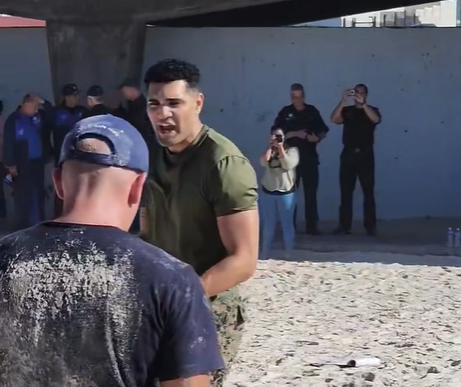
On 24 March 2026, videos circulated widely on social media showing members of the United States Marine Corps conducting what appeared to be joint training exercises with Cape Town Metro Police at Muizenberg Beach. The footage — foreign military personnel running drills alongside local law enforcement — immediately raised questions about legality, oversight, and sovereignty.
In response, JP Smith, the City’s Mayoral Committee Member for Safety and Security, downplayed the incident. He stated that the Marines are permanently based in Cape Town as part of the security detachment for the United States consulate, and that the interaction formed part of efforts to support physical fitness training within the Metro Police. He further emphasised that the Marines were unarmed and “not acting as Marines.”
However, this explanation raises more questions than it resolves.
While diplomatic missions may host US Marine security guards, their mandate is narrowly defined: protection of diplomatic premises and personnel. It does not extend to operational engagement or training with domestic law enforcement agencies. The shift from consular security presence to active participation in police training is therefore not a matter of routine cooperation — it raises distinct legal and constitutional concerns.
South Africa’s legal framework is clear. The Regulation of Foreign Military Assistance Act 15 of 1998 prohibits foreign military assistance unless authorised by the state through the appropriate channels. Any such engagement must be approved by the National Conventional Arms Control Committee (NCACC), the body mandated to regulate foreign military involvement. In addition, the Department of International Relations and Cooperation (DIRCO) would ordinarily be expected to be informed or involved in any arrangement involving foreign military personnel operating in a domestic context.
At present, there has been no public indication that such approval was sought or granted. If that remains the case, the incident raises serious questions about procedural compliance and institutional oversight.
Smith has characterised public concern as “fake outrage,” suggesting the matter is being politically exaggerated ahead of elections. Yet dismissing legal and constitutional questions as political theatre risks obscuring the central issue: whether South Africa’s regulatory framework governing foreign military involvement was followed at all.
This is not merely an administrative detail. It goes to the heart of sovereignty and civilian oversight of security structures. Metro Police institutions cannot unilaterally engage with foreign military actors outside established legal and procurement frameworks. Allowing such interactions without clear authorisation risks setting a precedent that weakens institutional accountability.
Beyond the domestic legal questions, the incident carries a broader geopolitical dimension.
The visible cooperation between municipal law enforcement and the United States Marine Corps inevitably generates symbolic meaning beyond its immediate context. Even if informal or limited in scope, such interactions may be interpreted externally as signalling comfort or alignment with United States security structures.
This is particularly sensitive given ongoing international scrutiny of United States military operations abroad, including in Iran, where Washington has faced sustained criticism from parts of the international community and legal scholars over the use of force and questions surrounding respect for sovereignty. Whether or not one accepts these characterisations, perceptions in international relations carry significant weight — especially for countries like South Africa, which has long positioned itself as an advocate of multilateralism and respect for territorial sovereignty.
In this context, even routine-looking engagements between South African authorities and foreign military personnel risk creating ambiguity in diplomatic signalling. The concern is not necessarily that South Africa is formally aligning itself with any foreign military agenda, but that such interactions may be read — domestically or internationally — as a degree of comfort with external military conduct that is itself contested in relation to sovereignty norms.
At a time when global tensions around sovereignty, military intervention, and international law are increasingly pronounced, South Africa must be particularly cautious about maintaining clarity in its own institutional conduct.
The constitutional order rests on transparency, legality, and civilian control over security structures. Any deviation from established procedures governing foreign military involvement must therefore be subject to rigorous scrutiny.
The central question remains unanswered: who authorised this engagement, and under what legal framework?
Until that is clarified, the incident at Muizenberg is not merely about a training exercise on a beach. It is about the boundaries of sovereignty, the integrity of legal oversight mechanisms, and the standards by which South Africa manages foreign military presence within its borders.
If no authorisation exists, then accountability cannot be optional.
Because in matters of foreign military involvement, ambiguity is not neutral — it is itself a political position.
Sõzarn Barday is a South African lawyer and author focusing on human rights, international law, and geopolitical events in the Middle East. The views expressed are her own.