
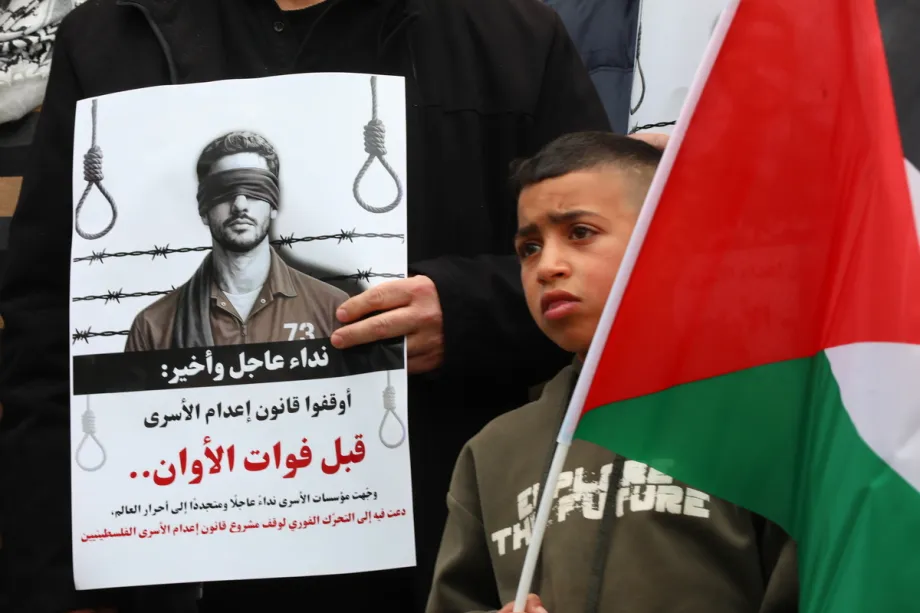
Demonstrators gather outside the International Committee of the Red Cross (ICRC) office to protest an Israeli law proposing the death penalty for Palestinian prisoners in Hebron, West Bank, Palestine on April 2, 2026. [Wisam Hashlamoun – Anadolu Agency]
The recent enactment of capital punishment legislation by the Knesset is not a mere domestic legal development. It is an act that demands examination under the most serious categories of international law. When a state creates a legal pathway to execute a specific, occupied population through a system structurally incapable of delivering justice, it does not simply violate rights—it enters the domain of prosecutable international crime.
The law’s intent is thinly veiled, and its effect unmistakable. It establishes a regime in which Palestinians, tried in military courts under occupation, may be sentenced to death and executed within an accelerated timeframe that all but extinguishes the possibility of meaningful appeal or clemency. The same law, in form, extends to Israeli citizens, yet in practice erects insurmountable barriers to its application against them. This asymmetry is not incidental. It is engineered.
International law has long recognised that discrimination, when embedded in legal systems, transforms into something far more insidious than isolated injustice. Article II of the International Convention on the Suppression and Punishment of the Crime of Apartheid is unequivocal in its language, defining apartheid as “inhuman acts committed for the purpose of establishing and maintaining domination by one racial group of persons over any other racial group of persons and systematically oppressing them.” Among these inhuman acts, the Convention explicitly includes the denial of the right to life and liberty of person.
What, then, is a law that facilitates execution under a discriminatory legal regime if not precisely such a denial?
READ: Israeli Knesset passes law mandating death penalty for Palestinian prisoners
The right to life is not a rhetorical aspiration. It is codified, binding, and non-derogable in its essence. Article 6 of the International Covenant on Civil and Political Rights provides that “every human being has the inherent right to life,” and that this right “shall be protected by law.” The same provision imposes the strictest limitations on the use of capital punishment, requiring not only that it be reserved for the most serious crimes, but that it be imposed following a process that meets the highest standards of fairness and due process.
A system that accelerates execution within ninety days, restricts avenues of appeal, and operates through military courts whose independence and impartiality are fundamentally compromised cannot, by any serious legal measure, meet these standards. It is not merely deficient. It is disqualified.
The jurisprudence of international human rights bodies has consistently reinforced this principle. The United Nations Human Rights Committee has held that the imposition of the death penalty following an unfair trial constitutes an arbitrary deprivation of life. The word “arbitrary” here is not casual; it is a term of art in international law, denoting actions that are unjust, unpredictable, and incompatible with legal norms.
By this definition, the law in question invites arbitrariness as a matter of design.
The use of military courts to try civilians in occupied territory introduces an additional and decisive layer of illegality. The Fourth Geneva Convention permits such courts only under conditions that guarantee fundamental judicial safeguards. These safeguards are not optional. They are the minimum threshold below which legal proceedings lose legitimacy. When conviction rates approach certainty, when access to counsel is constrained, and when the occupying power controls every aspect of the judicial process, the façade of legality collapses.
To impose the death penalty within such a system is to cross from illegality into what can only be described as judicialized execution.
There is, moreover, the question of method. Execution by hanging, a practice largely abandoned in modern legal systems, carries with it an inherent risk of prolonged suffering and degradation. International law does not treat all forms of capital punishment as equal. The prohibition of cruel, inhuman, or degrading treatment, articulated in the Convention Against Torture, extends to methods of execution that inflict unnecessary pain or humiliation. The reintroduction of hanging into a contemporary legal framework cannot be divorced from this prohibition.
It is an act that signals not restraint, but regression.
The cumulative effect of these elements—the discriminatory application, the compromised judicial process, the accelerated timeline, and the method of execution—must be assessed not in isolation but as a coherent whole.
When viewed in this manner, the law reveals itself as part of a broader system in which legal structures are deployed to maintain domination over a subordinated population.
This is the essence of apartheid.
The international community has, in recent years, shown an increasing willingness to name this reality. Reports and statements emerging from within the United Nations framework have pointed to patterns of discrimination and segregation that align with the legal definition of apartheid. The present law does not merely fit within this pattern; it intensifies it. It transforms a system of control into a system that claims the right to extinguish life with procedural efficiency.
In any functioning system of international accountability, such developments would trigger immediate and decisive action. The prohibition of apartheid is a jus cogens norm—a peremptory principle from which no derogation is permitted. It imposes obligations erga omnes, owed to the international community as a whole. These are not abstract legal concepts. They carry concrete consequences: the duty of states to refrain from recognising or assisting in the maintenance of such a regime, and the obligation to cooperate in its dismantling.
And yet, the response thus far has been marked by hesitation.
Expressions of concern have been issued. Diplomatic language has been deployed. But the gap between condemnation and consequence remains vast. This dissonance undermines not only the credibility of international law but its very purpose. A legal system that cannot respond to its own most serious violations risks becoming an empty formality.
It is here that responsibility extends beyond the state enacting the law to those that enable its persistence through silence or inaction.
The question that now confronts the world is not whether this law can be justified. It cannot. The question is whether the international community is prepared to treat it with the seriousness it demands. To do otherwise is to accept a world in which the machinery of death can be normalised under the guise of legality, and in which the protections of law are reserved for some and denied to others.
In such a world, the line between law and violence disappears.
And when that line is erased, what remains is not order, but domination—enforced, in this case, by the tightening of a noose.
The gallows of occupation: Law as execution in Israel’s apartheid state