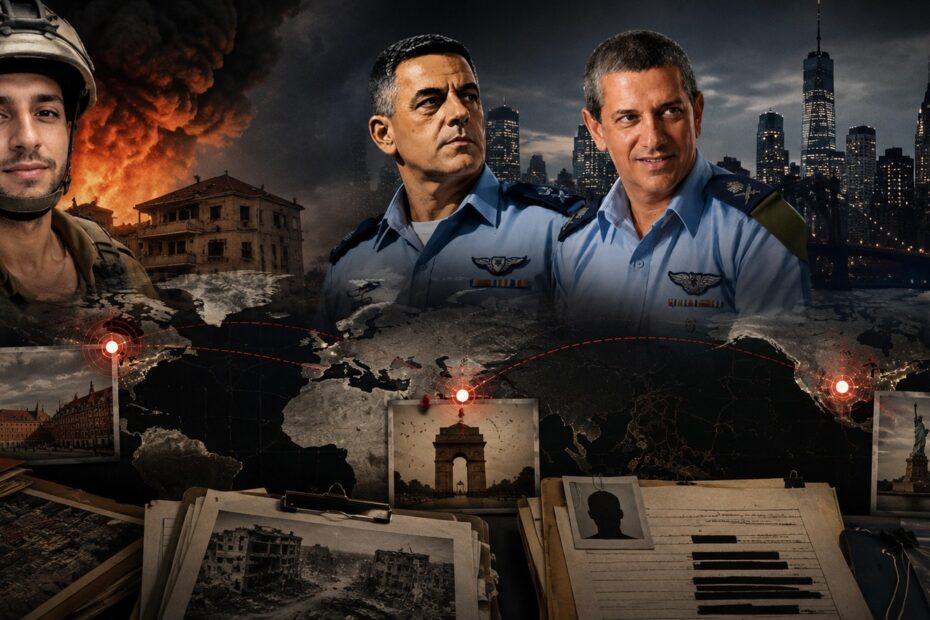
In recent days, the Hind Rajab Foundation (HRF) has launched a new series of legal and advocacy actions spanning three continents, further expanding the global effort to hold perpetrators of war crimes accountable. In India, HRF has called for the immediate arrest of Israeli reservist Eitan Gilboa, currently present in the country despite serious allegations linked to crimes committed in Gaza. In New York, HRF has demanded accountability for former senior Israeli Air Force commanders scheduled to appear at a Jerusalem Post conference, highlighting their alleged responsibility for devastating aerial campaigns against civilians. Meanwhile, in Poland, HRF has urgently requested the arrest of Jonathan Barkat, accused of war crimes, crimes against humanity, and genocide in Gaza.
Details below.
The Hind Rajab Foundation (HRF) has launched a new wave of international legal and advocacy actions spanning three continents, reinforcing a growing reality: individuals suspected of involvement in war crimes, crimes against humanity, and genocide in Gaza can no longer assume that international travel will shield them from scrutiny.
In recent days, HRF has called for action in India, Poland, and the United States against individuals alleged to bear responsibility for grave violations of international law. While the cases differ in their facts and legal frameworks, they share a common objective: ending the culture of impunity that has long protected those implicated in crimes against Palestinians.
In India, HRF has demanded the immediate arrest of Israeli reservist Eitan Gilboa, who is currently present in the country. The foundation argues that credible evidence linking Gilboa to crimes committed during military operations in Gaza requires urgent action by Indian authorities. HRF has called upon India to uphold its international obligations and ensure that its territory does not become a safe haven for individuals accused of serious international crimes.
At the same time, HRF has turned its attention to New York, where former Israeli Air Force commanders are scheduled to participate in a Jerusalem Post conference. The foundation has demanded accountability for senior military officials who allegedly played key roles in directing aerial campaigns that resulted in widespread civilian casualties and the destruction of homes, hospitals, schools, and other civilian infrastructure in Gaza. HRF argues that command responsibility does not disappear with retirement and that those who planned or oversaw military operations must also face legal scrutiny.
Meanwhile, in Poland, HRF has submitted an urgent demand for the arrest of Jonathan Barkat, who is accused of war crimes, crimes against humanity, and genocide. The foundation maintains that the evidence available against Barkat warrants immediate investigation and that Polish authorities have both the legal authority and the responsibility to act. The case reflects a broader effort to activate national jurisdictions against suspects who travel abroad despite allegations of involvement in grave international crimes.
Taken together, these three actions illustrate the evolving landscape of international accountability. Increasingly, legal complaints are not limited to direct perpetrators on the battlefield but extend to reservists, commanders, and individuals whose actions or decisions may have contributed to unlawful attacks against civilians. The growing use of universal jurisdiction and other accountability mechanisms is creating new avenues for justice where political obstacles have long stood in the way.
These cases are also part of a much wider effort. Over recent weeks, HRF has initiated numerous legal actions across multiple jurisdictions, many of which remain confidential for strategic reasons. Each filing contributes to a broader international network of accountability aimed at ensuring that serious violations of international law are investigated wherever suspects may be found.
The message emerging from India, Poland, and New York is clear: accountability is no longer confined by borders. As more jurisdictions become engaged and more evidence reaches prosecutors and law-enforcement agencies, the space for impunity continues to shrink. Justice may be gradual, but it advances one case at a time, one jurisdiction at a time, until impunity has nowhere left to hide.