
Everything you need to know.
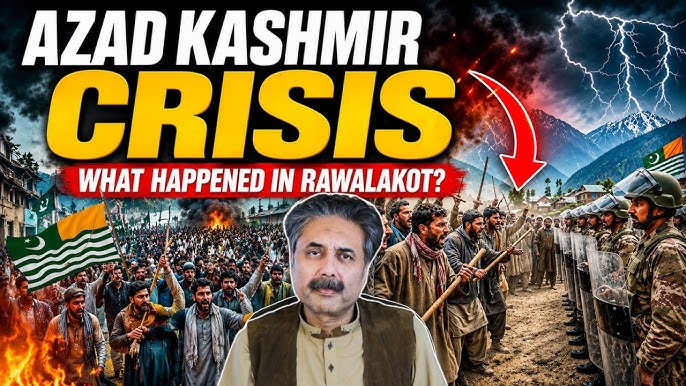
Azad Jammu and Kashmir (AJK), the part of Kashmir administered by Pakistan, is facing its most serious unrest since a protest movement first emerged in 2023. Here is everything you need to know. A dispatch from Pakistan.
The context
For days now, AJK has gone dark. Across the territory the internet has been switched off and only patchy phone services remain, leaving families abroad unable to reach relatives while the rest of the world is left to piece together events from fragments.
What has filtered out is alarming: in the town of Rawalakot, several people have been killed – estimates vary from 11 to 30 – after Pakistani armed forces moved against a grassroots coalition, the Jammu Kashmir Joint Awami Action Committee (JKJAAC), which the government had recently outlawed under anti-terrorism legislation.
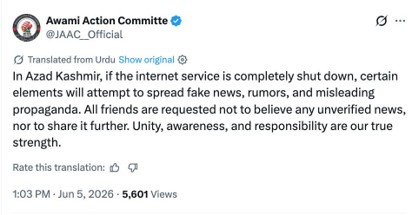
The coalition had called a region-wide strike and long march for June 9.
In the days leading up to it, authorities banned the mobilisation, arrested scores of activists, deployed thousands of additional personnel, and effectively cut the region off from the outside world.
As ever, protest leaders and government officials offer sharply conflicting accounts of how the violence unfolded and who bears responsibility. With communications severed, even the death toll has become a matter of dispute, impossible to verify independently.
The confrontation comes less than two months before legislative elections scheduled for July 27, intensifying a crisis that began over economic grievances — electricity costs, food prices, and demands for greater local control over the region’s resources – before evolving into a broader struggle over governance, accountability, and political representation.
Who is behind the protest movement?
The movement is led by the Jammu Kashmir Joint Awami Action Committee (JKJAAC), commonly known as JAAC or AAC.
Founded in September 2023 and headquartered in Muzaffarabad, the JAAC is a broad civil-society coalition bringing together traders, transporters, lawyers, students and other civic groups around a shared set of economic and governance demands.
The JAAC has been the driving force behind region-wide strikes and demonstrations since its formation.
It also led the major protest movements over economic and political grievances that swept AJK in 2024 and 2025.
The flashpoint: reserved seats
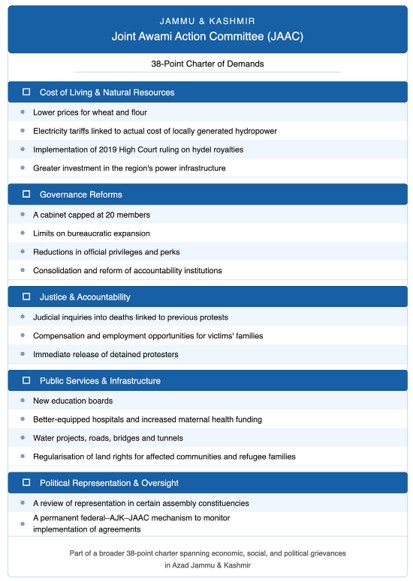
JAAC’s programme is built around a 38-point charter of demands that goes well beyond a single issue.
The group portrays the movement as a peaceful campaign for rights, accountability and the fulfillment of commitments previously made by authorities.
Government officials contend that substantial progress has already been made, maintaining that 35 of the 38 demands have been accepted.
According to the local government, the remaining three involve constitutional, political and financial questions that cannot be resolved through executive action alone.
Movement leaders dispute this assessment.
They argue that many commitments were accepted only in principle and have yet to be meaningfully implemented, making renewed mobilisation necessary.
Of all the committee’s demands, it is the dispute over reserved assembly seats that has become the central point of contention.
JAAC is demanding the abolition of 12 seats in the AJK Legislative Assembly reserved for refugees from Indian-occupied Kashmir who made their way to different parts of Pakistan following Partition in 1947 and after the 1965 India-Pakistan war.
The reserved seats were created under the AJK Act of 1970 rather than by the constitution itself, and were only later given constitutional protection through an amendment. This sits at the heart of the dispute, as the committee argues the seats were added to the constitution only after their legality was challenged.
The refugees in question are not residents of Azad Kashmir.
They and their descendants migrated from historic Jammu and Kashmir in 1947 and again in 1965, and settled across mainland Pakistan, concentrated in cities such as Karachi, Lahore, Rawalpindi and Sialkot, with the voters of some constituencies dispersed across more than two dozen districts of Sindh and Balochistan.
They are numbered at roughly 464,000, though the distribution is sharply uneven: around 434,000 registered as refugees from the Jammu division and only about 30,000 from the Kashmir region. Despite this disparity, each group elects six members to the assembly.
Many, particularly from Jammu, are widely held to have assimilated into the local population over the decades, as argued by prominent jurist of AJK, Justice Syed Manzoor Gilani.
The committee argues that the seats no longer reflect a genuine refugee constituency, given that they are elected by a large and widely dispersed population living outside the territory but still helping determine its government. It adds that the seats reserved for these Kashmiris in other parts of Pakistan allow Pakistan’s major political parties to exert undue influence over government formation in Muzaffarabad.
By “undue influence,” the movement means a structural lever: of the assembly’s 53 seats only 33 are directly elected from within Azad Kashmir, so the 12 refugee seats, voted on outside the territory, by a dispersed electorate, with minimal oversight from the AJK Election Commission, form a bloc large enough to tip the formation of any government in Muzaffarabad.
Whoever controls the federal or provincial machinery where those voters live, the committee argues, can effectively deliver the bloc, allowing mainstream Pakistani parties to decide who rules AJK without winning over its residents.
Abolishing the seats, in this view, would tie the Muzaffarabad government to an electorate that actually lives in the territory and strengthen local accountability.
Pressed on the objection that the seats embody AJK’s claim to the whole of historic Jammu and Kashmir – and that abolishing them would amount to accepting permanent partition – the committee offers two responses.
First, it says its aim is to reform what it regards as a flawed and fraudulent system, not to disenfranchise genuine refugees.
Second, it argues the Kashmir dispute rests on international law and Pakistan’s custodial role, nor on the existence of 12 assembly seats, and that refugees’ identity and rights could be preserved through other, more transparent measures.
Those opposing JAAC’s demand, including some members of Kashmiri population living in mainland Pakistan as well as the government itself say the reserved seats were envisaged to preserve the political link between Kashmiri refugees living across Pakistan and the wider state of Jammu and Kashmir pending a final settlement of the dispute.
Defenders of the seats, like former AJK Prime Minister Sardar Attique Ahmed Khan, argue that ending refugee representation in the territory administered by Pakistan would weaken Islamabad’s longstanding position at the United Nations that the status of Jammu and Kashmir remains unresolved pending a plebiscite. In his view, abolishing the seats would signal that Pakistan itself has come to regard the region’s division as permanent.
The legal force of this claim is disputed. The relevant UN resolutions concern an interstate dispute and do not require Pakistan to reserve seats in a domestic assembly for refugees. From this perspective, the seats are a political arrangement rather than an international obligation.
The argument is therefore better understood as one about symbolism and political signalling rather than one carrying any direct legal consequences at the UN.
This concern is shared by the refugee communities themselves.
Some go further, warning that the same principle, denying representation to Kashmiris who no longer reside in the territory, could eventually be turned against the Kashmiri diaspora settled in Britain and other Western countries, challenging their right to vote in, or hold property in, Azad Kashmir.
The JAAC committee rejects this analogy, arguing that its objection is to fraudulent voter rolls and out-of-territory electoral control rather than to diaspora Kashmiris maintaining their ties to the state.
Even many defenders of the current arrangement, like AJK Member Legislative Assembly Ahmed Raza Qadri, acknowledge its shortcomings. They point to significant disparities in representation, scattered voter populations across Pakistan and long-standing accusations that political parties use the seats to influence government formation in AJK.
They also view the timing of the demand, coming just weeks before the July 27 elections, as politically significant in its own right.
Their argument is that these problems require reform and redistribution rather than outright abolition driven by protests or mass mobilisation.
Former Education Minister, Syed Iftikhar Gilani, for instance, asked the coalition leaders to become part of the electoral process and abolish these seats through constitutional means via the Legislative Assembly.
How it escalated
The current confrontation intensified in the days leading up to JAAC’s planned June 9 long march.
After receiving presidential approval, the AJK government formally banned the organisation under the Anti-Terrorism Act, 2014.
Officials accused the group of promoting terrorism, public intimidation, hatred and disorder.
JAAC rejected the allegations, insisting it remained a peaceful movement and declaring that its protest campaign would continue.
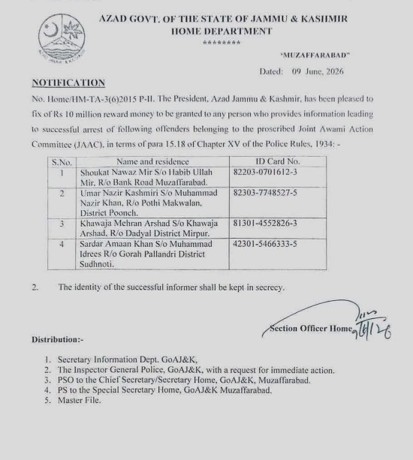
The AJK government also announced a reward of 10 million rupees ($35,000) for information leading to the arrest of four leaders of the campaign.
At the same time, authorities requested roughly 14,000 additional armed forces from federal and provincial agencies, issued a travel advisory, and launched a broad crackdown on the movement.
According to official government sources, more than 200 activists and supporters were detained across AJK, while others reportedly went into hiding.
Government officials argued that the measures were necessary to maintain law and order and prevent unrest ahead of the planned march.
JAAC, meanwhile, characterised the detentions as politically motivated and maintained that its movement remained peaceful.
Its leaders repeatedly urged supporters not to damage public or private property.
The most serious violence occurred in Rawalakot, in Poonch district, where the two sides offer sharply conflicting accounts of what transpired.
According to JAAC, security forces – particularly the Rangers – opened fire as well deployed tear gas on a peaceful sit-in.
The organisation said four young men were wounded on June 7 and taken to the Combined Military Hospital (CMH). It further alleged that firing continued from the evening of June 8 and claimed that multiple protesters were killed and dozens injured.
Government officials reject that account. According to Divisional Commissioner Sardar Waheed Khan, protesters surrounded and effectively took control of the military-run CMH in Rawalakot, forcing doctors and paramedics to flee.
He alleged that treatment of injured law enforcement personnel was obstructed and claimed that some protesters used firearms, petrol bombs, and other weapons in coordinated attacks on security forces.
Officials described the clashes as resembling “guerrilla-style” attacks launched from side streets and alleys.
Tensions escalated further following reports of violence against prominent JAAC figures.
Media reports claimed that police opened fire on two senior members of the organisation, Umar Nazir Kashmiri and Shahzaib Habib. According to those reports, Nazir Kashmiri was injured while Habib was killed. The reported killing of Habib quickly became a rallying point for protesters and contributed to the broader escalation in Rawalakot.
Casualty figures remain among the most contested aspects of the crisis. According to official accounts, 11 people were killed in the violence – seven civilians and four members of the armed forces.
Authorities identified the slain police personnel as SHO Hajira Muhammad Inayat and constables Muhammad Faisal, Faheem Anwar, and another officer. Officials also reported injuries to more than 20 armed forces and dozens of protesters.
The civilians who were killed were identified as Usman Sabir of Koiyan village, Fahad Barkat of Rehara village, ex-serviceman Wasaid Siddique of Parrat village, Naqash Zardad of Matyalmera Danna village, Jamshed Ashraf of Hussainkot village, Muhammad Rasheed of Choti Nakkar Pakhar village and Tariq Resham of Dothan village.
JAAC supporters and local residents dispute the official version of events, including the circumstances surrounding several of the deaths, and argue that the civilian toll may be much higher than acknowledged.
Multiple reports have emerged of people being arbitrarily detained or questioned by the security and government agencies.
With communications heavily restricted and independent verification difficult, many details remain unknown, contested, or incomplete.
With independent verification cut off, official accounts become harder to corroborate – and harder to believe for those already not inclined to trust them.
The communications shutdown
Alongside the security operation, authorities imposed extensive communications restrictions across AJK.
The region is experiencing a near-total internet blackout, with only limited mobile and landline services remaining available.
A notice bearing the branding of the Pakistan Telecommunication Authority (PTA) ordered the suspension of all fixed-line data services across AJK from the night of June 5 until the night of June 12, covering the period of the planned protests.
The restrictions mirror measures taken during previous periods of unrest.
The disruption has been significant enough that the University of Azad Jammu and Kashmir postponed examinations scheduled during the blackout period.
JAAC has made the communications shutdown a major grievance in its own right. Senior leader Shaukat Nawaz Mir has called on Kashmiris living abroad to protest the blackout and raise the issue with international human rights organisations.
The restrictions have also drawn attention overseas.
Several British MPs have voiced concern about both the crackdown and the communications blackout, with at least one reporting that constituents were unable to contact relatives in the region. Demonstrations expressing solidarity with the protesters have also been reported outside the Pakistan High Commission in London.
Whose story is it?
Indian state and private media outlets have given the unrest extensive coverage and have incorporated the crisis into its own colonial imagination.
Every episode of unrest in AJK is used by India to reinforce its narrative that residents of Pakistan-administered Kashmir are dissatisfied and that the region itself is unstable.
In other words, Indian discourse on the protests reflects a broader expansionist outlook that became more pronounced after New Delhi revoked Article 370 and Article 35A in 2019, thereby ending the semi-autonomous status of Jammu and Kashmir under Indian control.
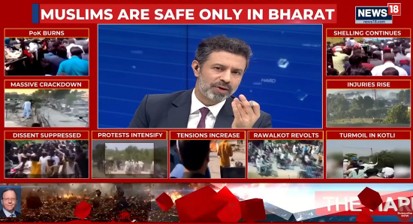
In this view, repeated calls by Indian politicians and commentators to New Delhi’s right to take over Pakistan-administered Kashmir means that unrest in AJK is often interpreted in Pakistan as a strategic opportunity for New Delhi to advance its claims, politically and militarily.
JAAC has consistently rejected allegations that its movement is linked to India.
Its leaders describe the campaign as a domestic dispute with the AJK and federal governments rather than a challenge to Pakistan itself.
Senior figure Imtiaz Aslam has previously said the organisation is self-funded and has argued that accusations of an Indian connection are routinely used to discredit critics and activists.
Shaukat Nawaz Mir, foremost leader of the movement, has similarly insisted that the movement is neither anti-Pakistan nor anti-military. While critical of specific individuals and policies, he has gone so far as to publicly credit and prais the military leadership’s role in “maintaining regional stability” and has framed the struggle as one centred on governance and accountability.
In a video published a couple of days ago, Mir, addressing Pakistani Field Marshal Asim Munir, stated:
“You are very respectable for us. The whole world acknowledges your efforts for peace. You are a source of great pride for Pakistan, the people of Pakistan, and Kashmir. It was you who gave India a bloody nose when they attacked the innocent civilians in Azad Kashmir (in May 2025)…We are on the streets for the last three years to end the marginalization of our common people caused by the incompetence and failures of the so-called politicians and political parties of Azad Kashmir.”
Mir’s statement appears aimed at distancing the movement from any suggestion that it is aligned with Indian interests.
If anything, Indian media discourse has worked against the protesters, who must, unfairly, expend considerable energy deflecting the accusation that they act at India’s behest.
Pakistani state media, for instance, has accused the movement of being backed by Indian intelligence agency, RAW.
India highlights the unrest through the lens of its own imperial interests; Pakistani commentators often dismiss that framing as propaganda; and JAAC seeks to maintain a third position, pressing its demands while denying that it serves the interests of either side.
For observers, the key distinction has to be between the local grievances driving the protests and the broader statist narratives that obfuscate the former.
The deeper pattern is what these mirror-image accusations do to the people caught between them.
A movement that began with complaints about electricity costs, food prices, and who controls the region’s resources has been drawn into the rival narratives of both capitals: for New Delhi, it is evidence of Pakistan’s human rights abuses; for Islamabad, proof of Indian meddling.
In each telling, the people of Azad Kashmir lose authorship of their own grievances.
They become either victims or pawns, but rarely people with their own case.
Hostile Homelands: a newsletter about India and Israel is a reader-supported publication. To receive new posts and support my work, consider becoming a free or paid subscriber.
A guest post by
|
You are currently a free subscriber to Hostile Homelands: a newsletter about India and Israel. If you have the means, please do become a paid subscriber. ALL funds are used to pay young writers/journalists contributing to the newsletter