
By Hassen Lorgat
FIFA’s president Gianni Infantino, called this World Cup “the greatest event humanity has ever seen,” and it’s definitely going to be the most money-making sports competition ever. FIFA expects to earn about $13 billion from the four-year period ending with this tournament, with nearly $9 billion coming just this year.
For comparison, the 2024 Paris Olympics only made about $5.24 billion. Global TV rights remain FIFA’s biggest revenue driver, with broadcast income forecast to rise from $3.4 billion in Qatar and $3.1 billion in Russia. Meanwhile, ticket sales and hospitality rank second, generating around $3 billion—a massive jump from the $950 million earned in Qatar.
FIFA, until now, has always taken over the countries where it hosted its World Cup. Ask me – I am a South African. Many of their moves were suspect, although some, like the FIFA Courts, could be adopted for other issues, as I suggested after the 2010 World Cup. But hosting it in the US has clearly shown that corrupt politics has taken control over corrupt business sports administrators.
FIFA 2026 World Cup has exposed FIFA for what it is: without principles of fairness on grounds of race, gender and other regions (like Asia and Africa), and it has revealed itself as an organisation where money talks and makes some players walk while others are reinstated for the same misdemeanours. Double standards are the order of the day, where the beautiful game is increasingly being played in the boardroom whilst a pliant media and officials stand by. Players must speak out – but from where I sit, FIFA looks unreformable. It must be replaced.
Egypt fell to Argentina 3–2 in the World Cup, despite holding a 2–0 lead. While some commentators agree that the refereeing was substandard, they argue it was consistently poor for both sides. I intend to explore this further.
Remember Gaza, Coach Says
On the eve of the match, Egyptian coach and legendary former player Hossam Hassan spoke out on the situation in Palestine, calling it “a stain on the conscience of the entire world.” He urged the public to support the rights of the Palestinian people, stating: “Palestinian people deserve to live.” Hassan has long been consistent in his support for Palestine. Both Egypt and Iran also displayed Palestinian flags before their match – without facing the kind of sanctions or insults that, for example, Lamine Yamal received earlier this year.
Mohamed Fawaz al-Wahidi via X
This is what Hassan Hossam said:
“If there is anyone in this world who does not feel the suffering of the Palestinian people, they have lost an essential part of their humanity, regardless of their nationality, religion, or background – whether Arab, European, American, or from anywhere else. We all sympathise when an animal is harmed. Human rights organisations and animal welfare groups respond, and the entire world condemns it. So what should the response be when thousands of people are killed every day? We live in safe homes, sheltered by air conditioning in the summer and warmth in the winter. We have food and water whenever we want. Meanwhile, children and families there live in tents through the summer heat and winter cold, without shelter to protect them. Children have nothing to eat, and families face illness, hunger, and fear every day.”
Hassan urged everyone in positions of authority or influence “to imagine themselves or their children spending just one day in the conditions endured by the people of Gaza and Palestine – sitting out in the open under the scorching sun or in the rain and cold, without shelter or security.” Shame on all of us for allowing this to continue, he said.
There is no doubt that Hassan was sincere, but this small gesture provoked a reaction from Israel far more pernicious than the treatment of dissenters like Lamine Yamal. Just before the Egypt–Argentina World Cup kickoff, an Israeli strike in Gaza killed a top Palestinian aid official and Mohamed al-Wahidi, an official with Egypt’s relief arm in Gaza. What should have been a moment of celebration – an Arab team challenging the reigning champions – became a grim reminder that near-daily Israeli strikes continue to kill civilians, despite a truce reached in October. According to local health officials, this killing brought the total number of deaths since the ceasefire to 1,084, including nine killed by strikes and gunfire across Gaza on Wednesday alone.
The Egyptian Football Federation Complains
Egypt felt robbed. In a statement, Hany Abou Rida, president of the Egyptian Football Federation, confirmed that they had “filed a complaint with FIFA, demanding an investigation into the French referee François Letexier after the serious refereeing mistakes committed by the team of referees and double standards, which caused the Egypt team to lose the match and leave the World Cup.” The EFA expressed anger over “blatant errors and insisting on not reviewing some of the footage.” They demanded “the exclusion of the referee and the entire crew from the World Cup after investigating these mistakes” and alleged “the crime of discrimination against the Egyptian national team.”
Goalscorer Zico added: “The referee was really unfair. The injustice was clear. There’s been unfairness right from the start of the match.” What our beloved footballer knew but did not say, that other teams in particular Iran were treated unfairly as well.
The Boardroom vs. The Pitch
Another qualifier suffered a similar fate but responded on the pitch. The match was overshadowed by political interference, with Donald Trump reportedly involved and claiming to have spoken directly to FIFA President Infantino. FIFA cited Article 27 to justify reducing Folarin Balogun’s suspension, allowing him to play against Belgium.
Ronaldo the Best?
Photo courtesy: https://www.theguardian.com/football/2025
This is the same clause apparently used to reduce Cristiano Ronaldo’s three-match ban to one game. The decision, made according to FIFA rule, carries a one-year probation period and has been widely seen as blatant favouritism toward the tournament’s biggest star. Trump loves big stars, and Ronaldo is one of the biggest – in marketing terms, more than any other, including country national teams combined.
It came about after Ronaldo’s high-profile White House visit with Donald Trump and FIFA President Gianni Infantino, raising questions about political influence. The article argues that no other player would receive such lenient treatment, as FIFA’s decision lacks precedent and appears designed to ensure Ronaldo’s participation in what will likely be his final World Cup at age 41, according to the Independent:
This reveals a deeper truth about how power operates in FIFA and beyond: when the powerful lobby, power usually concedes; but for the small and the marginalised, it rarely works. There is a clear pattern – exceptions are only made when they benefit those at the top, never for those from below.
Many believe Balogun was unfairly sent off, but the broader problem lies in overturning refereeing decisions after the fact or winning disputes in boardrooms. This also happened in the Africa Cup of Nations, where Morocco were declared champions – not Senegal, the winners on the day – a decision I strongly oppose.
Belgium responded by winning on the pitch, though beforehand their coach and players faced intense scrutiny. The Royal Belgian Football Association expressed astonishment at the decision to allow Balogun to play and said they would explore ways to protect the “legitimate rights of all participating teams and to safeguard the fundamental principles of fair play in our sport, both at this World Cup and in future editions.”
Yet again, I ask: where was the outcry when gross unfairness was inflicted on Iran? Silence.
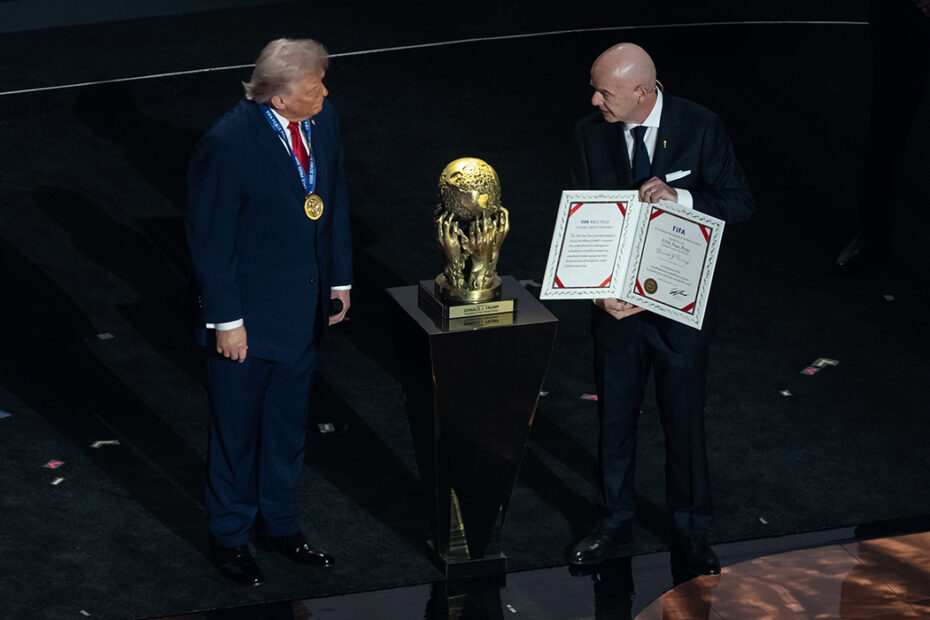
It is appropriate to mention here other silences in the media and society at large about the machinations of FIFA – or rather, Infantino and Trump have been at this money-go-round for a while now. Without FIFA members’ agreement, Trump was given a Peace Prize, then he managed to get his bro to rent from him. It is a fact that US President Trump, in his own capacity, has persuaded FIFA to move into his Trump Tower in New York City. Talk of insider trading, nepotism and mal-governance – it is all this and much more.
Don’t Cry for Us, Argentina
Argentina is currently led by Javier Milei, a highly reactionary figure with ties to Trump. The country has much to answer for in its historical treatment of Africans. Politically, Messi is no Maradona – he is quiet and reserved.
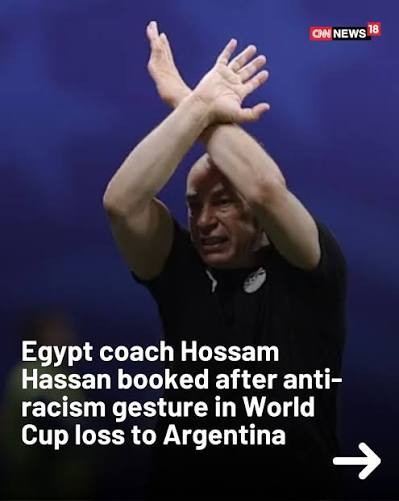
The referee, François Letexier, took an unusually long time to review a play after Egypt scored. With Egypt leading 1–0 in the second half, VAR ruled out a goal by Mostafa Zico after Marwan Attia was penalised for stepping on Lisandro Martínez’s foot at the start of the move – nearly a minute earlier. Egypt’s coach, Hossam Hassan, crossed his arms in an “X” shape – FIFA’s official anti-racism gesture – to express frustration and condemn the hypocrisy of racism in the game. Instead of initiating the anti-discrimination protocol, referee Letexier booked him with a yellow card.
African Teams Must Be Able to Lead and Remain on Top
To be fair, African teams have not needed referees to squander a 2–0 lead – I think of Senegal, and now Egypt. I believe the referee and VAR were wrong to disallow the goal, but Egypt quickly re-scored anyway, going 2–0 up. Football, however, is about mentality and belief. When Argentina went on the offensive, Messi began to play. Commentator Barney Ronay described him as a “generous genius” who elevates those around him.
Egypt had no plan to stem the tide, though they also protested a potential foul on Mohamed Salah in the Argentina penalty area, just before the champions broke away to score a stoppage-time winner. These calls are rarely given at the best of times. Having reviewed the highlights, I do not believe it was a penalty.
Even if the goal had stood and Egypt went 2–0 up, Argentina may well have fought back – they also hit the woodwork around the 60th minute. After the disallowed goal, Argentina scored, and for the first time, they believed a comeback was possible. That belief won them the game – though I do not think they are strong enough to win the World Cup.
So, while I agree the refereeing was unfair, African teams must learn to secure wins – even in hostile environments with questionable officials.
Media Complicity
As someone passionate about media, I must note that La Vanguardia and other outlets were ecstatic about Messi’s brilliance, ignoring Egypt’s legitimate grievances entirely. It was as if Argentina played itself. The sports press in Barcelona – Sport and Mundo Deportivo – were in love. Sport described the incident that annulled Egypt’s goal as “el leve pisotón sobre Lisandro” – “the slight step on Lisandro’s foot, 70 metres from Argentina’s goal” – which saved what would have been 0–2. They called it “slight” but failed to provide context or broader political analysis, contributing to a dumbing-down of the footballing public. Fans are not stupid.
Separately, and as if to reinforce the creativity of activists, a Basque socialist group (EHKS) displayed a large banner reading “Destroy Israel” at the opening of the San Fermín festival in Pamplona on July 6, 2026. The banner featured a crossed-out Israeli flag and was held up in the main square just before the traditional rocket launch. Participants chanted for an end to the genocide, declaring: “Dismantle Israel,” “Stop the genocide,” and “Zionists are not welcome.”
(Source: Al Jazeera)
The anti-Messi press in Madrid and elsewhere rightly raised concerns about referee leniency toward Argentinian players – though they should know that their own teams have long enjoyed similar protection. Some progressive outlets tried to paint Messi as a Zionist and Argentina as complicit in Zionist support, given Milei’s links to Netanyahu and Zionism. But this is simplistic and risks erasing legacies.
In my article “Merry Christmas, Mr. Messi, and Salaams to the People of Gaza” (Palestine Chronicle, December 2022), I touched on FC Barcelona’s naivety in convening its 2013 “Peace Tour,” which was co-opted by Israeli propaganda. Netanyahu was allowed to overshadow Palestinian President Abbas, while Barcelona failed to demand an end to the blockade or child killings. We saw photos of Messi with Netanyahu, but none with Abbas – illustrating the Zionist exploitation of Messi’s image.
Few are aware that Messi issued a public statement in 2014 supporting children in conflict zones, particularly Gaza – largely suppressed by hasbara (propaganda). He said:
“As a father and a UNICEF Goodwill Ambassador, I am terribly saddened by the images coming from the conflict between Israel and Palestine, where violence has already claimed so many young lives and injured countless children. Children did not create this conflict, but they are paying the ultimate price. This cycle of senseless violence must stop. We must reflect on the consequences of military conflicts and children must be protected.”
He also shared an image of an injured Palestinian child. At the time, Save the Children reported (2015) that 551 children had been killed and 3,436 injured, 10% with permanent disabilities. These concerns were suppressed, which is why it is simplistic to view the Argentina team as aligned with Zionism.
Conclusion
Egypt were given a raw deal, and Hassan was right to say that some decisions stem from a deep-rooted racist ideology embedded within FIFA. However, I do not believe this was significant enough to cause Egypt to lose a 2–0 lead. That question – how African teams squander such advantages – is a subject for another day. In my view, it is not due to the racist management of FIFA.
FIFA has always been about the money. They buy the allegiances of continental affiliates, and this culture creeps downwards, where national bodies ape the top dogs. It is legalised corruption, and after each attempt at cleaning up, it soon defaults back into corruption. As regards its management of the game as a whole, FIFA is inconsistent and appears unreformable.
For all the protestations of Egypt or Belgium, they will soon fall in line.
The only bright light now is the concern of some European Union lawmakers who are pushing for investigations into FIFA and its president, Gianni Infantino, over alleged political interference. They number over 35 Members of the European Parliament, but this could grow, and they are demanding probes after FIFA controversially lifted an American player’s red card following a direct call from US President Donald Trump. The African Union heads of state or the African Parliament too can take a lead on this, as Africans have been denied access to watch games, referees barred and others humiliated. They have to engage and take control to reset the rules for global sports so that all country teams are treated in an equal and just manner. In addition, the national teams and the national federations must begin to think like a non-violent and solidaristic unit – one that defends all teams who are harmed or treated badly, as Iran was treated. The current set-up is built against solidarity and equality.
FIFA is in the pocket of big money, permits elites to interfere in on-field events, and increasingly prioritises spectacle over genuine contest. It is not only in the pocket of big money – it is part of the system of big money.That view is contested by fans, communities, and most importantly, the players themselves. But the evidence of bias and double standards is mounting – and cannot be ignored.
Hassen Lorgat