
“Milei and his Zionist allies’ attempt to claim Messi and the Argentina team has backfired spectacularly”
By Hassen Lorgat
Spain’s 1–0 victory over Argentina in the World Cup final was a triumph for decency—on and off the field. Argentina, by contrast, let themselves down. They were no match for Spain, and their aggression—Fernández’s red card during the match and Paredes’s dismissal post-match—underscored a lack of discipline.
But the spectacle is one thing. The political response to it is another—and that is where the Left/Progressive bloc has failed. Rather than discerning the politics around the match, many progressives wrote off an entire country’s history because of one player (Messi), his team, and their fans. They fell for Zionist talking points that sought to claim Argentina—now under a neoliberal president—as an ally of Israel, using Messi as the fall guy. This narrow, elitist lens is what this article critiques.
Off the field, the final offered a clash of strategies and tactics as well as a generational clash: Spain’s Luis de la Fuente—a career youth coach who has spent decades developing young talent—oversaw a team of rising stars (Yamal, Cubarsí, Nico Williams, and others), while Lionel Scaloni, the World Cup-winning coach from Qatar 2022, found himself outmanoeuvred. In Qatar, the world rallied around Messi and his team. But the love for Argentina has since dissipated. Why? The answer lies not in football but in politics: Israel’s propaganda apparatus, working with Argentina’s right-wing, pro-Israel president Javier Milei, has sought to co-opt the team for its own agenda. But this is not the full story.
The Co-optation Backfires
Milei and his Zionist allies’ attempt to claim Messi and the Argentina team has backfired spectacularly. In a recent interview, Messi explicitly acknowledged Argentina’s economic crisis, stating that he plays for the people—not the president.
Speaking on El Destape, in an edition titled ESCÁNDALO EN LA ROSADA: Milei enojado con Messi por sus críticas y la bandera de Malvinas—Inside the presidential palace (the Pink House), Milei is angry with Messi over his criticisms and the Malvinas flag—Messi rebuked the president:
“We know that World Cups are special for us and we forget about all the bad things we have to go through—that there are people who have a hard time, who don’t have work, who can’t make ends meet…”
The team also displayed the Malvinas flag during the match against England—a direct challenge to Milei’s security minister, who had tried to ban it as “political content.” Milei was reportedly furious, and it troubled his inner circle. The Security Minister, Alejandra Monteoliva, publicly stated before the match that fans could not enter with flags containing the Malvinas map, citing it as “political content.” However, many flags did get in, and the players showed their patriotism in the match against England.
These acts of defiance were evident and confirmed that ideas of national sovereignty—the team is not the president’s team, and the Malvinas incident—combined with Messi’s comments on the economy and workers, all suggest that they were not playing ball with the pro-Israeli lobbyists.
It is true that since December 2023, Argentina has changed allegiances, sweetened by Trump and the US Treasury. We recall how he influenced the election before the Argentine presidential vote, stating of Javier Milei on social media: “He’s making us all look good.” Trump made it clear that a $40 billion US lifeline for Argentina would depend on Milei maintaining political momentum. Since then, Milei has shifted Argentina’s foreign policy—withdrawing from BRICS, for instance. At the UN, we also witnessed a change in Argentina’s foreign policy from its previous neutrality. Where there was openness to the Palestinian cause under the previous Peronist governments, now there is support for Zionism. Milei, self-proclaimed most Zionist president in the world, also moved the country’s embassy to Jerusalem, against international consensus.
But Messi and the team are not playing along.
Argentina on their minds—historically
The attempt to compromise and win over Messi and Argentina has a long history outside football, which I will not go into here. Suffice it to say that Theodor Herzl’s 1896 foundational text, Der Judenstaat (The Jewish State), considered Argentina a viable refuge for Jews fleeing European antisemitism—its rich soil and sparse population made it an economically attractive option.
Messi was targeted because he was the best player in the world and could be an asset for Hasbara campaigns. And this World Cup, coming after the numerous defeats that Israeli propaganda has suffered since October 2023, presented a good opportunity.
I want to point out how Zionist leaders backed Argentina’s team and how progressives went along with them, as if the public supported Zionist control over them. It seems that these images managed to give the impression that Israeli leaders and Milei were united behind Argentina. Progressive media showed some of these: one showing Messi crying, consoled by Trump on one side and Netanyahu on the other. Another video shows the Israeli regime attempting to compromise players, with comments hoping for a victory against Sánchez. In addition, videos and X/Twitter comments show Netanyahu, Ben Gvir, and Gideon Sa’ar backing Argentina. One clip shows Netanyahu saying (inaudible but clearly sounding like): “I’m by Argentina, but it’s going to be messy”—followed by laughter.
There were exceptions from the Left flank, such as PalTimesNews, which does a brilliant job providing context alongside the comments of the genocidaires, which can be seen here: https://www.instagram.com/reels/Da_GlSGsNo7/
Messi in focus: Playing Upfront
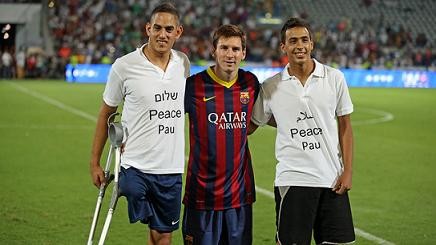
Messi detractors over the years fell for the image put out by Israel of Messi with Netanyahu, ignoring that it was the club, FC Barcelona, that upon the ill-conceived Peace Tour to Israel–Palestine in August 2013, believed it was a bridge-building exercise where players conducted coaching clinics for thousands of Israeli and Palestinian children.
At that time, it was difficult to see these other photos, and they suppressed Messi’s work in support of UNICEF and the children of Gaza. Messi was censored even by his own club and the media in Spain and elsewhere, as I wrote earlier.
Not one of Spain’s major sports newspapers—Marca, AS, Mundo Deportivo, or Sport—covered Messi’s message, and it is still not on Barcelona’s website. It is for this reason that I am compelled to repeat what he wrote then.
For all my criticism of the tour, the players did indeed meet with Palestinian players, including amputees wounded by Israel in its wars on Palestinians. Jewish Voices for Peace, speaking of amputees, noted that “Before the ongoing genocide, the Israeli military had already created a generation of Palestinian amputee athletes by deliberately targeting their limbs. Between March 30, 2018, and July 31, 2019, Israeli military snipers injured more than 7,500 Palestinians in Gaza during the Great March of Return weekly protests. Of 6,500 limb injuries, 148 directly resulted in amputations. This horrific number has increased exponentially since the Israeli government’s genocide.”
(courtesy:https://www.catalannews.com/sports/item/barca-football-for-peace-in-tel-aviv)
The regular reporting of deaths and the blockade of Gaza, amongst other objectives, inspired UNICEF to get their ambassador to speak.
Messi’s Call to Humanity
The now World Cup winner and Argentinian footballer Lionel Messi dared to defend the rights of children in conflict areas—especially those in Gaza—with this simple, caring, and solidary message, which read:
“As a father and a UNICEF Goodwill Ambassador, I am terribly saddened by the images coming from the conflict between Israel and Palestine, where violence has already claimed so many young lives and injured countless children,” read the statement published in Arabic and English.
“Children did not create this conflict, but they are paying the ultimate price. This cycle of senseless violence must stop.”
“We must reflect on the consequences of military conflicts and children must be protected,” he added.
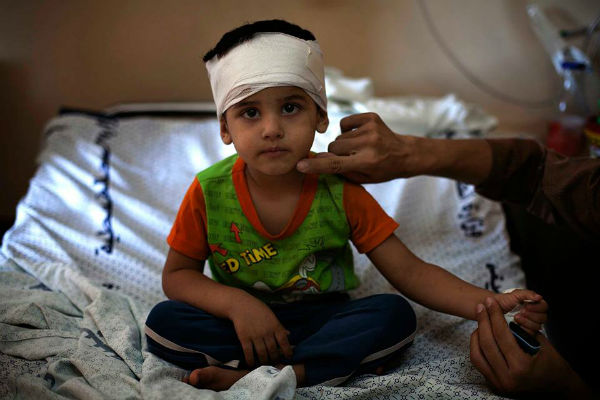
Messi also dared to post a picture of a Palestinian child who was injured during an attack on a school in Gaza. As an interesting aside on media injustice, we find an article in the Times of Israel headed “Messi posts pic of the wounded Gaza child,” but when visiting the article, we do not find the photo—only a photo of Messi and Netanyahu from that ill-fated Peace Tour.
We now know that the 2014 war on Palestinians—which the Israelis called Operation Protective Edge—killed over 1,900 Palestinians, including 551 children, while one Israeli child died. A Save the Children study found that most Gazan children suffered trauma, including nightmares, fear, and bedwetting, with Messi unaware of the full scale of devastation.
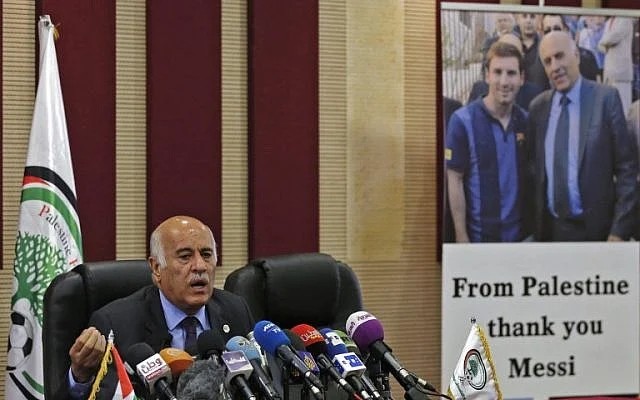
The extreme censorship and the control of platforms by Zionist sympathisers has resulted in the suppression of other voices on the so-called Peace Tour. At that time, the president of the Palestine Football Association, Jibril Rajoub, praised FC Barcelona for helping to promote the game.
The 2018 boycott led by BDS Argentina
It was only a few years later that he would lead a campaign to stop the Argentinian team playing a friendly match against Israel in June 2018. This match was cancelled due largely to the efforts of civil society and the human rights organisation BDS. The campaign was initiated by BDS Argentina, launched using the motto “Argentina don’t go,” or #ArgentinaNoVayas, and had wide support, including from the players. The Israeli embassy in Argentina was livid and said that the match was cancelled due to “the threats against Messi that logically generated the solidarity of his teammates.”
Nothing could reverse the decision; even the pressures by Netanyahu to beg the then president of Argentina, Macri, for the match to continue failed. Nick Butler wrote that: “According to Israel’s Army Radio, the country’s Prime Minister Benjamin Netanyahu even called Argentinian President Mauricio Macri in an attempt to broker an agreement, but was told that there was ‘nothing he could do’.”
“In the end, they’ve done the right thing, and this is behind us,” Argentinian striker Gonzalo Higuain told ESPN.
Rajoub, for his activism—in particular his urging of fans to burn T-shirts and pictures of Messi—was banned and given a suspended fine of 20,000 Swiss francs (£15,826) for “inciting hatred and violence.”
What must not forget is the Argentinians that supported the campaign to stop their national team playing in Israel.
(courtesy: times of israel)
Argentina’s Solidarity with Palestine
From the above, and the recent activism of Argentinians on Palestine, it is clear that the Zionists are on a losing ticket, but we cannot be complacent. A Pew Research Centre survey conducted between 8 February and 13 May 2026 found that 55 percent of Argentinians held a very or somewhat unfavourable view of Israel. Only 21 percent viewed it favourably.
In addition, a few months after the 2010 World Cup in South Africa, Argentina under the administration of former President Cristina Fernández de Kirchner formally recognised the State of Palestine as a free and independent state within its pre-1967 borders. The date was 6 December 2010.
These views, and in particular the two statements by UNICEF–Messi on the violence against Palestinian children, you will not find in the SAJR, whose agenda was to claim Messi for Zionism. I recall what we used to say about CNN’s Amanpour: when she enters a country, the tanks are not far off. Something similar could be said about The South African Jewish Report entering a space—we must already know that it is an integral part of hasbara’s game plan. There will be no criticism of Israel, however justifiable the consensus may be. So, when I read their article “Is Lionel Messi a Zionist? The Argentinean soccer star’s long history with Jewish and Israeli life, explained” by Juan Melamed (14 July 2026), I had some idea of what to expect.
Melamed writes on Jewish matters in his home country, Argentina, as well as covering Milei prominently. In a recent article, he outlined Javier Milei’s strategy of presenting himself as a promoter of “Judeo-Christian values, spiritual and material life become aligned and resonate on the same wavelength,” and further on, he is “calling on European Jews to make Israel their home.” Melamed wrote that: “Under Milei’s leadership, Argentina has invited European Jews worried about rising antisemitism to consider the country as a destination.” Melamed’s supposed revelations that Messi was a Zionist do not add up to what Messi has actually said about the violence against innocent children in Gaza. Other Jewish media could not even show the photo of the devastation to the lives of children which Messi highlighted and which I quoted above.
So, as you can see, Messi was on the right side of history, as raised above, and the belated attempts to co-opt him and the players are part of a concerted Zionist strategy that has no love for the players or the people of Argentina.
What is to be done?
Instead of performative condemnation, we need a deep, critical analysis that understands the structures producing both Messi and the politicians who claim him. We must refuse to fall for the algorithm’s bait and focus on genuine solidarity, not symbolic boycotts.
As I turn to the end, I believe that the Left and progressives must become organisers again, and we must start by thinking before sharing. We must break with the media that affirms elites and oppressors and avoid reaching conclusions without doing real, deep critical thinking. Sharing Zionist talking points only weakens us. Even engaging them on social media on their posts empowers them. When looking at their argument of Messi’s support for Zionism, one can clearly see how powerful Messi’s commitments are to humanity, as the UNICEF statements confirm. Stop sharing the cheap images, one-sided stories, and photos of the so-called Peace Tour.
We must recommit to supporting the struggles of Palestinians, focusing on Gaza, the West Bank, and those living in what is known as Israel. We must redouble our efforts in supporting grassroots organisations and movements. Finally, we have to overcome our Anglophobe biases and attempt to read Spanish-language media and Argentine media to understand the domestic context that English-language algorithms do not factor in.
Conclusion
Messi is a leader of a different type, and for a long time in Barcelona was not the captain. So, when people rightfully demand that he speak out against the racist chants of the Argentine fans at the World Cup, or others think him strange for saying to his teammates, “let’s play, guys” (implying not fight or lose focus), we get what we get. He is complex and not without faults.
The late, beloved Uruguayan writer Eduardo Galeano defined Messi in 2011 as his “insolent rascal,” when the player did not yet win the World Cup, and said that Messi “plays like a child enjoying the pasture, playing for the pleasure of playing, not the duty of winning.” The interviewer concluded that Galeano was “reminding the reader of the simple truth that soccer is at its best when it makes the player and the fan happy.” Nothing has changed since he won the Cup and lost in two other World Cup finals.
Messi is a simple player and deserves more respect, but he is not infallible. We have to do more to discern who is putting out what and for what purposes. Being an imperfect role model means that there are those who want to contest the meaning of Messi. We should not leave the field open to Zionists, nor give away the game of football to them. We must reject the Zionist lens throughout, and we must not allow these Zionist leaders to decide who is a good or bad Argentine player. This is the distraction… The targeting of Messi is a distraction, and we must refocus around Palestine, putting our energies back to Gaza and the devastation of land and people. Two years is a short time in politics… and we must not lose hope.
Hassen Lorgat