
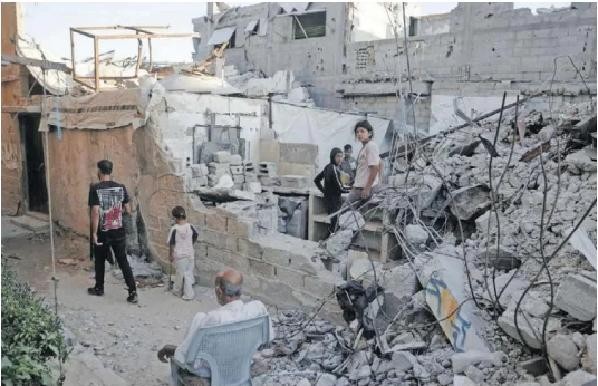
DISPLACED Palestinians gather amid the rubble of a heavily damaged building being used as a shelter in Khan Yunis in the southern Gaza Strip. Israel’s full-scale war on Gaza – which began after a Hamas attack inside Israel on October 7, 2023 – reduced much of the Palestinian territory to rubble. | AFP
By PROFESSOR USUF CHIKTE
ON SEPTEMBER 28, the UN General Assembly marked 25 years since the adoption of the Durban Declaration and Programme of Action, the UN’s main blueprint for fighting racism. On October 7, Gaza enters the fourth year of what the UN’s own investigators have found to be genocide. The two dates belong together. One is a promise the world made on South African soil. The other is the test of whether that promise meant anything for Gaza.
Israel passed the Nation-State Law, declaring that the right to national self-determination in Israel is “unique” to the Jewish people. Any South African can read that without a translator. We called it baasskap. Scholars called it Herrenvolk democracy, democracy for the master race and boots for the rest. In 2024, the International Court of Justice found the occupation unlawful and Israeli policies in breach of the ban on racial segregation and apartheid.
What Durban promised
In 2001, seven years after apartheid ended, South Africa hosted the World Conference against Racism, Racial Discrimination, Xenophobia and Related Intolerance in Durban.
Its final declaration was historic. It recognised slavery and the transatlantic slave trade as crimes against humanity and opened the door to discussion of reparations. In paragraph 63, governments expressed concern about “the plight of the Palestinian people under foreign occupation” and recognised their right to self-determination and an independent state. Paragraph 65 recognised the right of refugees to return to their homes.
Palestine divided the conference. The parallel NGO Forum branded Israel a racist, apartheid state. The US and Israel walked out, accusing the conference of singling Israel out, even though the final text never mentioned Zionism. Three days after it closed, the attacks of September 11, 2001 changed the world’s agenda, and Durban’s commitments were pushed aside. Every follow-up meeting since, in 2009, 2011, 2021 and now 2026, has been boycotted by Washington and a group of Western allies.
Three years on
The Gaza Strip is a coastal territory in the land of Palestine of just 365 square kilometres. Before October 2023, it was home to more than 2.1 million people, most of them refugees or descendants of refugees driven from their homes in the 1948 Nakba (catastrophe).
Israel captured Gaza in 1967 and has kept it under a land, sea and air blockade since 2007. By October 2023, the Gazans had already endured
16 years of siege under occupation. What came next was not a war between two armies but the destruction of a besieged people.
Nearly 74 000 Palestinians have been killed by Israel since October 2023, more than 1 380 of them after the so-called ceasefire of October 10, 2025. In September 2025, a UN commission of inquiry chaired by the South African jurist Navi Pillay concluded that Israel had committed genocide. South Africa’s own genocide case against Israel, filed at the International Court of Justice in December 2023, will take years to decide.
The price of speaking
What is changing is who is willing to name what these numbers mean, and what it costs them. On September 4 and 5, the American rapper Macklemore opened for Ed Sheeran in New Jersey. He wore a keffiyeh, said “Free Palestine”, and performed Hind’s Hall, his song named after Hind Rajab, a six-year-old girl killed by the Israeli army while trapped in her family’s car. The Israeli American Council petitioned Sheeran to remove him, and within days he was dropped from the tour.
Mark Ruffalo, the four-time Oscar nominee known as Marvel’s Hulk, was accused of antisemitism by Paramount after he said one of its board members was “revelling” in genocide. More than 180 Jewish figures signed a letter in his defence. On American campuses, Rumeysa Ozturk, a Turkish student at Tufts University, was detained by immigration agents for writing an opinion piece criticising Israel’s actions in Gaza.
Israelis who break ranks are punished harshly. When The Sea, a film about a Palestinian
boy from the West Bank who risks checkpoints to see the sea in Tel Aviv, won best film at the 2025 Ophir Awards, Israel’s equivalent of the Oscars, Culture Minister Miki Zohar cut the ceremony’s state funding.
This month, NAZA won the Special Jury Prize at the Venice Film Festival. Made by the Israeli filmmakers Yuval Abraham and Rachel Szor, it draws on interviews with 24 Israeli soldiers and intelligence officers about the AI-driven systems used to choose targets in Gaza. Its title comes from the Hebrew military term for “collateral damage”. Within days, Zohar called the film treason and threatened to strip both directors of their citizenship. The army rejects the film’s claims.
It takes real courage to make such a film in Israel today, and the price is real: lost funding, careers under attack, and now citizenship itself. Yet the same state that punishes these filmmakers points to them as proof of its democracy: look, we allow criticism.
Palestinians have no such stage. They cannot threaten a culture minister back. They get checkpoints, occupation and bombardment, and a world that is often more moved by an Israeli’s conscience than by a Palestinian’s survival.
These filmmakers matter, and so does their risk. But their punishment reveals something the world should not miss: Israel does not tolerate the truth, not even from its own.
It is happening here too
South Africans should not assume this only happens elsewhere. Zionist lawfare is on the rampage: the complaint to the regulator, the defamation claim, the racial-hatred suit, the definition of antisemitism, the IHRA (International Holocaust Remembrance Alliance) text, whose examples treat criticism of Israel as hatred of Jews.
These largely manufactured claims are designed less to win than to drain, to make speaking so costly that the next person stays silent. Activists here and abroad now face suits they call SLAPPs, strategic lawsuits against public participation.
In 2025, the artist Gabrielle Goliath was chosen to represent the country at the 2026 Venice Biennale, the world’s leading art exhibition. Her work, Elegy, mourns women killed in South Africa and the victims of Germany’s genocide of the Herero and Nama in Namibia. Her new version also mourned Hiba Abu Nada, a Gaza poet killed in an Israeli airstrike in 2023. Culture Minister Gayton McKenzie cancelled it. Goliath says his letters made clear that only the Palestinian part had to go. A court declined to reverse his decision.
This is the country that hosted Durban and took Israel to the world’s highest court for genocide.
Doubted, dismissed, demonised
Palestinians have paid the highest price for telling the truth. Their casualty figures have been treated as suspect for three years, yet a study published in 2026 estimated 75 200 violent deaths up to January 2025, about 35% more than the ministry’s count at the time. The Committee to Protect Journalists has recorded 207 Palestinian journalists killed in Gaza, while foreign reporters have been kept out. The people best placed to tell Gaza’s story have been killed, and the world has been told not to believe the survivors.
Is the tide turning?
There are signs that it is. A Gallup poll in February 2026 found that more Americans now sympathise with Palestinians than with Israelis, by 41 to 36%; before October 2023, it was 54% for Israel and 31 for the Palestinians.
In 2025, more than 5 500 film workers pledged to boycott Israeli film institutions they see as complicit in genocide and apartheid. In 1985, nearly a decade before apartheid in South Africa ended, artists recorded Sun City, refusing to lend their names to the regime’s showpiece resort. The artists moved first, and the institutions followed. Israel is increasingly looked upon as the polecat of the world.
Durban promised that racism in all its forms is the whole world’s business. Gaza remains the moral compass of the world, and the test of that promise. For far too long Palestinians have been doubted, dismissed and demonised for telling the truth.
As we mark three years of genocide, let us escalate the revolt against Zionism as well as Israeli tyranny, the occupation, apartheid and genocide of Israel against the Palestinians.

PROFESSOR USUF CHIKTE Professor Usuf Chikte is the coordinator of the Palestine Solidarity Campaign, in Cape Town.
Article rank…. The Post
“Reprinted from…”https://www.pressdisplay.com/pressdisplay/viewer.aspx#