
By Iqbal Jassat
South Africa’s democratic identity is rooted in a global struggle against systemic oppression, legalised segregation, and state-sanctioned racism. Because of this history, the nation’s foreign policy and civil society have long maintained a deep solidarity with the Palestinian cause.
However, within the domestic landscape, a persistent and aggressive effort by Zionist lobby groups seeks to shield the state of Israel from accountability. The primary weapon in this public relations arsenal is the strategic weaponization of antisemitism—a calculated ruse designed to silence legitimate critique and whitewash documented violations of international law.
The core tactic of these lobbying efforts is to deliberately blur the line between antisemitism—a distinct, abhorrent form of racial and religious prejudice—and anti-Zionism, which is a political critique of a state ideology and its practices.
By branding any systemic critique of Israeli policy as an attack on Jewish people globally, lobbyists attempt to create an ideological shield around Israel.This strategy relies heavily on highly contested frameworks, such as the International Holocaust Remembrance Alliance (IHRA) working definition of antisemitism. While intended to track prejudice, certain codicils of the definition effectively criminalise structural critiques of Israel, such as labelling it a settler-colonial or apartheid state.
When South African activists, legal experts, or politicians call out the ongoing occupation of the West Bank or the devastation in Gaza, the immediate response from these lobby groups is rarely a defense of the policy itself, but rather an accusation of bigotry against the speaker.
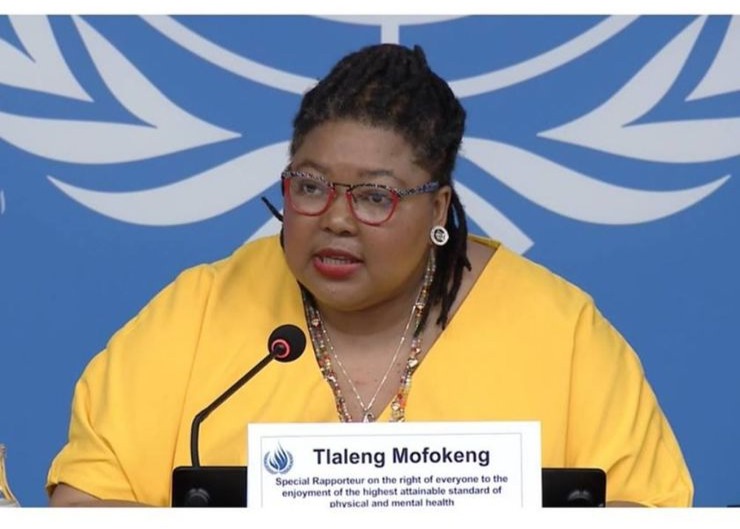
A textbook example of this malicious deflection is the recent legal warfare waged by the South African Zionist Federation (SAZF) against Dr Tlaleng Mofokeng, a prominent local medical professional and the former United Nations Special Rapporteur on the Right to Health.
Dr Mofokeng has used her global platform to loudly denounce the deliberate collapse of the healthcare sector in Gaza, framing the destruction of hospitals and the targeted detention of medical workers as an erasure of the fundamental human right to health.
Unable to substantively counter her evidence-based UN findings, the SAZF resorted to a calculated strategy of personal and professional lawfare. The lobby group lodged an aggressive complaint with the Health Professions Council of South Africa (HPCSA), aiming to weaponise local regulatory frameworks to find her guilty of “unprofessional conduct” and fine her over defiant social media statements made against Israeli political figures.
They even escalated their campaign internationally, lodging formal complaints with the UN Secretary-General in a desperate bid to strip her of her international credibility.This was never about professional ethics; it was a transparent attempt to silence a high-profile Black South African woman who dared to name Israeli war crimes and genocide.
The SAZF’s reliance on bureaucratic intimidation suffered a humiliating blow in September 2026 when the Gauteng High Court reviewed and completely set aside the HPCSA ruling, vindicating Dr Mofokeng.
As public interest law groups like Section27 noted during the battle, punishing healthcare workers for speaking out against institutionalised state violence is a direct threat to the very fabric of public advocacy.
For South Africans, the SAZF’s ongoing deflection campaigns are particularly egregious because they attempt to invalidate the very legal frameworks that liberated this country.
In July 2024, the International Court of Justice (ICJ) issued a landmark advisory opinion confirming that Israel’s policies in the occupied territories amount to systemic discrimination and segregation—the legal definitions of apartheid.
Furthermore, South Africa’s own ongoing genocide case against Israel at the ICJ is grounded in rigorous international law, backed by extensive documentation from United Nations bodies and global human rights organizations like Amnesty International and Human Rights Watch.
When local Zionist organizations dismiss these international legal interventions as products of “antisemitic bias,” they insult South Africa’s constitutional democracy and judicial integrity.
They ask the public to ignore empirical evidence—the expansion of illegal settlements, separate road systems, blockades, and mass civilian casualties—and instead focus entirely on the perceived motives of the critics.
South Africa’s history teaches that true security and peace cannot be built on the subjugation of another people.
Dismantling the rhetoric of local lobby groups is not an act of prejudice; it is an act of historical consistency.
To allow the ruse of antisemitism to shield Israel from criticism is to allow the language of human rights to be inverted.
South Africans must continue to reject these deflections, separate real bigotry from political critique, and insist that no state—regardless of its historical trauma or political alliances—is immune to the demands of international law and universal justice.
Iqbal Jassat
Executive Member
Media Review Network
Johannesburg
South Africa