
The spiritual economy.
Many come on the what is known as the “Hummus trail” to rest, replenish, and apparently seek forgiveness.
Himachal Pradesh, Uttarakhand, and Rajasthan, along with union territories like Goa, Ladakh, and Puducherry, see a steady, high-volume influx of Israeli visitors year-round.
I came face to face with these soul-searchers during a recent visit to Rishikesh, a Hindu holy town and one of the trail’s best-known stops.
Here, I was immediately struck by how the Israeli presence had merged into a place built around Hindu pilgrimage and spiritual practice.
Cafés serving ‘Israeli’ cuisine and Shabbat meals, signage in Hebrew, and local shopkeepers who have picked up enough of the language to serve their customers.
Rishikesh calls itself the “yoga capital of the world”, yet during my visit I encountered so many Israeli-led workshops that you might have thought Israelis had invented yoga, too.
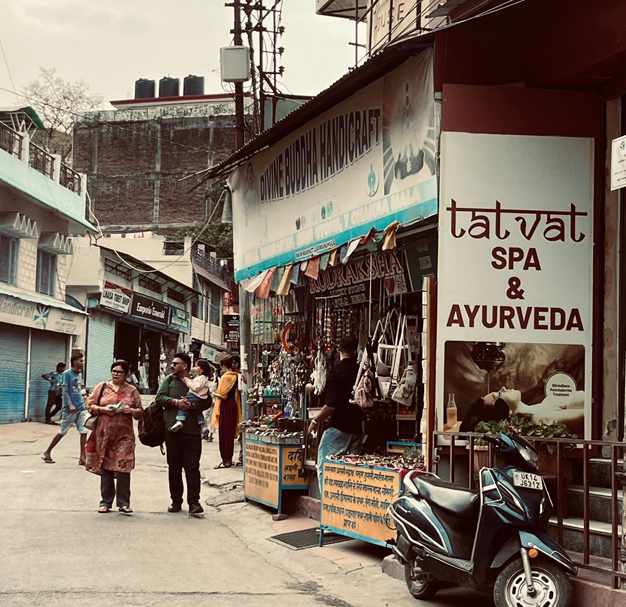
Many Israelis also own shops selling healing crystals, “indigenous” herbs and teas, and “first-aid kits” for psychological and spiritual healing.
I felt I had entered a shopping mall for self-help.

It would seem that Rishikesh offers these visitors two things at once: easy and unchecked access to drugs and trance parties, along with a spiritual backdrop that offers something drugs and music cannot – the promise, or illusion, rather, of absolution for their actions.
In Rishikesh, I watched Israelis participate in weekly ‘Ganga dips’, followed by group singing sessions or kirtans of bhajans and other religious hymns.
The river Ganga holds an important position in Hindu cosmology.
Widely regarded as the most sacred river in Hinduism, devotees believe that a single dip in its waters can absolve a person of all their sins. But I noticed that many of the events organised by Israelis excluded Indians.
I put this to a pandit (Hindu priest) at one of Rishikesh’s ghats.
I asked him about the significance of the river and why there were so many foreigners bathing in it.
“Mother Ganga is all-forgiving,” he told me, smiling. “No matter how grave the sin, if your intentions are true, Ganga can purify the soul and rid it of all evils. That’s why people can’t stop coming back here.”
“All sins?” I asked.
“Yes. All sins,” he replied.
“Would Mother Ganga forgive someone for shooting bullets into the heads of innocent, unarmed children? Or someone who, using a position of authority, tortured and raped people to death?” I asked pointedly.
Here pandit Ji had no answer.
He remembered, rather suddenly, that he had somewhere else to be.

I also spoke with an Indian woman in her twenties who had recently moved to Rishikesh to work in P.R. in the hospitality industry.
When I asked whether she felt any discomfort being around a group of people widely condemned internationally for their actions as a society, as former soldiers, she was unequivocal:
“There is no discomfort, honestly. It’s not like they’re harming us. It’s not like they’re Pakistani terrorists. They’re harmless tourists here to have a good time.”
I pushed a bit harder.
Was her belief that they were harmless based solely on her own experience of them?
“A lot of them suffer because of what their government did. Places like this give them a chance to start afresh — not as people from a certain country or community, but as individual souls in the universe.”
“They do regret it. You can see the guilt and fear in their eyes when they talk about what happened during service. A lot of them are surprisingly honest about it, if you ask.And as long as they regret it, who are we to judge them?” she asked rhetorically.
The conversation reminded me of a recently released report by an Israel-sponsored academic department that found that Indian youth aged 18–29 were more supportive of Israel than older demographics.
Many Indians deny that a lot of young people support Israel or are desensitized towards violence against Muslims.
And here, I had walked straight into someone who fitted the survey’s findings.
In June 2026 and then again in August, the Hind Rajab Foundation (HRF) filed war crimes complaints against two Israeli soldiers vacationing in India.
The first soldier allegedly fled the country after the complaint was filed, while the whereabouts of the second soldier have yet to be revealed.
It is clear that the Indian state does not feel any responsibility to act upon these complaints and is willing to ignore its own laws as well as international law.
Not only is the Indian state protecting war criminals under its roof, but the Indian people – locals and tourists alike – are also offering Israelis the warmth and comfort that they do not deserve.
The pandit’s non-answer to my question has left me wondering: Do the Israelis really believe they can participate in, mock, and be entertained by the murder of Palestinians, trek to the foothills of the Himalayas, take a dip in a river, and then start afresh in the world?
Where did they acquire this sense of heavenly grace for their crimes?
And why did they think they were uniquely impervious to justice on earth?
This search for absolution isn’t happening in a vacuum.
Israel is in the midst of a documented mental health crisis among its returning soldiers.
An Israeli parliamentary committee found that 279 soldiers attempted suicide between January 2024 and July 2025 – a sharp increase over prior years – with combat soldiers accounting for 78% of all suicide cases in Israel in 2024.
Israel’s Defence Ministry has reported a nearly 40% rise in PTSD cases among soldiers since September 2023 and projects that the figure could climb 180% by 2028; of the roughly 22,300 troops currently being treated for war-related injuries, 60% are being treated for post-traumatic stress.
Israel’s second-largest healthcare provider reported separately that 39% of the military personnel under its care sought mental health support in 2025, and 26% reported symptoms of depression.
Military suicide deaths reached 21 in 2024 – the highest annual toll in over a decade.
Set against that backdrop, India’s spiritual economy becomes even more unsettling.
Through its tourism industry and this cocktail of “wellness” and Hindu spirituality, India offers these former Israeli soldiers more than physical refuge.
It offers them emotional refuge where their ‘trauma’ and ‘suffering’ can be healed and their actions forgiven without accountability.
They then fly back to Israel and rejoin Israeli society refreshed and reborn.
“Reprinted from…”Where Israeli soldiers go to wash away Gaza