
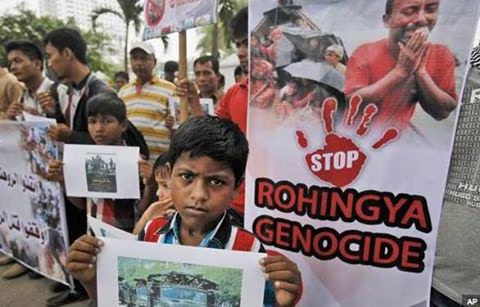
The people marked for extermination have secured a historic judgment against their exterminators. The Rohingya verdict does more than condemn genocide: it exposes the Islamophobic machinery through which empire manufactures enemies, legitimizes mass slaughter, and claims the moral authority to destroy those it subjugates. Five centuries of Western hegemony now confront a reckoning their military power can neither suppress nor escape.
On November 19, 2026, the International Court of Justice ruled that Myanmar committed genocide against the Rohingya Muslims. This was no ordinary judicial condemnation. It was a historic reversal: a people condemned to political erasure, championed by the Global South, had forced the machinery of international law to confront the machinery of their annihilation.
The Rohingya verdict places more than Myanmar on trial. It places the political logic of global Islamophobia — and the imperial order that has weaponized it — in the dock.
Myanmar’s military slaughtered thousands, destroyed communities, and expelled more than 700,000 Rohingya into Bangladesh. Muslim existence became a demographic threat. Persecution became national security. Extermination became collective survival.
The judgment demolishes these justifications. And the case was brought by The Gambia, a Muslim-majority African nation supported by the Organization of Islamic Cooperation.
A persecuted Muslim people, championed by the Global South, have compelled international law to condemn the machinery of their annihilation.
The implications are profound.
Islamophobia is not merely a prejudice accompanying imperial domination. It has repeatedly served as an indispensable mechanism of political legitimacy. Colonial conquest, military intervention, economic strangulation, and the suppression of Muslim sovereignty have been rationalized through the construction of Muslims as inherently violent, reactionary, and civilizationally threatening.
The mechanism is unmistakable: dehumanize Muslims, criminalize their resistance, and sanctify the violence inflicted upon them as civilization’s defense.
Islamophobia does not merely justify imperial violence. It manufactures the political conditions that make such violence permissible.
Nowhere is this machinery more brutally exposed than Palestine.
For generations, Palestinians have endured settler colonialism, dispossession, ethnic cleansing, and military occupation under an imperial-Zionist order sustained by Western power. Gaza has suffered genocidal devastation: civilians slaughtered, communities obliterated, and the foundations of collective existence systematically destroyed.
Yet Palestinian resistance to colonization is invoked to justify their continued destruction.
The colonized are punished for resisting colonization. The occupied are condemned for resisting occupation. The victims are held responsible for the violence of their persecutors.
The Rohingya judgment exposes the ideological structure underlying this inversion. Myanmar and Palestine have distinct histories, but both demonstrate how racialized constructions of Muslim danger legitimize dispossession, mass violence, and political erasure.
And that ideological structure is confronting a profound crisis.
Across the Global South, and among movements for justice within the imperial core, the distinction between supposedly civilized Western violence and allegedly barbaric Muslim resistance is losing legitimacy.
Yemen has exposed the humiliating limitations of Saudi military supremacy sustained by Western weaponry. Iran’s defiance challenges Washington’s presumption of unlimited coercive authority over sovereign nations. Palestine has made resistance to genocide and settler colonialism a defining global struggle for liberation.
The Rohingya verdict adds a historic judicial dimension: the oppressed can mobilize international law to establish their persecutors’ criminal responsibility.
The Islamicate is no longer merely enduring imperial domination. It is becoming indispensable to dismantling its ideological and political foundations.
Confronting Islamophobia is therefore not peripheral to decolonization. It is a fundamental condition for constructing a just, egalitarian, post-Western international order.
No such order can emerge while Muslim lives remain expendable, their sovereignty conditional, their resistance criminalized, and their extermination rationalized.
The Global South refuses annihilation. The Islamicate refuses submission. And the Western-dominated order is losing its authority to determine whose humanity matters.
The Rohingya judgment cannot restore the lives destroyed or immediately end persecution. But it exposes the criminality of the perpetrators and challenges the ideology that legitimized their atrocities.
Empire spent generations constructing Muslims as civilization’s enemies. Its victims are now exposing the moral bankruptcy of the imperial order itself.
From Myanmar to Palestine, from Yemen to Iran, the historical confrontation is unmistakable.
Those whom empire sought to eliminate are challenging its legitimacy, dismantling its ideological supremacy, and advancing the struggle for a world beyond Western domination.
Five centuries of imperial supremacy are confronting their reckoning. The Rohingya verdict is not merely a judgment against genocide. It is a declaration that the age of unaccountable domination can no longer presume its own survival.
https://countercurrents.org/2026/11/the-rohingya-verdict-genocide-global-islamophobia-and-the-imperative-of-decolonization/