
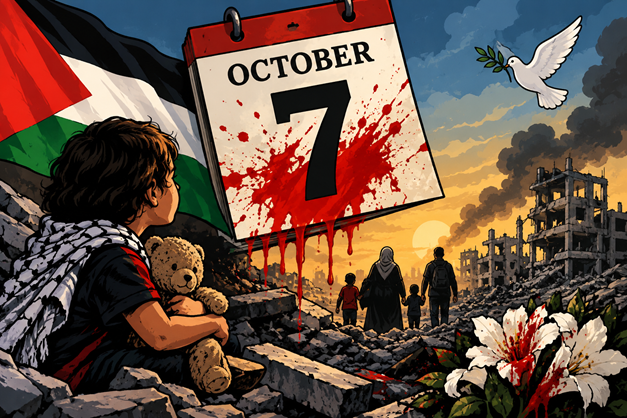
By Hassen Lorgat
Reading—or rather re-reading—The Holocaust for Beginners by Haim Bresheeth, Stuart Hood, and Litza Jansz (Icon Books) in its graphic form, I was stunned to find a reference to October 7 in connection with prisoners awaiting death at the hands of the Nazis.
The context is Hungary, with the Red Army advancing. Desperate Nazi leaders ordered the gas chambers, crematoria, and all evidence destroyed. The inmates realised their days were numbered, and the camp underground ordered a rebellion on 7 October 1944 (p. 131).
Between May and July 1944, approximately 440,000 Hungarian Jews were deported to Auschwitz-Birkenau in Poland in just 56 days. The Sonderkommando—mostly Jewish prisoners—were forced to operate the gas chambers and crematoria. By late summer, transports had slowed, and the prisoners feared imminent liquidation, since the SS routinely killed Sonderkommando crews to erase witnesses. Meanwhile, the Red Army was advancing.
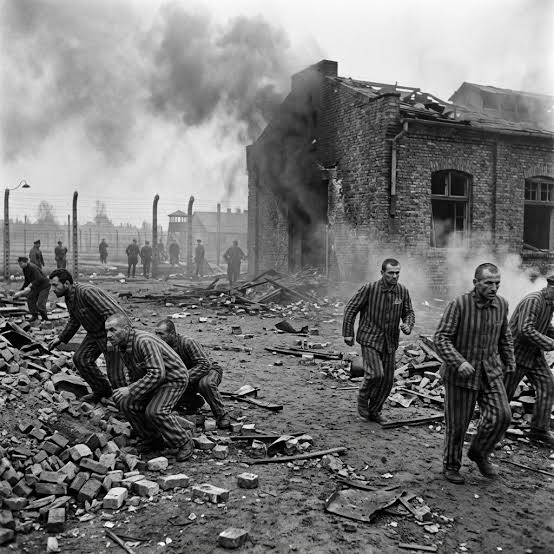
On October 7, 1944, prisoners in Crematorium IV revolted, attacking SS guards with stones, axes, and makeshift weapons. Using gunpowder smuggled over months by female resistance prisoners—Róża Robota, Ella Gärtner, Ester Wajcblum, and Regina Safirsztain—from the Union munitions factory, they blew up and set fire to Crematorium IV, disabling it. The SS crushed the revolt, killing or executing roughly 450 Sonderkommando prisoners. The four women were tortured and publicly hanged in January 1945, weeks before liberation. In November 1944, as the Red Army approached, Himmler ordered a halt to the gassings and the dismantling of the remaining crematoria to destroy the evidence.
The revolt was crushed. It is reported that nearly 250 prisoners died in the fighting, and another 200 were shot after the mutiny was suppressed. In addition, about 400 of the 600 Sonderkommando prisoners were killed as a result of the revolt and the subsequent executions. The prisoners managed to kill three SS guards and wound more than ten. We remember not only struggles that end in victory, but this story too: it underwrites and contests the revisionists who try to suggest there was no resistance. Even under such dire circumstances, staying alive was resistance, and when spaces opened up, it took on new dimensions.
Fast Forward to October 2023
Fast forward to 7 October 2023—79 years later—and we are forced to consider it as a literary device embedded in love, the case of the genocide in Gaza, and to ask: are there any similarities and differences?
The first difference is that there was no state of Israel, but the name Palestine was in the history books, albeit under the British Mandate, while much of the world we now know as the Global Majority or Global South was still under colonial rule. Secondly, there was a Red Army—whose resistance to Nazism cost over 20 million Soviet lives—on the march, dismantling the prisons and freeing those who were suffering. Today, this is not the case, at least for Palestinians in Gaza and the West Bank, and for the Sudanese, and for those considered not deserving victims or survivors.
What is undeniable is that the despised people—the Jewish people in this story, many from Hungary—had the moral right to fight and the only option, against all odds, to resist the white supremacists. They had the right to resist because they wanted to exist. This memory of resistance inspires—and continues to inspire—those who demand social justice every day and everywhere in the world.
Gaza as an Open-Air Prison
Tracing the original user of the phrase “open-air prison” is a long challenge, and I have no time to engage with it here, but thanks to Ilana Feldman (2015), her useful piece entitled “Gaza as an Open-Air Prison” is most helpful:
Her purpose was to state even then the inadequacy of the concept to explain life in Gaza, where no future seems possible. The author speaks of Gaza’s “ongoing and steady deterioration”—”as bad as the present may be, there always seems to be a worse future yet to come.” In addition, she adds to “the inadequacy of existing vocabulary,” since even “open-air prison,” while properly calling attention to confinement and control, “might also suggest a process of ordered judgment that may unwittingly accept that Palestinians in Gaza deserve their punishment,” and “might also suggest a degree of routine and regularity that belies the constant threat faced by those who live in Gaza.” As a Rafah resident put it in 2001: “This is worse than prison…. In prison, you can be safe. Here you are in danger all the time.”
For the purposes of this essay, I will stay with this definition, found then already in 2001 and 2015 to be grossly inadequate. Feldman traces the reference to describing Gaza as an open-air prison at least since the late 1990s, and it has been used by activists—Palestinian solidarity activists “such as Noam Chomsky and Ralph Nader”—and by “not-so-sympathetic officials (such as former World Bank head James Wolfensohn),” by humanitarian and human rights organizations (such as Médecins Sans Frontières and B’Tselem).
Banksy too entered the fray.
The twists offered by Banksy and the unnamed Israeli analyst suggest that conditions have become so dire that this language may now be inadequate to describe the state of affairs.
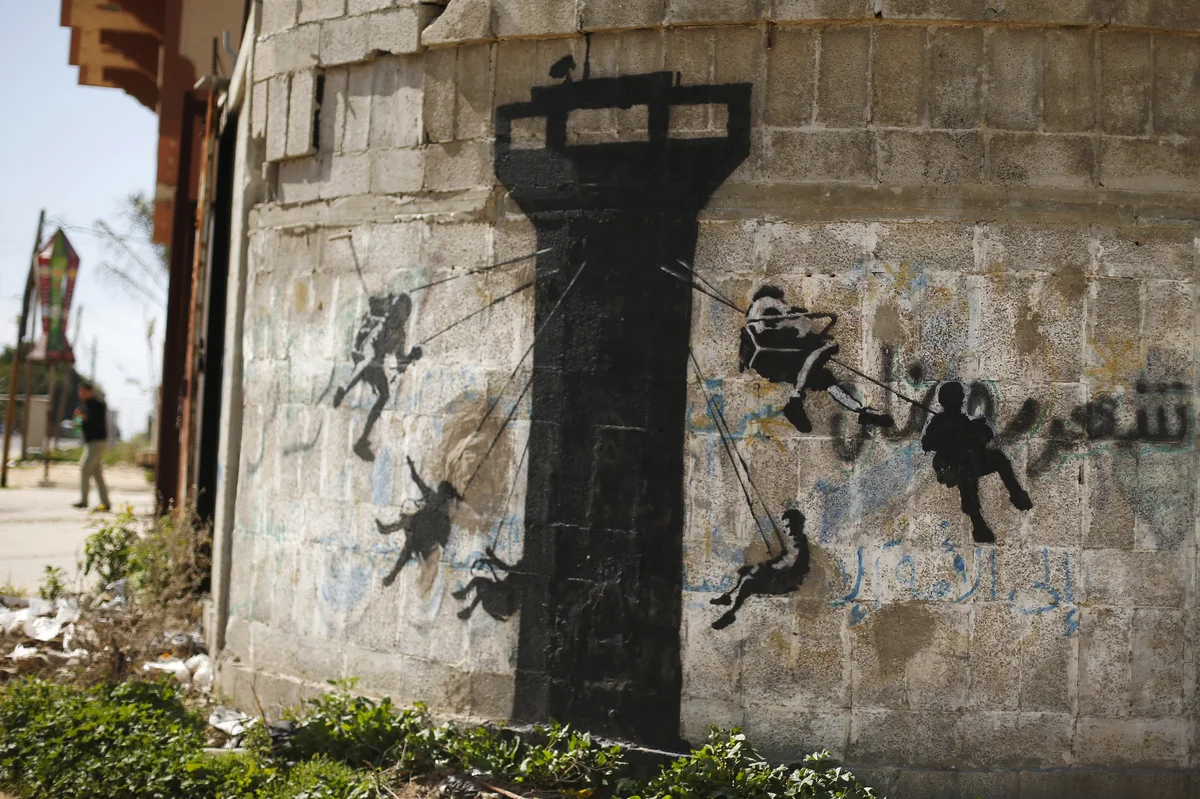
Banksy 2015, courtesy NPR
The concept was meant to highlight the total control Israelis had over Palestinians. It marked total control and occupation by Israelis in practice, often with great impunity. In 2019, Sinn Féin’s Gerry Adams said that “this is a total denial of the rights of the people of Palestine. This is an open-air prison…. People can’t travel out of here; they can’t travel in.” Other media picked up on this. In the 2014 attack, the New York Times reported that “the vast majority of Gazans cannot leave Gaza…. Prime Minister David Cameron of Britain in 2010 called Gaza ‘an open-air prison,’ drawing criticism from Israel,” Feldman writes.
Oppressive Conditions in Prison
The UN in 2017 warned that Gaza’s living conditions for two million Palestinians are deteriorating “further and faster” than the 2012 prediction that the enclave would become “unlivable” by 2020. Robert Piper, the UN Coordinator for Humanitarian Aid and Development Activities, said Gaza has continued on its trajectory of “de-development,” in many cases even faster than originally projected.
Access to materials necessary for the economy, infrastructure, and basic services to recover from the 2014 conflict remained highly restricted. Of the electricity supply, the UN reported that it was “the most visible deterioration in the living conditions in Gaza”—as low as 90 megawatts in recent days against the 450 megawatts needed. “Ongoing humanitarian assistance, especially through UNRWA’s services, is helping slow this descent, but the downward direction remains clear,” said Mr Piper.
With this in mind, some have called it an incremental or slow-motion genocide, a term used to describe a process where a state or group deliberately inflicts conditions of life with the aim of bringing about the gradual, long-term destruction of a targeted group, rather than relying on a sudden, mass-scale outbreak of violence.
It was left to Norman Finkelstein to say that while he considers all atrocities acts of terrorism, he believes context matters. He describes Gaza as a “concentration camp” where two million people have been blockaded for two decades. He argues that the youth who broke through the border fences felt they had “no choice except to die as slaves” or revolt, having exhausted all diplomatic and nonviolent alternatives.
Frederick Douglass
Furthermore, Finkelstein compared the struggles of Palestinians not to Holocaust resistance but to the slave revolts led by Nat Turner during the 1831 uprising in Virginia. In the Piers Morgan debate with Dershowitz, he was clear that he would not condemn them, as Gazans faced a choice between resistance and dying “like slaves” under a long-standing blockade, and that diplomatic channels, legal support, and nonviolent civil resistance—such as the Great March of Return—had all failed.
Speaking forthrightly about Nat Turner, who ordered his men to “kill all white people,” resulting in the horrific hacking and massacres of innocent white men, women, and children, Finkelstein argued that this has not diminished Turner being regarded as a freedom fighter rather than simply dismissed as a monster. He quotes Frederick Douglass, who, while committed to moral persuasion to end slavery, regarded Nat Turner as one of black people’s glorious martyrs. W. E. B. Du Bois also regarded Turner highly as the “hallowed dead that died for freedom.“
To critics who wonder if the comparison to slavery does not diminish those who were enslaved, he insists that the conditions of the people of Gaza were appalling from the start in 1948… expelled people have always been a very “forbidding place.” After the legendary Edward Said returned from a visit to Gaza in 1991, he stated that “nothing I saw in South Africa can compare with Gaza in misery, in sheer programmed oppression, in confinement and racial discrimination.”
In his video already quoted above, Finkelstein details the Israeli programmes of “mowing the lawn” as well as the evil starvation programmes where various food items could not enter Gaza. There is so much in this that I will not summarise. What was prohibited: potato chips, musical instruments, chickpeas, etc.—he lists them. Just about starving to death… “We want to keep Gaza on the brink of collapse without pushing it over the edge.”
Finally, Finkelstein in various interviews cited the long-term confinement of roughly two million people, half of them children, in a blocked-off environment, arguing that moral lecturing is inappropriate under such conditions.
Two events separated by time and context but fundamentally underwriting the right of oppressed people to resist occupation and injustice. For many scholars of genocide and also of resistance, the answer is clear: the conditions perpetrated or massaged by the ruling authorities were met with resistance.
Finkelstein’s argument concerns the moral standing of the oppressor. Peter Beinart, appearing on Fareed Zakaria GPS on February 2, 2025, takes up the same question from a different angle—what the denial of rights does to the society that denies them—in discussing his book Being Jewish After the Destruction of Gaza: A Reckoning and his shift from supporter of Israel to critic. He was unapologetic:
“Israel is the most dangerous place for a Jew to live of any large diaspora community, and I think that’s because when you deny people their basic rights, you inflict tremendous violence on them, and that violence endangers you as well. Israeli Jewish political culture has become accustomed to supremacy. Illegal supremacy over Palestinians is simply taken for granted, and it is equated with safety.
That is, supremacy means safety, which is the same way that white South Africans felt during Apartheid, the same way that white Southerners felt during Jim Crow, the same way that Protestants felt in Northern Ireland. The argument of this book is to those people, to say, look at those other places. People became safer when everyone got a voice in government, because when people have a voice in government, they don’t need to take up arms to get the government to listen to them.”
Beinart thus arrives at the same destination as Finkelstein by another route: he paid a visit to the victims and survivors and saw first hand what Zionism does in practice, and was led to conclude that the denial of basic human rights—equality and justice—undermines all of humanity.
Conclusion
Finkelstein’s conclusion, then, is that Israel forfeited its moral right to self-defence in Gaza through its prolonged blockade and occupation, and that after October 7 it had no moral right to commit genocide. He drew a parallel to slave owners, arguing they too had forfeited any right to hang Nat Turner.
Finkelstein, Beinart, and others from the Jewish community have been strident in their criticism and truth-telling that would make even Frederick Douglass proud.
I end with my favourite speech by Frederick Douglass, which underwrites the right to resist, now aptly titled around its core truism: Frederick Douglass, “If There Is No Struggle, There Is No Progress,” West India Emancipation speech, 1857.
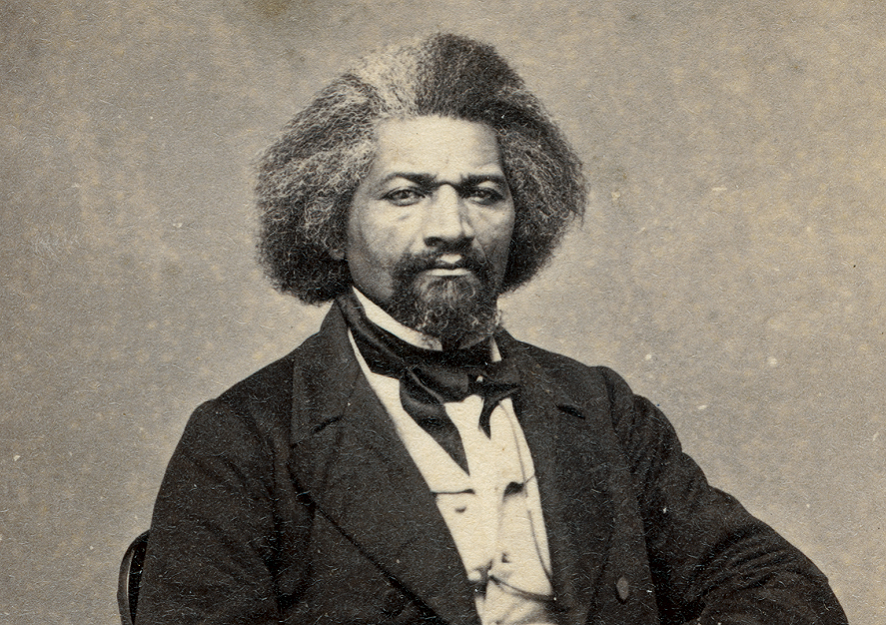
But I want to ask readers to consider his side of the debate addressed to and about fellow abolitionists, comrades, who were afraid of oppressed or Black leaders leading their own struggles. He said these comrades “don’t like any demonstrations in which colored men take a leading part. They talk of the proud Anglo-Saxon blood as flippantly as those who profess to believe in the natural inferiority of races.”
Is this why some find these acts of resistance and rebellions of October 7 so controversial?
Hassen Lorgat, Media Justice Activist