
By Iqbal Jassat
The emergence of new defence arrangements across parts of the Arab/Muslim world exposes a profound contradiction. Saudi Arabia, Türkiye, Pakistan, the UAE and Morocco are demonstrating that the political and military capacity exists to construct strategic partnerships beyond the traditional Western security architecture. Yet during the destruction of Gaza, when Palestinians faced mass civilian deaths, displacement and the devastation of an entire society, this strategic capacity was not translated into a collective defence mechanism capable of protecting them.
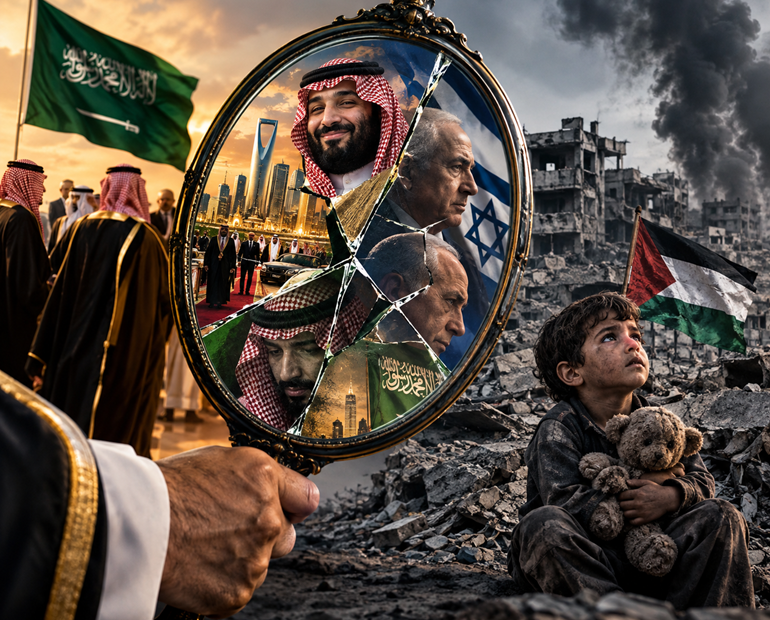
The arrangement between Saudi Arabia, Türkiye and Pakistan has deliberately been framed as “Makkah Pact” to mislead Muslim public opinion. Far from being an Islamic structure, it is a plot designed to protect each other’s narrow nationalist interests while allowing the Zionist settler colonial regime to continue its barbaric slaughter of Palestinians.
The question confronting the wider Muslim world is therefore unavoidable: where was this strategic solidarity when Gaza was being destroyed?
Where were the collective defence mechanisms when hospitals were attacked, civilians were displaced and the infrastructure necessary for civilian life was systematically devastated?
Where was the willingness to translate military capability into strategic deterrence when Palestinians were facing a catastrophe that governments across the Muslim world repeatedly described as intolerable?
The answer exposes a fundamental weakness in the existing political order within the House of Saud and allies the monarchy has drawn into a pact to destroy Yemen’s Ansarullah – a potent arc of the axis of resistance.
The Muslim world has never lacked military resources. Saudi Arabia possesses enormous financial resources and sophisticated military capabilities. Türkiye has one of the most powerful armed forces in the region and a growing indigenous defence industry. Pakistan possesses a substantial military establishment and extensive strategic experience. The UAE has developed sophisticated armed forces and an extensive network of military relationships. Morocco has steadily expanded its defence capabilities and military partnerships.
Yet Gaza exposed the distance between possessing military power and exercising collective strategic power.
The emerging alliances demonstrate that coordination is possible when governments perceive a direct threat to their own national security. They demonstrate that defence agreements can be negotiated, military capabilities can be integrated and strategic commitments can be formalised.
But Gaza presented a real test.
The Palestinian population did not possess the military capability to protect itself against one of the most heavily armed states in the region, backed by powerful Western governments and supplied by an extensive international military and diplomatic network.
The Palestinians had no air force capable of establishing air superiority, no integrated missile defence system, no conventional military alliance and no external security guarantor willing to place its military power between civilians and the forces destroying their communities.
The response by these regimes ganging up under the new pact, remained overwhelmingly diplomatic, humanitarian and rhetorical.
Summits were held. Statements were issued. Condemnations were delivered. Aid was discussed. International institutions were approached. But the military alliances now emerging were not activated in defence of Gaza.
This exposes the central weakness of the Muslim world’s existing security architecture. States have built national military capabilities, purchased sophisticated weapons systems and established bilateral defence relationships, yet collective security has remained largely confined to protecting states and regimes rather than populations facing external military assault.
The new security arrangements also reveal another uncomfortable reality. The Muslim world is capable of strategic autonomy when governments believe their own sovereignty is at stake. The Makkah Pact demonstrates that Saudi Arabia, Türkiye and Pakistan can construct a defence mechanism that does not depend exclusively upon Washington.
The growing military relationship between Morocco and the UAE demonstrates that Gulf and North African states can deepen defence cooperation. Türkiye has developed its own defence industry and expanded military partnerships across regions. The UAE has established extensive security relationships extending into Africa.
Though strategic options existed as they still do, clearly what has been lacking is the political decision to apply those capabilities collectively when Palestinians faced catastrophic violence, which they still do.
A lesson we need to take into account is that the consequences of Gaza extend beyond Palestine.
The war has exposed the limitations of the Western security architecture upon which many Muslim states have depended. It has also exposed the limitations of the Muslim world’s own political architecture.
States that can organise rapidly around national security threats have struggled to construct an equivalent mechanism for collective protection of Palestinians.
That failure has consequences for the credibility of every declaration about Muslim solidarity.
If collective defence means that an attack on one member constitutes an attack on all, then the principle remains confined to states that possess the political status required to invoke it. Palestinians remain outside that protection.
The Islamic Republic of Iran has demonstrated what the Muslim world is now beginning to recognise that dependence upon a single external security provider creates vulnerability.
Security architecture cannot be judged only by how effectively it protects borders, governments, energy infrastructure and strategic interests. It must also be judged by what happens when a population without comparable military power is subjected to sustained destruction.
The tragedy of Gaza therefore exposes two failures simultaneously.
The first is the failure of the Western dominated security system to provide anything resembling impartial protection when the victims are Palestinian.
The second is the failure of Muslim states with substantial military and economic capabilities to construct a collective mechanism capable of protecting Palestinians when diplomacy repeatedly failed to stop the destruction.
The emergence of the Makkah Pact makes this contradiction even more difficult to dismiss.
And Gaza will remain the measure against which these developments are judged by the Muslim Ummah.
Iqbal Jassat
Executive Member
Media Review Network
Johannesburg
South Africa