
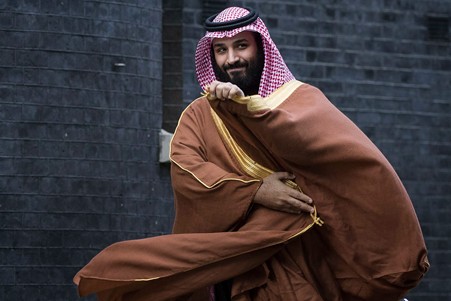
A few weeks ago, according to the New York Times, American commanders had approved their target lists in Yemen and ground crews were loading bombs onto the warplanes. Mohammed bin Salman had spent the day before on the phone to the White House, begging. The Houthis had just taken Yemen’s entire Red Sea coast, including Perim island at the mouth of the Bab el-Mandeb, and the Saudi-backed forces were running for Aden. Trump had told his own advisers he didn’t want to strike. After the crown prince’s call he changed his mind and ordered the Pentagon to get ready. By midday he had changed it back. The bombs came off the planes. The Houthis, Trump told Fox News, had promised not to hit American targets.
Bin Salman is 41. He has been crown prince since 2017, prime minister since 2022, and the man actually running Saudi Arabia for most of the last ten years. In that time he has taken apart everyone and everything in the kingdom that could say no to him: the senior princes, the Interior Ministry, the National Guard, the clerics, the big merchant families, the activists and the critics living abroad. He put the security services under his own office, put the country’s savings into a fund he chairs and handed the military to men who owe him their jobs. No Saudi ruler has ever held this much power in his own two hands. This year that system came up against an enemy it couldn’t scare, buy or lock up, and the state underneath turned out to be hollow.
The kingdom he inherited
Steffen Hertog, who teaches at the LSE, calls these ministries states within the state. Each one had its own hospitals, schools and housing. The princes fought each other over contracts, and sometimes one would block another’s arms deal just to spite him. It was corrupt and slow, and ordinary Saudis had no say in any of it. But a reckless prince had to win over his brothers and cousins before he could do anything big, and no one man ever controlled the money, the spies and the army all at once.
The clerics were the other half of the deal. Ever since the eighteenth century, when Muhammad ibn Saud teamed up with the preacher Muhammad ibn Abd al-Wahhab, the royal family had let the Wahhabi scholars run the courts, the schools and public morals in exchange for their blessing. The religious police patrolled the shopping malls. The senior scholars sat on their council and every so often made trouble.
Oil paid for the rest. Saudis got government jobs, cheap fuel and no income tax. Merchant families like the bin Ladens and the Olayans got rich on state contracts. Nobody voted, but the money spread far enough that the system survived the oil crashes of the 1980s, Saddam’s invasion of Kuwait and al-Qaeda’s bombings inside the kingdom in the early 2000s.
Salman’s son
He learned his real trade in his father’s office. Salman was governor of Riyadh for almost fifty years and the family’s disciplinarian, the prince who settled fights among the founder’s descendants and kept a file on every one of them. Mohammed sat in on those meetings. He found out which princes were in debt, which ones hated each other and which ones had business partners to protect. Diplomats and writers who met him back then describe a young man who was impatient, physically big and openly contemptuous of the old men around his father.
His father got to the throne mostly because his older brothers kept dying. Crown Prince Sultan died in 2011 and Crown Prince Nayef in 2012. Salman became the heir, and in 2013 he made his son head of his court. It sounds like a desk job. It wasn’t. Whoever ran that office decided who got to see Salman, which papers reached him and which appointments went through. The senior princes had ministries, regiments and business empires. Mohammed had the door to his father’s office.
King Abdullah died in January 2015. Salman was 79, and diplomats in Riyadh had been quietly talking about his memory problems for years. His son was 29.
The first hundred days
A few months later Salman pushed aside his half-brother Muqrin as crown prince, put Mohammed bin Nayef in his place and made his own son deputy crown prince. So now the kingdom had two heirs and one throne. Mohammed bin Nayef, known as MBN, was 55. Washington loved him. He was the man who had crushed al-Qaeda inside the kingdom, and he had survived a 2009 assassination attempt by a suicide bomber who had hidden explosives inside his own body. He had the Interior Ministry, the domestic spy service, the counterterrorism forces and the CIA’s trust. Bin Salman had the army, the economy and his father.
Yemen
It has now been going on for more than eleven years. By August 2018 the UN had counted 17,062 civilian casualties, 6,592 of them dead, most of them killed by coalition airstrikes. The coalition bombed a funeral hall in Sana’a in 2016 and killed more than 140 mourners. Two years later it hit a school bus in Dahyan and killed 40 boys on a field trip. UN investigators said there were reasonable grounds to believe that Saudi Arabia, the UAE, the Yemeni government and the Houthis had all committed what could be war crimes. The blockade, and the bombing of water and sewage plants, helped cause the biggest cholera outbreak in modern history.
Bin Salman couldn’t even put together the coalition he wanted. Pakistan’s parliament voted unanimously to stay out. Egypt sent warships but kept its soldiers home. So Riyadh paid for soldiers instead. A Times investigation in 2018 found that up to 14,000 Sudanese fighters were in Yemen at any one time, many of them from Darfur, some of them children, their families paid in cash. Saudi officers gave them orders over the radio from far behind the front.
At home the war did exactly what it was meant to do. It made the young defense minister the face of the nation’s sacrifice and turned any criticism into disloyalty in wartime. In Yemen it failed. By 2022, Bruce Riedel at Brookings had counted almost 25,000 Saudi-led airstrikes, against fewer than 1,300 Houthi missiles and drones. The Houthis still held Sana’a and most of the north. A UN truce that spring froze the front lines and left them right where they were.
How he got rid of his cousin
Within weeks he went after his cousin’s power base. A royal decree created a new Presidency of State Security and moved almost everything that mattered out of the Interior Ministry and into it: the domestic spy service, the counterterrorism units, the special forces, the security air wing, the national data center and the financial investigations unit. The new agency reported straight to the king, which in practice meant to his son. The public prosecutor was cut loose from the Interior Ministry the same summer and also put under the king. What was left of the Interior Ministry was ordinary police, passports and civil defense. The new interior minister was MBN’s young nephew, whose whole career now depended on the man who had just thrown out his uncle.
Then he went after MBN’s people. Saad al-Jabri, MBN’s longtime intelligence chief and the CIA’s main Saudi contact, had already fled to Canada. In a lawsuit he filed in Washington in 2020, al-Jabri claims bin Salman sent a hit squad to Toronto in October 2018, two weeks after the Khashoggi murder, and that Canadian border officers turned them back at the airport. Saudi Arabia denies it. Two of al-Jabri’s grown children, Sarah and Omar, were arrested in Riyadh and later sent to prison on charges their family calls plain hostage-taking. MBN was put under house arrest. In March 2020 he was detained along with Prince Ahmed bin Abdulaziz, the king’s last surviving full brother and one of only three Allegiance Council members who had voted no. Nobody has seen either man in public since.
The Ritz-Carlton
The government later said 381 people had been called in, 87 had made deals and more than $106 billion in cash, property, companies and shares had been handed over. There were no trials, no evidence made public and no accounting of where the money ended up. People who were held there later talked about night-time interrogations and threats against their families. Human Rights Watch cited reports that 17 detainees had to be taken to hospital. One of them, Major General Ali al-Qahtani, an aide to one of King Abdullah’s sons, died in custody. The Times reported that his neck looked broken and his body had other signs of abuse. Saudi officials denied any torture. Miteb reportedly paid more than a billion dollars to get out.
Saudi Arabia really was corrupt, and plenty of Saudis cheered. But look at who ended up in that hotel. The last branch of the royal family with its own army, Abdullah’s sons and the National Guard, was knocked out. The merchant dynasties that could have bankrolled a rival were brought to heel. The biggest TV network in the Arab world ended up under palace control, after al-Ibrahim reportedly handed over a majority stake. The bin Laden family lost its grip on its own company. Every rich family in the kingdom learned that its money now belonged to them only as long as the crown prince said so.
He didn’t care whether the men in the Ritz were guilty. He wanted them on their knees, and he got that.
Taking the guns
In February 2018 a decree issued in the middle of the night fired the chief of staff, the head of air defense and the commander of the land forces. That same month the king signed off on a defense plan with 308 initiatives, a new Joint Forces Command and lots of promises about efficiency and modern equipment. Arms buying was moved under a new military industries authority, and a state weapons company was set up inside the Public Investment Fund. Both answered to bodies bin Salman chaired. When he became prime minister in 2022, he handed the Defense Ministry to his younger brother Khalid, a former F-15 pilot and ambassador to Washington.
Each of these moves came with a sensible-sounding reason, and some were long overdue. The old setup was full of duplication and kickbacks. But the changes also got rid of the only people who could ever have refused an order. Under the old system a National Guard commander answered to his royal patron, and in a crisis he could refuse to move against another branch of the family. Today every commander answers to the same man, and every promotion goes through the same office.
The clerics
He didn’t get rid of the religious establishment, though. He put it on the payroll. A Carnegie study found the changes gave the state more control over religion, left individual scholars with less independence and shifted control of religious institutions toward the Royal Court. Obedient clerics went on TV to bless the same entertainment festivals they used to call sinful. The head of the Muslim World League took a delegation to Auschwitz.
The clerics who wouldn’t play along went to prison. In September 2017 the state arrested Salman al-Odah, a scholar with more than 13 million followers on Twitter, after he refused to tweet support for the blockade of Qatar and posted a prayer for reconciliation instead. Awad al-Qarni and Ali al-Omari were picked up the same week. Prosecutors asked for the death penalty for all three. Al-Odah is still in prison. His son Abdullah, who lives in the United States, says his father has lost much of his hearing and sight.
So bin Salman didn’t swap religious rule for freedom. He just moved control over Saudi private life from the mosque to the palace. Saudis can now dress more freely and watch what they like. What they can’t do is say anything about how they are ruled.
Reform without reformers
Women got to drive because the crown prince allowed it. The women who asked for it before he allowed it went to jail. The reform had to be his gift and nobody else’s.
Everyone else filled the prisons too. In 2022 a court gave Salma al-Shehab, a PhD student at Leeds and a mother of two, 34 years for following and retweeting dissidents. In 2023 Mohammed al-Ghamdi, a retired teacher, was sentenced to death for posts on X and comments on YouTube, where he barely had any followers. Bin Salman himself told Fox News he was embarrassed by that sentence and blamed the law, as if he had nothing to do with it. Both sentences were cut after a global outcry. Last year the kingdom executed 356 people, the most ever, many of them poor foreign drug convicts from Pakistan, Nigeria, Ethiopia and Egypt. The poor die in Saudi execution yards. The princes stripped of their fortunes at the Ritz mostly walked out alive.
Up near the Gulf of Aqaba, the Huwaitat tribe were told to leave land they had lived on for generations so NEOM could be built. In 2020 one of them, Abdul Rahim al-Huwaiti, posted videos saying he wouldn’t go. Security forces shot him dead at his home. Several of his relatives were later sentenced to death. Most of the futuristic city they were thrown off their land for has since been shelved.
The enforcers
In October 2018 the journalist Jamal Khashoggi walked into the Saudi consulate in Istanbul to pick up papers for his wedding. A fifteen-man team flown in from Riyadh was waiting for him. It included members of the crown prince’s own protection detail and a forensic doctor carrying a bone saw. Turkish intelligence recordings, parts of which were later made public, show Khashoggi was dead within minutes. His body has never been found. Riyadh denied it, then changed its story, then admitted the killing and blamed a rogue operation. A Saudi court convicted eight low-level men in a closed trial. Qahtani was fired and never charged. In 2021 the US Director of National Intelligence released a report concluding that bin Salman had approved the operation to capture or kill Khashoggi.
He got away with it. Within four years Biden, who had promised to turn the kingdom into a pariah, was fist-bumping him in Jeddah. Trump welcomed him at the White House last year, and when a reporter brought up Khashoggi, Trump said the crown prince knew nothing about it and that “things happen.” Back home, not one prince spoke up and not one officer moved.
Rule by fund
He did it through the Public Investment Fund, which he chairs. Its assets went from about $150 billion in 2015 to more than $900 billion at the end of last year. It owns or pays for NEOM, the Red Sea resorts, the new airline Riyadh Air, a stake in Nintendo, Newcastle United, LIV Golf, the bid that won the 2034 World Cup and hundreds of Saudi companies. In the same industries, at the same time, the fund is the investor, the owner, the customer, the regulator and the competitor. The IMF has warned more than once that it risks pushing out the very private investment the whole plan was supposed to attract.
Business got the message from the Ritz. Foreign companies were told to move their regional headquarters to Riyadh or lose government contracts. Saudi business families learned to put their money wherever the palace pointed. Nobody had any reason to tell the crown prince that one of his projects was failing.
So the failures stacked up quietly until they couldn’t be hidden anymore. The Line, NEOM’s 170-kilometer mirrored city, was once supposed to cost more than a trillion dollars and house 1.5 million people by 2030. This spring Semafor reported that work had been stopped until after 2030 and the 2030 population target cut to as few as 100,000. Trojena, the ski resort in the mountains that was meant to host the 2029 Asian Winter Games, gets no new money until the next decade. The Mukaab, a giant cube-shaped tower in Riyadh that was meant to hold twenty Empire State Buildings, is on hold. The fund stopped paying for LIV Golf after putting in $5 billion. The finance minister, Mohammed al-Jadaan, said the government would adjust, delay or cancel projects “without hesitation.”
Ordinary people are paying the bill. In the first three months of this year the government ran a deficit of about $33.5 billion, the biggest since 2018, and borrowed every cent of it. Public debt has passed 1.67 trillion riyals. VAT was tripled to 15 percent in 2020 and has never come back down. Meanwhile the South Asian and African migrant workers who poured the concrete for these giga-projects worked through the Gulf summers under the kafala system, their deaths routinely written off as “natural causes.” Now the cranes over the desert have gone quiet.
The army he built
What bin Salman did was centralize that system without fixing it. The old rivalries between princes are gone, but the fear now sits in one office. Officers who used to play one royal patron against another now answer to a ruler who has shown he will lock up his own cousin. Nobody brings bad news to a man like that. The kingdom spent about $83 billion on its military last year, the eighth-biggest budget in the world, and it buys more major weapons than almost any country on earth, three-quarters of them American. That money bought F-15s, Patriots and THAAD. It didn’t buy commanders who think for themselves, intelligence that gets shared between branches or a military that learns from its own mistakes.
We saw it at Abqaiq in 2019, when drones and cruise missiles knocked out half of Saudi oil production overnight even though Patriot batteries were sitting nearby. Analysts at CSIS found radars pointed the wrong way and separate agencies each running their own piece of the air defense. We saw it again last week. According to the first Saudi investigation, the Houthis opened the airport attack with drones to swamp the radars, then followed with cruise and ballistic missiles, some of which changed course in flight. They flew more than 1,000 kilometers and nobody raised the alarm in time. A month earlier the kingdom said it had shot down a drone headed for Mecca.
On the ground it was even worse. In September, at Mokha, the coast was being held by Yemeni government forces that the Emiratis had built and then abandoned when the UAE pulled out of Yemen in January. Their commander, Tareq Saleh, the late president’s nephew, warned Riyadh for weeks that the Houthis were heading for the Bab el-Mandeb and begged for air support. He got a few strikes. The Houthis broke through at Kadaha, a stretch of mountains split between two government factions that didn’t trust each other. The government side lost 1,800 square miles in one night. At least 500 of Saleh’s fighters were killed and the rest ran to Aden. And why had the Emiratis left? Because Saudi jets had bombed what Riyadh called Emirati weapons shipments to southern separatists. Bin Salman had bombed his own best ally out of the war.
Bin Salman abroad
That same November, Lebanon’s prime minister Saad Hariri flew to Riyadh and read out his resignation on Saudi television. Lebanese officials said his phone had been taken away and the speech written for him. Lebanon’s president, Aoun, accused the Saudis of holding him hostage. It took Macron stepping in personally to get Hariri out to Paris, and Hariri took back his resignation as soon as he got home. Hezbollah came out of it stronger.
By 2023 the crown prince had changed his tune. He ended the fight with Qatar, opened talks with the Houthis and signed a deal in Beijing to restore relations with Iran. The new caution made sense, but it came from the same place as the old recklessness. No institution forced him to change course. One man changed his mind, and next time he changes it, nothing will stop him.
What his defenders say
The first is that he modernized the country. Women drive, cinemas are open, tourists come. All true, and those freedoms are real for the people who enjoy them. But reform handed down by one man can be taken back by one man, and the women who asked for it first went to prison for asking.
The second is that he cleaned up corruption. The Ritz brought in $106 billion. Nobody knows where it went, not one charge was tested in court, and the committee that took it was run by a prince who, in those same years, bought a $450 million Leonardo and a $300 million French chateau. What he really cleaned up was the competition.
The third is that Saudi Arabia is stable. Next to Iraq or Syria, sure. His grip is tighter than ever, and no rival prince has an army or a fortune left to challenge him. But stability that hangs on one man’s judgment only lasts until that judgment fails, and since the Iran war began in February it has failed again and again. The Yemen war came back and Riyadh lost the coast. The capital’s airport was hit three times in a week. The pipeline was shut. The interceptors are running out. An American president loaded the bombs and then unloaded them. And the kingdom had to ask Pakistan, whose parliament once refused to send a single soldier, to come and guard it.
Where this leaves Saudi Arabia
He runs the security services through State Security, the economy through the PIF, religion through the scholars he picked and the military through his brother and the commanders he chose. Every big decision in the kingdom goes through him. So does every big failure.
The price of those failures never reaches the palace because it is paid by the Bangladeshi and Sudanese workers killed in the Riyadh airport last week, by Yemeni children who have lived under Saudi bombs for eleven years, by the Sudanese teenagers who fought his war for cash, by the migrant workers who built cities that will now never be finished, by the 356 people executed last year, and by the Pakistani soldiers being flown in to guard a kingdom that spends nine times more on defense than their own country does. Washington and London must stop arming this man. The Saudi-Houthi talks must restart now with every Yemeni faction at the table. And every political prisoner, from Salman al-Odah to the al-Jabri children, must be set free. But you know why these talks will fail, because MBS can’t allow for a unified Yemen and he can’t figure out what to do, who to back, and whom to trust. More on this topic later.