
By Iqbal Jassat
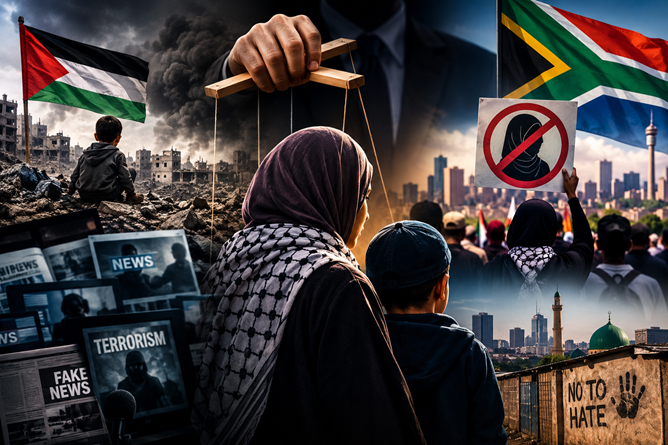
The growing visibility of anti-Muslim rhetoric in South Africa must be examined against an international backdrop in which Islamophobia has become a powerful political instrument. From attempts to discredit Muslim communities in North America to the demonisation of Muslim traders, charities and public figures in South Africa, a recurring narrative portrays Muslims as a threat to national identity, social stability and Western civilisation.
Evidence of organised influence operations abroad establishes that the deliberate amplification of anti-Muslim sentiment is a documented political tactic. The question of how these methods intersect with South Africa’s political environment demands serious investigation.
What is clear is that the international campaign to rehabilitate Israel’s image has increasingly faced the consequences of its genocide in Gaza. Images of civilian devastation, the destruction of hospitals and universities, mounting Palestinian casualties and proceedings at the International Court of Justice have placed Israel’s public relations apparatus under extraordinary pressure.
Research reported in September 2025 revealed that Stagwell, a major global marketing group, had conducted extensive public opinion research for work commissioned by the Israeli government through a broader communications arrangement.
The reported findings included testing messages about “terrorism and Islamic radicalism” as ways of improving perceptions of Israel among Western audiences. The work involved surveying more than 13,000 people in the United States and Europe.
When defending Israeli military conduct becomes increasingly difficult, shifting public attention towards fears of radical Islam offers an alternative means of influencing public opinion. The conflict can then be presented through the language of civilisation, religious extremism and Western security rather than occupation, Palestinian dispossession and accountability for state violence.
The significance lies in the choice of narrative. The Palestinian struggle for national liberation becomes secondary to a manufactured confrontation between Israel and an imagined threat to Western civilisation. Palestinian suffering is displaced by security rhetoric, while Muslim identity itself becomes associated with danger.
South Africa presents a particularly important case because of its diplomatic and legal confrontation with Israel over Gaza.
South Africa instituted proceedings against Israel at the International Court of Justice under the Genocide Convention. The Court issued provisional measures, while the underlying case remains a separate legal process from any final determination on the merits. South Africa’s position has placed it at the centre of an international dispute over Israeli accountability.
Against this backdrop, increasingly visible anti-Muslim rhetoric in South Africa deserves scrutiny. The country’s Muslim population is small relative to the national population, yet Muslim organisations, businesses and public figures have become prominent targets in online debates about immigration, religious identity and national belonging.
In August 2026, Al Jazeera reported on the growing visibility of online anti-Muslim rhetoric in South Africa. The coverage documented accusations that Muslims were attempting to take over the country and claims that Muslim charities were exploiting poverty to convert Black South Africans. Gift of the Givers, one of the country’s most prominent humanitarian organisations, was among the institutions targeted by such narratives.
The pattern deserves attention because it connects separate controversies through a common accusation: Muslims are presented as outsiders pursuing a concealed agenda.
The result is a political environment in which ordinary Muslim participation in South African society is subjected to a different standard of scrutiny.
The rise of anti-Muslim rhetoric cannot be separated from South Africa’s escalating anti-immigrant mobilisation.
The Human Sciences Research Council reported in May 2026 that the proportion of South Africans who said they would welcome no immigrants rose from 28% in 2020 to 42% in 2025. Those willing to welcome all immigrants fell from 24% to 15% over the same period.
These findings establish a deteriorating climate for migrants. They do not, by themselves, establish a coordinated anti-Muslim campaign. They do, however, identify the social conditions in which religious scapegoating can gain traction.
Unemployment, crime, pressure on public services and competition for economic opportunities are real concerns. Political movements can exploit these frustrations by directing public anger towards foreign nationals rather than the institutional failures that contribute to hardship.
A debate about immigration enforcement then shifts towards claims of Islamic expansion, the imposition of Sharia law and an alleged Muslim takeover of South Africa.
This shift is politically consequential. It allows existing hostility towards foreigners to draw upon a much older international agenda of anti-Muslim propaganda.
The distinction between genuine public grievances and their deliberate exploitation is essential. One does not cancel out the other.
South Africa’s online environment provides further evidence that anti-immigrant hostility is being amplified through coordinated activity.
A September 2026 report discussed by Daily Maverick, drawing on research by Tales of Turning, found that 27% of the anti-foreign national narratives analysed in its sample were linked to a disinformation network involving disruptive and bot accounts.
The research examined publicly available social media posts from May and June 2026. Its findings concern the sampled anti-immigrant narratives, not all online discussion and not Islamophobia specifically.
In March 2026, an image circulated online purporting to show South African police arresting undocumented Muslims for praying during Eid. AFP Fact Check established that the image was AI generated and that police had no record of the alleged incident.
The fabrication exploited religious identity and anti-immigrant sentiment simultaneously. It presented an invented incident as evidence of a real threat.
This is how disinformation operates. It does not need to invent every underlying grievance. It takes existing anxieties, supplies a false or misleading narrative and encourages the public to treat that narrative as confirmation of what it already suspects.
What the evidence establishes is that coordinated anti-immigrant disinformation exists, fabricated material targeting Muslims circulates online, and similar techniques have been documented in an influence operation linked by investigative reporting to Israeli government structures.
When Muslim charitable activity is routinely interpreted as a demographic threat while comparable activity by other religious organisations escapes equivalent suspicion, the disparity demands explanation.
The controversy surrounding halal certification illustrates how ordinary commercial practices can be transformed into claims of religious imposition.
Halal certification is a commercial and religious standard used by businesses serving Muslim consumers and markets. Its existence on a product does not mean that non Muslim consumers are being compelled to practise Islam.
The political significance emerges when halal labelling is presented as proof of an alleged Islamisation project.
South Africa’s confrontation with Israel over Gaza gives this investigation a wider geopolitical dimension.
The South African government has challenged Israel through international legal mechanisms and maintained a strong public position in support of Palestinian rights. These actions have made South Africa an important participant in the international dispute over Israel’s conduct.
It is reasonable to investigate whether hostile messaging directed at South African Muslims is connected to attempts to undermine solidarity with Palestine or discredit organisations that support Palestinian rights.
Anti-Muslim politics has a long history that predates the present Gaza war. The post September 11 security environment, the global War on Terror and the rise of far-right movements helped normalise the association of Islam with extremism and cultural incompatibility.
In parts of Europe and North America, political movements have combined anti-immigration positions with claims that Muslim communities threaten national identity. Some of these movements have simultaneously defended Israel as a strategic ally against Islamist extremism.
In South Africa, the relevant question is whether imported anti-Muslim narratives are being adapted to local grievances and amplified by political entrepreneurs who stand to benefit from division.
The growing hostility towards foreign nationals, the circulation of fabricated material about Muslims and the documented existence of coordinated anti immigrant networks make that question legitimate.
South Africa’s constitutional order protects religious freedom and equality. Muslim citizens and residents are entitled to participate in public life without being treated as presumptive threats because of their faith.
Immigration enforcement, public safety and economic policy are legitimate subjects of democratic debate. They cannot justify collective suspicion of Muslims or the attribution of criminality to entire national or religious communities.
The same principle applies to criticism of Israel. Opposition to Israeli government policy, support for Palestinian rights and scrutiny of Zionist political organisations are not inherently antisemitic.
The real danger lies in allowing religious prejudice to become an accepted language of political mobilisation. Once Muslims are portrayed as a collective threat, discrimination becomes easier to justify, solidarity becomes harder to sustain and the institutions responsible for addressing economic and social failures escape scrutiny.
The weaponisation of Islamophobia is a legitimate subject of investigation. South Africa cannot afford to ignore it, and neither can it afford to confuse suspicion with proof.
Iqbal Jassat
Executive Member
Media Review Network
Johannesburg
South Africa