
By Iqbal Jassat
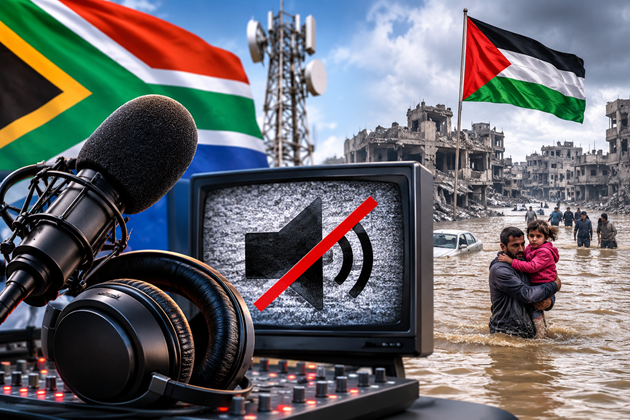
The first major winter storm of the season has just ripped through Gaza, submerging an estimated 70,000 tents and claiming the lives of five people, including three children. It is a catastrophic humanitarian crisis layered on top of an existing genocide by the Zionist regime.
Yet, if you tuned into South Africa’s premier television news platforms—the SABC, e.tv, or Newzroom Afrika—you would barely know it happened. The same can be said of radio stations, from 702 to Cape Talk and many more.
Instead, our airwaves remain cluttered with the minor domestic squabbles of the United States and the United Kingdom, treated with an urgency that exposes a deep, structural hypocrisy in local journalism.
For years, local newsrooms have rolled out a standard deck of cards to excuse their inadequate coverage of global humanitarian disasters outside the Western axis. We are told, with rehearsed solemnity, about “severe financial constraints.” We are reminded of the astronomical costs of maintaining foreign bureaus or the logistical impossibility of deploying South African journalists into active conflict and crisis zones.
These excuses no longer hold water. In the digital age, hiding behind the lack of an official passport or a corporate expense account is a failure of editorial imagination and a violation of the public’s right to be informed.
The reality is that South African media platforms do not need a multi-million-rand budget to cover Gaza accurately. They do not need to fly a crew out of OR Tambo International Airport. Why? Because the ground in Gaza is already populated by hundreds of articulate, resilient, and courageous voices—journalists, aid workers, and ordinary citizens—who are entirely willing and able to offer their views, footage, and lived experiences.
We live in an era of unprecedented hyper-connectivity. Independent Palestinian journalists, civil defence workers, and displaced families are broadcasting their reality daily via smartphones.
International agencies like UN OCHA and UNICEF publish meticulous, real-time data and eyewitness testimony. To claim that a story cannot be told because a South African reporter isn’t physically standing in the mud is an insult to the digital tools at our disposal and to the very people enduring the crisis.
Overcoming these alleged barriers requires only editorial will. Local newsrooms could easily establish remote syndication networks, conducting virtual interviews with on-the-ground contributors.
They could feature the verified dispatches of Palestinian reporters who are already doing the heavy lifting under catastrophic conditions. They could partner directly with regional networks or independent creators to diversify their feeds.
Instead, our broadcasters choose the path of least resistance: looping pre-packaged, automated segments from Western syndicates. By relying blindly on these feeds, South African media passively inherits the geopolitical biases of the Global North, where a minor political gaffe in London or Washington routinely outranks the drowning of children in a Middle Eastern refugee camp.
South Africa has positioned itself globally as a moral vanguard for international law and human rights, famously taking a stand on the global stage regarding the plight of Palestinians. It is a bitter irony, then, that our domestic airwaves fail to reflect that very commitment.
Is it not the case that the right of media consumers to be informed about the world is being compromised by editorial laziness masquerading as financial hardship?
It is time for the SABC, e.tv, and Newzroom Afrika, 702, Cape Talk and many other news outlets to drop the outdated excuses, leverage the voices in Gaza screaming to be heard, and fix their international blind spot.
Iqbal Jassat
Executive Member
Media Review Network
Johannesburg
South Africa