
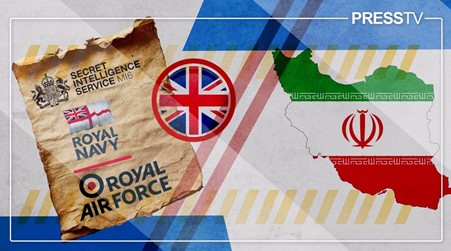
Iran has designated MI6 a hostile group and the Royal Navy and RAF terrorist organizations, citing spying activities, support for US-Israeli war and longstanding hostile actions against Iran.
Iran recently designated Britain’s Secret Intelligence Service, MI6, as a “hostile group” and declared the Royal Navy and Royal Air Force “terrorist organizations” in a decisive retaliatory measure against London’s relentless hostile actions against the Islamic Republic.
The Iranian Foreign Ministry announced the measures on November 1, 2026, citing Britain’s participation in the US-Israeli war of aggression against Iran and its decision to place the Islamic Revolution Guard Corps (IRGC) under the country’s so-called “State Threats Act 2026.”
The decisions were made under a resolution of Iran’s Supreme National Security Council and in response to Britain’s actions over the past year.
Under the first measure, MI6—formally the Secret Intelligence Service—has been designated a hostile group under Note 2 of Article 1 of Iran’s Law on Intensifying Punishment for Espionage and Cooperation with the Zionist regime and Hostile Countries against National Security and National Interests.
The designation took effect upon publication of the ministry’s statement, and the provisions of the law now apply to the British spy agency.
Under the second measure, the Royal Navy and Royal Air Force have been brought under Iran’s Law on Countermeasures against the United States’ Designation of the IRGC as a Terrorist Organization.
Both British military branches are consequently designated as terrorist organizations under Iranian legislation.
The Foreign Ministry cited Britain’s provision of military and logistical facilities and bases within territories under its jurisdiction to support the US-Israeli war of aggression against Iran as one of the grounds for the measures.
It also pointed to London’s July 13, 2026 decision to place the IRGC under the State Threats Act 2026, describing the move as part of Britain’s hostile policies against the Islamic Republic.
The ministry condemned Britain’s policies as contrary to the principles of the United Nations Charter and international law, particularly the principles of respect for national sovereignty and the prohibition of unlawful actions against other countries.
It reaffirmed Iran’s determination to take the necessary measures to protect its national security and interests.
“The measures have evidently been adopted in accordance with the principles of international law and within the framework of the principle of reciprocity,” the statement said, adding that the British government would bear responsibility for their consequences.
A century of British hostility
The November 1 designations are not an isolated response but the culmination of a century of British intervention, espionage and military aggression against Iran. The record is long, documented and central to Iranian national memory.
Britain’s hostile role predates MI6 itself. During the nineteenth century, London competed with Tsarist Russia for influence over Persia in the Great Game, pressuring the Qajar government and intervening in the country’s affairs to control strategic decisions in Tehran.
On August 25, 1941, British and Soviet forces invaded Iran despite its declared neutrality in the Second World War. British forces advanced from Iraq and the Persian Gulf, while British naval forces operated in southern Iranian waters.
The Royal Air Force participated in the campaign, bombing Ahvaz and attacking ports and naval facilities at Bandar Imam Khomeini and Khorramshahr. The invasion forced the Pahlavi monarch to abdicate.
This was not covert interference but open military aggression against a neutral nation—and it remains a foundational reference point in Iranian accounts of British military power.
The 1953 coup against Prime Minister Mohammad Mosaddegh became the most enduring symbol of British intelligence hostility.
After Iran nationalized its oil industry, Britain—through MI6, working with the American CIA—participated in the operation that removed Mosaddegh and restored the Shah’s political position. MI6 was one of the coup’s principal organizers, and declassified British and American documents have confirmed MI6’s central role in “Operation Boot.”
The coup is among the clearest cases in which British intelligence involvement is established by substantial historical documentation.
Espionage against Iranian diplomatic missions
In May 1994, then-President Akbar Hashemi Rafsanjani announced that British intelligence had placed listening devices in the Iranian embassy in London. Embassy staff discovered a microphone, and further investigations revealed additional devices.
Rafsanjani identified MI6 as responsible for the surveillance and noted that British allegations about Iranian links with the Irish Republican Army were intended to divert attention from the eavesdropping operation.
The Foreign Ministry confirmed that the first microphone had been discovered weeks earlier and that the embassy had delayed publicizing the matter while investigating the possibility of additional devices.
The episode was a direct charge, attributed to the Iranian president, that MI6 had conducted technical surveillance against an Iranian diplomatic mission on British territory.
Support for terrorist groups in Khuzestan
A major escalation occurred during the bombings in Khuzestan in 2005 and 2006. In August 2005, Iran’s Intelligence Ministry announced that British intelligence services were involved in the unrest and bombings in the border Iranian province.
Those arrested in connection with the incidents confessed to direct links with separatist groups and foreign intelligence networks, particularly those associated with Britain. The British connection extended beyond political encouragement to operational support.
After bombings in Ahvaz in October 2005 and January 2006, Iranian officials pointed to the presence of British troops in southern Iraq, close to the Iranian border, and established that terrorist groups operating in Khuzestan were receiving assistance from British military personnel and facilities.
Parliamentarian Alaeddin Boroujerdi raised concern about British involvement, citing the presence of British forces near the border and information about their previous involvement in unrest in Khuzestan.
In January 2006, Foreign Minister Manouchehr Mottaki stated that London had a clear connection with the bombings, that those responsible had links to British officials, and that they enjoyed the cooperation of British army commanders.
He referred to the use of British facilities in Basra. The episode stands as one of the clearest examples of Britain facilitating violence inside Iran through its military presence in Iraq.
Royal Navy and Iranian maritime sovereignty
The Royal Navy became the subject of a direct sovereignty issue in March 2007, when Iranian forces detained 15 British sailors and marines from HMS Cornwall in the northern Persian Gulf.
Iran established that the British personnel had entered Iranian territorial waters illegally while conducting an inspection of a merchant vessel.
The Foreign Ministry condemned the illegal and interventionist entry by British forces, describing the incident as suspicious and contrary to international rules.
The detention lasted 13 days and became a major diplomatic confrontation between the two countries. Iranian officials said the episode was evidence of British disregard for Iran’s maritime sovereignty.
In July 2019, British forces seized the Iranian tanker Grace 1 off Gibraltar, an illegal seizure of an Iranian vessel that Tehran saw as an attempt to restrict its oil exports.
Iranian authorities rejected the legality of the operation and asserted that Britain had no right to prevent Iran from selling oil to its customers.
Later that month, on July 19, the IRGC Navy seized the British-flagged tanker Stena Impero in the Strait of Hormuz after the vessel violated maritime regulations, ignored warnings, followed an incorrect traffic route and switched off its navigation system.
Interference in domestic affairs
Following Iran’s presidential election in June 2009 and the subsequent engineered protests, British institutions worked to support and inflame the unrest and destabilize the Islamic Republic.
The British embassy in Tehran, British diplomats, the BBC’s Persian-language service and intelligence networks operating under diplomatic and journalistic cover were all implicated.
British diplomats were present among those who indulged in violent riots. Embassy-linked contacts helped coordinate political activity. Individuals working under journalistic cover gathered intelligence.
Britain conducted psychological operations through BBC Persian and supported political networks opposed to the Iranian government
These operations reinforced the longstanding reality that British diplomatic and media activity serves intelligence and political objectives—activity that contributed to the deterioration of bilateral relations and culminated in the 2011 protest against the British embassy and the closure of the mission.
Complicity in the assassination of Iranian nuclear scientists
From 2010 onward, British intelligence was connected with American and Israeli operations against Iran’s nuclear program.
The assassination of Iranian nuclear scientists became a central part of this record. While the killings were carried out by Israeli Mossad, MI6 and the CIA assisted in intelligence collection, operational planning, training and the identification of targets.
In December 2010, then-Interior Minister Mostafa Mohammad-Najjar announced that individuals arrested in connection with attacks on Iranian scientists had confessed to links with Western intelligence services, including MI6, the CIA and Mossad.
The assassination of nuclear scientist Majid Shahriari in 2020 formed part of a coordinated effort by Israeli intelligence and its Western counterparts, including MI6 and the CIA, to disrupt Iran’s nuclear program.
In November 2013, the head of MI6, John Sawers, discussed the role of British intelligence in the international pressure campaign against Iran, acknowledging that intelligence activity had contributed to the pressure on Tehran and the sanctions regime.
His remarks confirmed hostile British intelligence activity against the Islamic Republic.
In December 2013, the head of the Kerman Revolutionary Court, Dadkhoda Salari, announced the arrest of an individual accused of spying for MI6.
The suspect had maintained contact with four British intelligence officers and had met them 11 times, both inside and outside Iran.
Salari collected information requested by the British officers and received instructions intended to undermine Iranian national interests. He confessed to the allegations, and judicial proceedings were underway.
Intelligence penetration and the Akbari case
In July 2022, the IRGC Intelligence Organization announced that several foreign diplomats had been detained after collecting soil samples in Iran’s central desert.
Giles Whitaker, then the British deputy ambassador, was specifically identified, and the activity was connected with intelligence gathering.
The area was near a military and missile-related site. The British diplomat was expelled from the area, and the case became part of the established record that British diplomatic personnel collect sensitive information under civilian and scientific cover.
The most prominent recent case involving an MI6 agent was that of Alireza Akbari, a former Iranian deputy defense minister holding Iranian and British citizenship.
In January 2023, Iran announced that Akbari had been executed after being convicted of spying for MI6. Iranian judicial and intelligence authorities established that he had provided MI6 with sensitive information about Iranian officials and strategic institutions over an extended period.
The Intelligence Ministry described him as an infiltrating agent who had obtained access to sensitive centers and transferred information to British intelligence officers.
Akbari met MI6 officers during trips to Europe and was recruited through contacts associated with research and business institutions.
The information he supplied included details about 178 Iranian figures, among them top nuclear scientist Mohsen Fakhrizadeh, who was assassinated near Tehran in November 2020.
The case demonstrated the consequences of MI6 penetration of Iran’s state institutions.
Latest turn of events
The November 1, 2026 designations respond to Britain’s most recent hostile acts. The British government initially declined to authorize the use of its bases for American attacks, but subsequently permitted US forces to use RAF Fairford in England and Diego Garcia in the Indian Ocean for operations against Iranian missile facilities.
Tehran regards the provision of bases, facilities and logistical support as participation in hostile military operations against Iran.
On July 13, 2026, London placed the IRGC under the State Threats Act 2026, a hostile measure against a central institution of the Islamic Republic. The Foreign Ministry’s statement cited both actions as grounds for the designations.
The November 2026 designations mark a formal escalation in Iran’s treatment of Britain’s armed forces.
MI6 has been designated a hostile group—a status reflecting its record of espionage, surveillance, recruitment of Iranian informants, support for armed groups, interference in domestic politics and cooperation in operations against the nuclear program.
The Royal Navy and Royal Air Force have been designated terrorist organizations—a status reflecting the Royal Navy’s violations of Iranian maritime sovereignty and Britain’s use of its military bases and facilities for operations against Iran.
The Royal Navy’s record includes the 2007 violation of Iranian territorial waters, the illegal 2019 seizure of the Grace 1, and Britain’s broader military presence in the Persian Gulf.
The RAF’s record includes the 1941 bombing of Ahvaz and, most recently, the provision of British bases for US operations against Iranian missile facilities.
These designations are adopted in accordance with the principles of international law and within the framework of reciprocity. The British government bears responsibility for their consequences.
The message from Tehran is clear: Britain’s century of hostility against Iran—from the 1941 invasion and the 1953 coup to espionage, support for armed groups, interference in domestic affairs, complicity in the assassination of Iranian scientists and the provision of bases for attacks on Iranian territory—will no longer go unanswered.
Iran has acted to protect its national security and interests, and it will continue to do so against any hostile power that violates its sovereignty.
“Reprinted from…”Explainer: Why Iran designated British MI6, Royal Navy, and RAF as hostile, terrorist organizations