
By Iqbal Jassat
Israel’s treatment of African nationals seeking refuge exposes another dimension of a political and legal system increasingly defined by racial discrimination, exclusion and the unequal application of human rights. The same state whose treatment of Palestinians has attracted findings of apartheid, whose military campaign in Gaza has been the subject of a UN Commission of Inquiry finding of genocide, is now expanding a financial programme to encourage African nationals to leave its territory.
These developments belong in a wider examination of how Israel exercises power over populations it regards as outside its preferred national and political order.
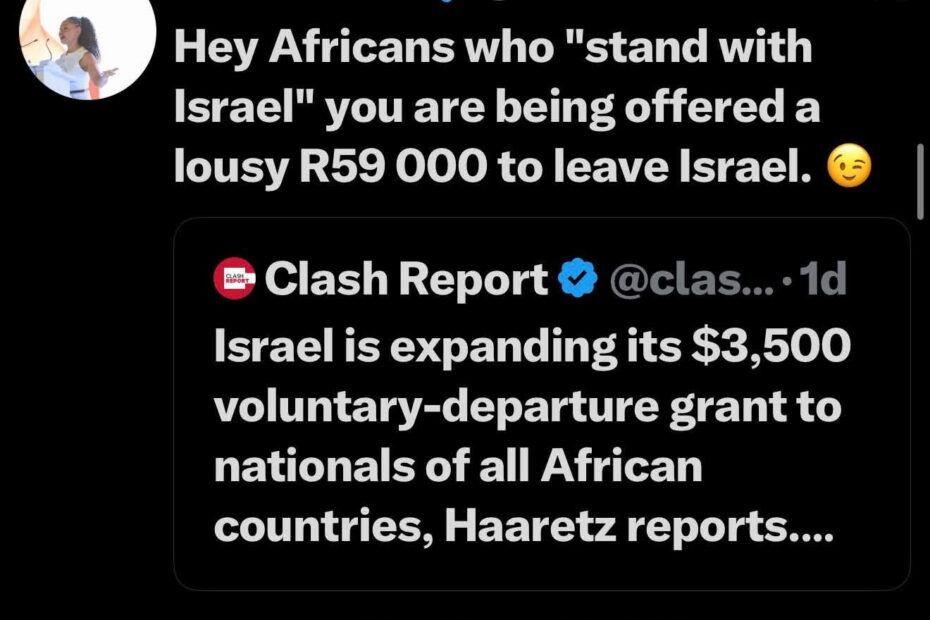
The announcement that Israel is extending $3,500 departure grants to nationals of all African countries deserves far greater scrutiny than it has received.
As core to its hasbara (propaganda), the Israeli authorities misleadingly describe this as “voluntary” departure. But the circumstances surrounding the programme raise a number of fundamental questions about the meaning of voluntary consent when people face insecure immigration status, financial restrictions and the threat of enforcement.
The treatment of Palestinians provides essential context for understanding Israel’s approach to populations living under its authority.
Take the case of Palestinian citizens of Israel who possess formal citizenship, yet face documented inequalities in housing, public services, land access and other areas of public life.
Also, Palestinians in the occupied West Bank who live under a completely racist legal and administrative framework from Israeli settlers, with restrictions on movement, access to land and resources.
In January 2026, the UN Office of the High Commissioner for Human Rights published a major report documenting Israel’s discriminatory administration of the occupied West Bank, including East Jerusalem. It warned that Israel was violating international law prohibiting racial segregation and apartheid.
The report documented how Palestinians and Israeli settlers living in the same territory are subjected to different legal systems, producing unequal access to movement, land, water and essential services.
This is institutionalised inequality documented by the United Nations.
The distinction matters. Palestinian citizens of Israel, Palestinians living under occupation and African foreign nationals do not share the same legal status. Yet their treatment exposes a broader question about the hierarchy of rights maintained by the Israeli state.
The treatment of Palestinians cannot be separated from the genocide that has led to massive devastation in Gaza.
Though the Zionist regime and its lobbyists in South Africa and elsewhere deny it, the facts speak for themselves.
In September 2025, the UN Independent International Commission of Inquiry concluded that Israeli authorities and security forces had committed genocide against Palestinians in Gaza. Its findings identified four of the five acts listed in the Genocide Convention.
The Commission reiterated its findings in 2026, documenting continued violations against Palestinian children and further atrocity crimes.
South Africa’s genocide case against Israel remains before the International Court of Justice. The ICJ has issued provisional measures requiring Israel to comply with its obligations under the Genocide Convention. The final merits judgment remains pending.
These are significant legal developments. They place Israel’s conduct under the scrutiny of international institutions and establish that the allegations cannot be dismissed as political rhetoric.
Yet the diplomatic and military relationships protecting Israel from meaningful international accountability remain largely intact.
The United States continues to be central to Israel’s military and diplomatic position, while several Western governments maintain relationships with the Israeli state despite the findings of international investigative bodies.
This is the wider environment in which Israel’s treatment of African nationals must be examined.
Israel’s relationship with African asylum seekers has a documented history.
In 2018, the government attempted to relocate African asylum seekers to Rwanda and Uganda, offering financial incentives and travel arrangements. Those who refused faced the prospect of detention.
The arrangements attracted international criticism. UNHCR expressed concern that people transferred to those countries had not necessarily found adequate protection. Israeli refugee organisations challenged the claim that departures under these circumstances were genuinely voluntary.
Though the programme eventually collapsed, the current one relies on the same architecture of removal, including financial inducements to encourage African nationals to leave Israel.
There is another important dimension. Israel’s own immigration authority uses the term “infiltrators” to describe eligible African migrants, including people from Eritrea and Sudan. Refugee organisations have frequently described many within this population as asylum seekers.
The language matters. It frames vulnerable people through the vocabulary of security and illegality rather than beginning with their protection needs.
There is a particularly troubling historical irony in this policy because African societies understand the consequences of racial classification, segregation and systems that assign different rights and protections according to identity.
South Africa’s experience of apartheid established why such systems must be examined through their laws, administrative practices and distribution of power.
The UN’s findings concerning Israel’s administration of the occupied West Bank make that comparison especially relevant.
The continent cannot therefore view the issue simply as an immigration arrangement between a foreign government and individual migrants. It concerns the treatment of African people, the protection of asylum seekers and the international standards that governments claim to uphold.
Iqbal Jassat
Executive Member
Media Review Network
Johannesburg
South Africa