
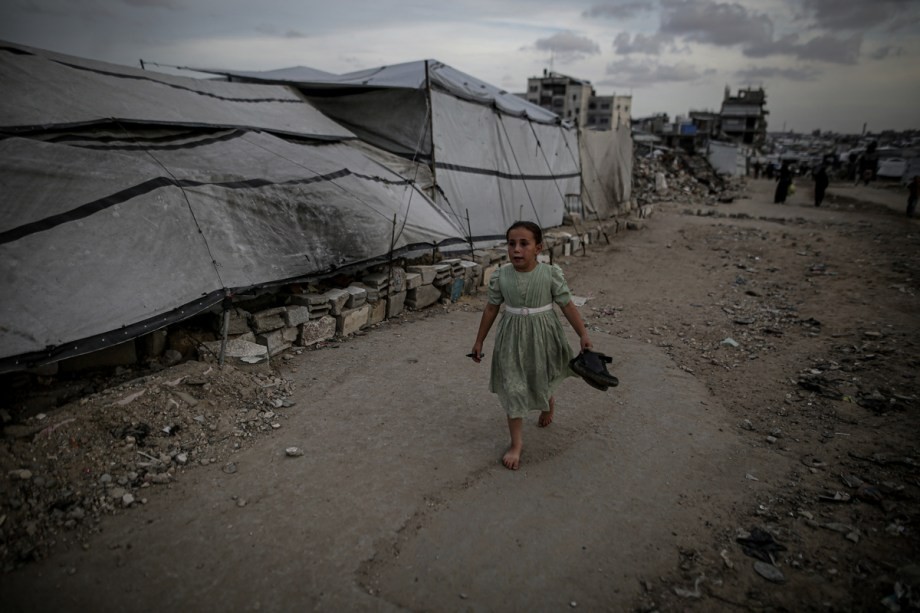
Displaced Palestinians struggling to survive in tents set up amid the rubble of their destroyed homes light fires in makeshift stoves to keep warm in cold weather conditions amid Israeli attacks and blockade in Jabalia, northern Gaza Strip, Palestine, on November 17, 2026. [Saeed M. M. T. Jaras – Anadolu Agency]
Every day, new footage emerges from Gaza: more explosions, flashes of light illuminating every corner of the Strip, on both sides of the so-called Yellow Line.
And every day brings a seemingly endless stream of devastating images, now coupled with scenes of epic proportions: massive floods sweeping away thousands of tents, drowning entire families and destroying what little remains standing in the Strip.
The storm, which began battering Gaza on 6th November, devastated displacement camps already ravaged by Israel’s genocide. According to Gaza’s Government Media Office, at least 70,000 tents were flooded within just 12 hours of the storm, affecting approximately 350,000 displaced Palestinians.
And when these dramatic scenes subside, however briefly, Gaza returns to its grim everyday reality: millions of people waiting for salvation, languishing under fragile tents and flimsy plastic tarps that have served as their homes for nearly three years.
We watch them. We report on their suffering, particularly when the news cycle slows down. We call for action, but little action follows. We demand pressure and accountability to force Israel to honor its obligations under the so-called ceasefire agreement by allowing more aid, medicine, construction materials and other essential supplies into Gaza. Yet these demands are met with little meaningful pressure and virtually no accountability.
READ: The beginning of the end: Israel at the heart of America’s political civil war
Ultimately, many of us look the other way. But herein lies the danger.
This is the very pattern that has preceded every major upheaval, not only in Gaza but throughout occupied Palestine: immense suffering left unaddressed, compounded by widespread discontent and a profound sense of betrayal among Palestinians. Then comes the storm, as collective Palestinian resistance ruptures the cycle of suffering and imposed silence.
An almost scripted scenario follows. Mainstream media rush to blame Palestinians, portraying their response to Israeli violence as the cause of the conflict, rather than a consequence of decades of occupation, dispossession and oppression.
Indeed, blaming the victim has been a textbook feature of mainstream media coverage of Palestine for nearly a century. That pattern of media coverage has remained largely unchanged.
What has changed, however, is how the world responds, and on a historic scale.
Even in the United States, the historic champion of Israel, Zionism and their crimes against the Palestinian people, a political revolt has taken shape, reflected in one of the Republican Party’s most devastating electoral defeats in decades.
The outcome of the elections must not be misinterpreted as renewed faith in the Democrats, either. Only time will tell whether they will capitalise on this historic opportunity to build genuine political legitimacy.
But the message is clear: the Biden administration paid a political price for its unconditional support of Israel and its warmongering in the Middle East. Now Trump’s party is receiving the same punishment.
No one is spared, as political and moral accountability is increasingly proving to be nonpartisan.
While US opinion polls reveal an unprecedented shift in public attitudes toward Israel, Britain is also awakening to the growing danger Israel poses. A November 5 survey by the National Centre for Social Research found that 78 percent of Britons regard Israel as a “serious threat” to world peace.
And yet, herein lies the dilemma: between the political reckoning unfolding in the West and the reality in Gaza, and throughout Palestine, stands a seemingly immovable wall: the persistent failure to translate words into meaningful action.
One might argue that we are entering an unprecedented historical phase, and that the inability to transform growing support for Palestine into meaningful political action reflects the challenges of navigating unfamiliar political territory.
That explanation is not entirely inaccurate. But it can no longer suffice when Israel is actively destroying the very foundations of Palestinian existence.
The circumstances simply do not allow for prolonged historical reflection while Palestinians continue to perish. Much more must be done.
A historic Arab vote: Can Palestinians disrupt Israel’s apartheid system?
Strong condemnations by UN officials are appreciated, but they have proved of little value.
References to international and humanitarian law make a powerful case for why Israel must end its genocide, lift the siege and spare Palestinian children. Yet these appeals have had virtually no impact on the reality on the ground.
Even the feeble sanctions imposed by some European countries against a handful of violent Israeli settlers in the occupied West Bank, though welcomed by some Palestinians, have failed to slow down, even slightly, the relentless attacks on Palestinian farmers and communities.
There is little mystery about why words and reluctant action are yielding no dividends.
Israel has never cared about international law when it stood in the way of its political and military objectives. Why should it care now?
Weak measures merely reassure Israel that Western governments have no serious intention of escalating pressure, and that it can continue doing as it pleases.
Countries across the world, beginning with those in the Middle East, must coordinate their efforts through a unified political framework, not merely demanding accountability from Israel and its supporters but exacting it.
Collectively, these countries possess immense political, diplomatic and economic leverage that remains largely unexplored.
What is needed now is a concrete plan of action. And there may be no more opportune moment than the present, when both the Israeli and US administrations are politically weakened, beleaguered by electoral setbacks and increasingly unable to dictate political outcomes as they once did.
However, accountability cannot be achieved through tweets or press releases, but only through the decisive use of political, diplomatic, and economic leverage against those who refuse to respect international law.
That leverage already exists. It is time to use it, before it is too late.
The views expressed in this article belong to the author and do not necessarily reflect the editorial policy of Middle East Monitor.